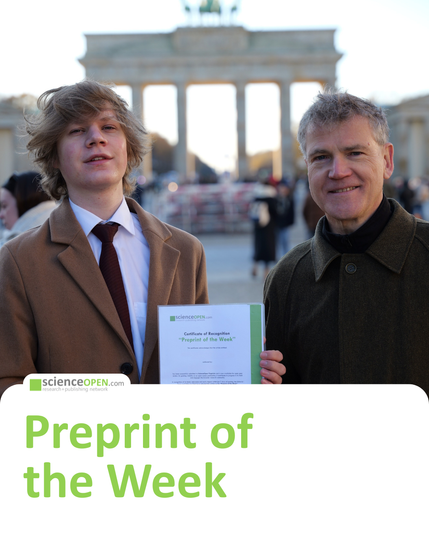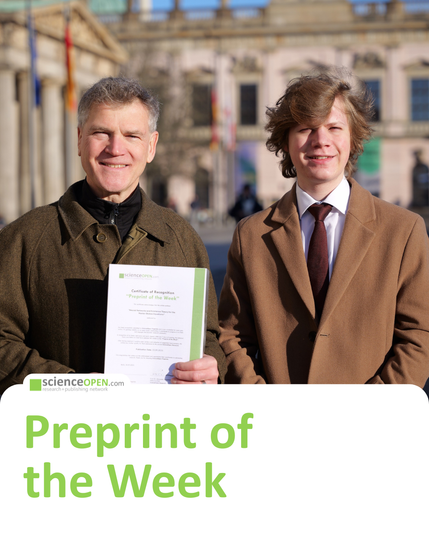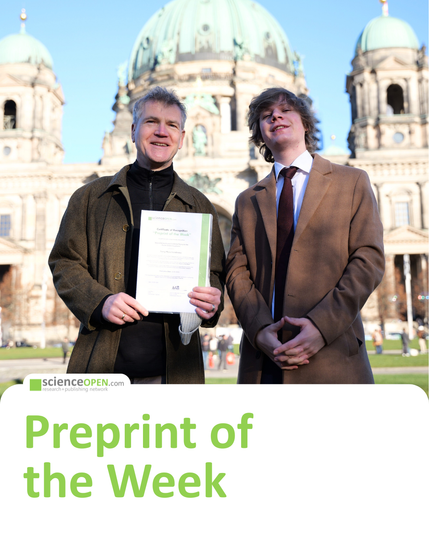
🏆 #PreprintOfTheWeek on #ScienceOpen "Europe's Problem Child : The Turkish Path to Europeanisation"

Congrats from the Editors of ScienceOpen Preprints to the author Andreas Savva.

Discover the full #preprint and join the discussion.
🔗Link in the first comment.
#Turkey #EU
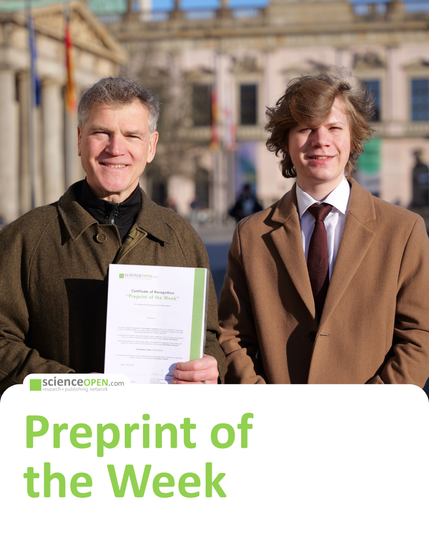
🏆 #PreprintOfTheWeek on #ScienceOpen

"Development and Clinical Evaluation of a Digital Blended Therapy Intervention for Self- Monitoring in Work-Related Stress Disorders"

Congrats from the Editors of ScienceOpen Preprints to the author Prof. Dr. habil. Stefan Paulus

🏆#PreprintOfTheWeek on #ScienceOpen

“Spectral–Geometric Regulation of #RadioTransients: Survey Bias, Magnetospheric Morphology, and #ObservationalRecoverability

Congrats to Savio Antonio Vogt from the Editors of ScienceOpen Preprints!

Read the #preprint & join the discussion

🏆 #PreprintOfTheWeek on ScienceOpen
“Beyond Cannabinoids: Olivetol as the Central Intracellular Mediator of Cannabis Therapeutics”
Congrats from the Editors of ScienceOpen Preprints to the author Karl Young 👏

#ScienceOpen #Preprint #Cannabinoids #CannabisTherapeutics

#PreprintOfTheWeek: Long Short-Term Memory Networks for Image Enhancement and Restoration ✨

Exploring LSTM models to tackle denoising, deblurring & artifact removal in images.

🔗 Link in comment.

#AI #ImageProcessing #OpenScience

🌟 Preprint of the Week 🌟
“Fractal Quantum Architecture of Matter: A Unified Framework for Particle Physics”

Exploring bold new ideas to unify particle physics through fractal quantum structures.

🔗 Link in comments
#PreprintOfTheWeek #OpenScience

🌟 Preprint of the Week 🌟

“The Signature of a Sequence: Variability and Stability in Keçeci and Oresme Numbers” explores fascinating properties of number sequences in mathematics.

🏆 Congrats to Mehmet Keçeci for this recognition on ScienceOpen!

🔗 Link in first comment

#PreprintOfTheWeek #Maths #NumberTheory #OpenScience

🎉⭐ Congratulations to Pragati Kumari — author of this week's #PreprintOfTheWeek at #ScienceOpen:

📄 "Climate Variability and Change in the North Atlantic and Arctic since 1980"

🔗 Read the preprint here: https://www.scienceopen.com/hosted-document?doi=10.14293/PR2199.001789.v1

Climate Variability and Change in the North Atlantic and Arctic since 1980

<p xmlns:xsi="http://www.w3.org/2001/XMLSchema-instance" class="first" dir="auto" id="d269019e83">This report highlights the patterns and drivers of climate variability and change in the North Atlantic and Arctic regions since 1980. Using a combination of observational datasets and climate indices such as the North Atlantic Oscillation (NAO), Atlantic Multidecadal Oscillation (AMO), and El Niño–Southern Oscillation (ENSO), the study indicates various multiscale variability in the ocean temperatures, surface air temperature, sea ice extent, and cyclone activity. The trend analysis signifies warming in the Arctic with surface air temperature anomalies more than +6°C after 2015, which indicates Arctic amplification. Also, the study of the detrended AMO confirms that since the mid-1990s, a persistent positive AMO phase has led to enhanced sea surface temperature (SST) and increased instances of Atlantic cyclonic days. A negative correlation (r = -0.228) between NAO index values and SST anomalies highlights the role of the NAO in ocean heat content modulation. Looking at the sea ice trend confirms that in the high latitudes, sea ice extent in November has a declining trend of approximately –0.0518 million km² per year, while the Greenland Ice sheet continues to lose over 270 -300 Gt of ice annually. ENSO teleconnections highlight the role of NAO phase and storm track in amplifying interannual variability. Further, the study evaluates climate variability impacts on the carbon cycle in the North Atlantic, revealing weakening of AMOC and shifts in NAO phases, which may reduce the oceanic CO₂ uptake, particularly in the subpolar North Atlantic.Overall, the results highlight that both internal variability and anthropogenic forcing are causing the physical and biogeochemical changes across the North Atlantic-Arctic system. These shifts have a prominent impact on the ocean circulation pattern, carbon sequestration, and the trajectory of future climate change. </p><p xmlns:xsi="http://www.w3.org/2001/XMLSchema-instance" dir="auto" id="d269019e85"/><p xmlns:xsi="http://www.w3.org/2001/XMLSchema-instance" dir="auto" id="d269019e86"/><p xmlns:xsi="http://www.w3.org/2001/XMLSchema-instance" dir="auto" id="d269019e87"/><p xmlns:xsi="http://www.w3.org/2001/XMLSchema-instance" dir="auto" id="d269019e88"/>

ScienceOpen

🚨 New at #ScienceOpen!

We’re launching Preprint of the Week & Poster of the Month Competitions🏆

Submit your research to be featured, earn a certificate, and get promoted across our channels!

🔗https://about.scienceopen.com/publish/

🖇️ #OpenScience #Preprints #AcademicPosters #ScholComm #ResearchVisibility #PreprintOfTheWeek #PosterOfTheMonth

Publish with ScienceOpen - About ScienceOpen

ScienceOpen offers a full suite of free tools to publish, manage, peer review preprints and posters. Register for free and learn more!

About ScienceOpen

To start off the 1 paper per week challenge of this year, here is my #PaperOfTheWeek, or rather #PreprintOfTheWeek 😀

https://tc.copernicus.org/preprints/tc-2022-225/

They present and evaluate a new one-layer dynamical model to improve the fine-scale representation of #melt patterns under #Antarctic #IceShelves. Interesting to see how this can be applied to improve future #SeaLevel projections!
Quite technical but interesting for #ocean and #IceSheet #modelers!

TCD - Modeling Antarctic ice shelf basal melt patterns using the one-Layer Antarctic model for Dynamical Downscaling of Ice–ocean Exchanges (LADDIE)