šŸ“±šŸš« On withdrawal from social media

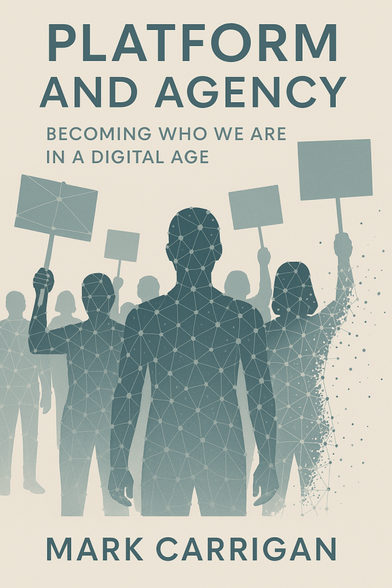
In less than twenty four hours my book Platform and Agency: Becoming Who We Are will be released. In an important sense I worked on this book for fifteen years, beginning with my part-time PhD in 2008 and ending with the initial phase of my LLM research in 2023. I feel ambivalent about it in a number of ways. I somehow conspired to rush it despite the fact I worked on it for well over a decade. I let an utterly avoidable crisis of intellectual confidence derail it in the later years of the 2010s. I didn’t get the chance to ask Maggie Archer to write a forward to it. I somehow dropped the ball and agreed to a Ā£35 eBook and Ā£116 hardback which means I wouldn’t buy it myself. Rather than enter a third year of negotiation with the publisher I pushed it over the finish line when it still wasn’t quite in the shape I wanted to get it into. Frankly I needed to move on with my life and completing Platform and Agency enabled me to do it in a whole range of ways.

It still feels like a significant occasion though. It’s my fourth monograph, fifth if you count the second edition of Social Media for Academics which was basically a rewrite from scratch. It’s the tenth book I’ve published overall. This makes it feel less significant in the sense that I’ve released five books in the last five years and the novelty is wearing off. What makes it feel special is that this book, for all its flaws, has a radical originality which other things I’ve written or edited lack. It captures a specific way of making sense of the role of technology in the social world, which I’ve been monomaniacally pursuing ever since I realised how significant bulletin boards were to my teenage years. It offers a genuinely original way of making sense of how platforms influence how we became who we are, including what this process of becoming entails in psychosocial terms. I’ll leave it to readers to decide if it’s useful or interesting. But it’s certainly intellectually unique. It captures what I think is a coherent social ontology underpinning the bizarre range of topics I’ve worked on over the course of my career.

Hence the vague desire to shout about it. Look look I did a book! I did a big theory book! Even if it’s much smaller big book than planned because pragmatism, a concern for my own well-being and the publisher’s reticence meant I dropped a couple of chapters from the plan. I would sincerely like anyone who’s interested to know this book exists so they are more likely to read it. I would like anyone who has expressed curiosity about my research agenda to at least skim the book because it’s the most foundational answer to the question ā€œwhat do you research?ā€ I’m ever likely to produce. But I realised this evening as I was psyching myself up for a joyless engagement with social media that I don’t want these things enough to reenter the Twittering Machine.

I can see the costs involved in not shouting about this book (or the three papers I’ve had published recently) but I just don’t care enough to want to reactive my Bluesky account or log into Linkedin for the first time in months. I last posted on Linkedin almost six months ago and I’m suddenly wondering if I’ll ever post on it again. Or any other social media for the matter. I just feel such a vivid aversion when I contemplate logging into these platforms again that I’m wondering what, if anything, would prompt me to do it. I feel a precarious sense of clarity about my life (and my work) which the rhythms of social media now appear profoundly threatening to. It feels like standing on the side of a choppy ocean and realising how stupid it would be to dive in even if I felt it might be a useful way to get some exercise. Clearly these are addiction metaphors and I don’t use them in a psychoanalytically naive way. I think my addiction to Twitter was worse than most people’s but social media is nonetheless suffused with addictive behaviour. From the vantage point of retreating from platforms for a couple of years and then entirely leaving them six months ago, they just look profoundly uninviting.

There’s a privilege in escaping the Twittering Machine. I have a fairly widely followed blog that’s been on the internet forever (which increasingly means it shows up in LLM responses amongst other advantages). I know how to write guest blogs for visible platforms even if I don’t do it as much as I should. I’ll be setting up a project blog and podcast imminently which I’m fairly certain someone else will be able to handle the social media for. I get invited to give lots of talks and keynotes, albeit pretty exclusively on the applied side of my work rather than the theoretical stuff I do. I’m securely employed in a place I feel valued and where people listen to me about stuff that I’m interested in. In this sense I’m not suggesting that full withdrawal from social media is a generalisable solution or even the right one for most people. But I wanted to share how I increasingly experience it, in the interests of honesty as someone who spent a big chunk of the 2010s persuading academics to use social media.

I don’t think my argument that you can use social media reflectively was wrong, only that I was naive about how platform incentives made that extremely difficult in practice. Indeed the second edition of Social Media for Academics was an attempt to work this out in real term and steer the debate in a more productive direction. Likewise I now think that my advice in Generative AI for Academics had a similar weakness in that it didn’t consider how LLMs are going to be optimised for engagement over the coming years. I slightly underplayed how difficult higher education makes it to use LLMs reflectively (though the final chapter explores this at length) but much as with social media I think the problem will soon be designed into the platforms rather than something we can circumvent through reflective practice. There are structural reasons why it’s difficult to use platforms without getting sucked into a vortex which makes attention and commitment difficult to sustain. There are certainly gains which can come through their use but everyone still using social media needs to think carefully about whether these outweigh the costs.

There’s something which clarifies when you say ā€˜no’ to all this. A sense of sharper edges that come from choosing boundaries rather than just letting them emerge.

https://www.youtube.com/watch?v=u5CVsCnxyXg

Such a pretty house
And such a pretty garden
No alarms and no surprises (get me out of here)
Please

#acceleratedAcademy #addiction #blog #books #life #PlatformAndAgency #platforms #promotion #selfPromotion #SocialMedia #socialMediaForAcademics #writing

šŸ“£ Platform and Agency: Becoming Who We Are now available

The first chapter is available on Google Books here. Unfortunately the book is going to be expensive in print (though an eBook is available) so let me know if you have trouble accessing it and I’ll do my best to help.

Here’s the introduction to the book:

We live in a digital age. That statement can feel platitudinous, yet it expresses a defining feature of our contemporary world: an era shaped by digital technology, from smart phones and tablets to the consumer-facing internet. While the term ā€˜digital age’ can obscure the variety of lived experience across different contexts, it also insists upon a horizon of change that exceeds immediate empirical observation. It implies a meta-process that will be difficult to characterise without oversimplifying the empirical complexity which ultimately defines it (Archer 2013). We can point to the rapid expansion of internet access across the global population, the diffusion of smart phones as primary devices, or the rise of social platforms that now dominate what ā€˜the internet’ means in everyday life. The danger in talking about a ā€˜digital age’ is that it can obscure the fact that global internet access remains deeply uneven, with many still lacking reliable connectivity. The range of what ā€˜the internet’ means can too easily be subsumed into epochal generalisations about digital change. However, if we avoid terms like ā€˜digital age’ we risk failing to grasp an emerging reality which surpasses any single trend. Once you insist on a certain degree of empirical robustness, it becomes difficult to keep hold of the meta-process. 

The starting point for this project is that such a meta-process is unfolding, which we urgently need to grasp but that doing so is an epistemically complex undertaking. These are not isolated or easily quantified phenomena, but rather a qualitative shift in the parameters of social life (Couldry 2020). There is a change in the texture of the social which is widely felt, yet difficult to pin down in a robust or comprehensive way. Nearly three decades ago, Castells (1996: 508) noted the ā€œunseen logic of the meta-network where value is produced, cultural codes are created, and power is decideā€, suggesting that this ā€œincreasingly appears to people as meta-social disorderā€. It is this ā€˜meta’ level that we evoke by talking about a ā€˜digital age’, imprecise as that term may be. Only at this higher level can we address how the ā€œparameters of social life – of social interaction and even of socialisationā€ have begun to shift, rather than confining ourselves to discrete new forms of interaction (Couldry 2024: loc 1174). Otherwise we are left with ā€œthe detection of empirical patternsā€ in which social transformation is inferred when a pattern is ā€œbig and bold enoughā€. These are by their nature perspectival claims, even when methodologically robust in their statistics, relying on ā€˜striking’ observations which produce an intuitive sense of transformation in the analyst (Archer 2013:: loc 1232).

And this is the conclusion:

The problems with the detraditionalisation thesis arose from the grandiose poetics which left it captivated by its own pronouncements about epochal change. For this reason I believe we ought to as cautious as we can be about declaring an outcome to sociotechnical change, without dispensing with the recognition there will be an outcome. If anything the vast investment in LLMs and the data infrastructure which supports them, intersecting with a post-pandemic political economy which appears to be leaving neoliberalism behind, heralds an intensification of change rather than a diminution (Tooze 2021;, Varoufakis 2023). It’s possible this might be leading towards a perpetual polycrisis, a social order unable to stabilise itself amidst an accelerating climate catastrophe. But even this doom loop, suggested by Seymour’s notion of disaster nationalism, represents a social order of sorts, even if it’s an apocalyptic one. 

It is difficult to incorporate this horizon of crisis into our frame of reference without subordinating our analysis of the interaction phase through which it is being generated. However by approaching platformisation through the concepts of psychobiography and personal morphogenesis, I have argued that we can avoid both grandiose (and premature) pronouncements about a ā€˜digital age’ and dismissive rejections of the reality of genuine change. The analysis I’ve offered of distracted people and fragile movements explores how platforms reconfigure rather than replace human agency. By examining how reflexivity operates within platformised contexts, tracing its biographical unfolding rather than proclaiming wholesale transformation, we gain a more textured understanding of contemporary social life. This has meant breaking with an account of agency premised, as Savage (2021: 191) puts it,  ā€œon this ontological temporal difference between past, enduring structures, and a contemporary contingent agency that breaks from themā€. Unless we can surrender this baggage, we are left with a meta-process defined through the falling away of the past, operationalising ā€˜tradition’ as that which is experiencing a decline and thus squeezing out continuities through definitional fiat. The problem is not an epochal horizon, as much as ontological assumptions which lead to the epistemic mistakes of pronouncing epochal change in a grandiose and premature manner. A realist conception of the platform can acknowledge its emerging status as a condition of our social existence, while remaining clear that is we who must decide what to make of it.

#criticalRealism #digitalisation #PlatformAndAgency #platformisation

Platform and Agency

This book examines how digital platforms are reconfiguring the parameters of agency and reflexivity in contemporary social life. Drawing on Margaret Archer's social realist framework, it moves beyond treating platforms merely as tools or environments to conceptualize them as distinct sociotechnical structures with emergent properties and powers that shape human action without determining it.The book develops the concept of platform and agency to explore the temporal dimensions of sociotechnical change, tracing how platforms condition personal and collective reflexivity through mechanisms of distraction, cultural abundance, and multiplying communication channels. While affirming the analytical distinction between structure, culture and agency, it demonstrates how platforms constitute a fourth dimension necessary for understanding contemporary social morphogenesis. Through the conceptual pairing of psychobiography and personal morphogenesis, the book offers a nuanced account of how individuals become who they are within platformized lifeworlds. Rather than announcing an epochal break with previous social forms, the analysis illuminates the accumulating consequences of platform mediation across biographical timescales.This book will interest researchers and graduate students in social theory, philosophy of technology, digital sociology, platform studies, media and communication studies, critical data studies, internet studies, surveillance studies, sociology of knowledge, digital anthropology, and social informatics.

Google Books

Platform and Agency: Becoming Who We Are

Well I’m a bit dismayed that it’s Ā£145 and hardback only (at least initially) but still nice to see this being trailed for an October release:

This book examines how digital platforms are reconfiguring the parameters of agency and reflexivity in contemporary social life. Drawing on Margaret Archer’s social realist framework, it moves beyond treating platforms merely as tools or environments to conceptualize them as distinct sociotechnical structures with emergent properties and powers that shape human action without determining it.

The book develops the concept of platform and agency to explore the temporal dimensions of sociotechnical change, tracing how platforms condition personal and collective reflexivity through mechanisms of distraction, cultural abundance, and multiplying communication channels. While affirming the analytical distinction between structure, culture and agency, it demonstrates how platforms constitute a fourth dimension necessary for understanding contemporary social morphogenesis. Through the conceptual pairing of psychobiography and personal morphogenesis, the book offers a nuanced account of how individuals become who they are within platformized lifeworlds. Rather than announcing an epochal break with previous social forms, the analysis illuminates the accumulating consequences of platform mediation across biographical timescales.

This book will interest researchers and graduate students in social theory, philosophy of technology, digital sociology, platform studies, media and communication studies, critical data studies, internet studies, surveillance studies, sociology of knowledge, digital anthropology, and social informatics.

#BecomingWhoWeAre #personalMorphogenesis #PlatformAndAgency #platformStudies #realistSocialTheory #reflexivity

Platform and Agency: Becoming Who We Are

This book examines how digital platforms are reconfiguring the parameters of agency and reflexivity in contemporary social life. Drawing on Margaret Archer's social realist framework, it moves beyond treating platforms merely as tools or environments to conceptualize them as distinct sociotechnical structures with emergent properties and powers that shape human action without determining it. The book develops the concept of platform and agency to explore the temporal dimensions of sociotechnical

Routledge & CRC Press

Chapters abstracts for my new book

I’m so excited this is finally going into production šŸ¤—

Chapter 1: What does it mean to live in a digital age?

This chapter introduces the central dilemma of conceptualizing sociotechnical change without resorting to platitudinous claims about ā€˜living in a digital age’. It explores how everyday experiences with digital technology have altered social life, using illustrative real-world examples while still retaining a conceptual focus. The chapter argues that while digital technologies have transformed information access and social interaction, we need a more robust analytical framework than technological determinism or epochal generalization. It establishes the book’s aim to investigate the ontological status of personhood amid digital transformation, proposing a sociological recovery of agency as central to understanding contemporary sociotechnical change.

Chapter 2: Personal Reflexivity and Social Change

This chapter critically examines influential accounts of ā€˜late modernity’ from theorists like Giddens, Bauman, and Beck, particularly their claims about detraditionalization. It demonstrates how these approaches recognize the crucial relationship between personal reflexivity and social change but ultimately fail to develop adequate conceptual tools for analyzing this relationship empirically. The chapter reveals how Giddens’s structurationist approach, despite its sophistication, creates an oscillation between voluntarism and determinism that cannot properly account for the variable ways in which agents relate to their social environments. This critical analysis lays groundwork for a more robust account of reflexivity that can better grasp how digital mediation transforms everyday experience.

Chapter 3: The Realist Account of Reflexivity

This chapter introduces Margaret Archer’s realist theory of reflexivity as an alternative framework for understanding the relationship between personal and social change. It outlines Archer’s ā€˜three-stage model’ of structure and agency, contrasting it with ā€˜two-stage models’ that black-box reflexivity. The chapter explores how reflexivity operates through internal conversation, manifesting in four distinct modes (communicative, autonomous, meta-reflexive and fractured) that condition how individuals navigate social constraints and enablements. Focusing on the relational and cultural dimensions of reflexivity, it demonstrates how ideas and relationships shape our deliberative processes and life projects, creating a foundation for understanding how digital platforms might transform these fundamental aspects of agency.

Chapter 4: Biography as an Ontological Category

This chapter develops biography as a critical ontological category for social analysis, moving beyond the limitations of concepts like Giddens’s ā€˜fateful moments’. It draws on Archer’s morphogenetic approach to conceptualize biography not as a sequence of discrete turning points but as a temporally extended process through which persons become who they are. Through critical engagement with biographical research, the chapter demonstrates how treating biography as ontologically robust provides a more secure foundation for understanding social change. It concludes by proposing two essential concepts (psychobiography and personal morphogenesis) as tools for analyzing how individuals navigate social transformation through ongoing cycles of change and stability.

Chapter 5: Personal Morphogenesis

This chapter elaborates the concept of personal morphogenesis as a framework for understanding how people change over time through their engagements with the social world. It explores how personal morphogenesis unfolds through three temporal relations: past conditioning (ā€˜Me’), present action (ā€˜I’), and future orientation (ā€˜You’). Drawing on Derek Layder’s concept of psychobiography, the chapter demonstrates how social contexts and reflexive responses accumulate over time to shape who we become. Rather than reducing the individual to an individualistic frame, this approach recovers the person as a stratified entity whose biographical emergence is central to understanding social change, establishing a conceptual foundation for analyzing how platforms shape this process.

Chapter 6: Sociotechnical Transformation

This chapter traces the historical development of digital technologies from early utopian visions to contemporary critical perspectives on platforms. It examines how the initial rhetoric of technological utopianism has given way to growing concerns about surveillance, manipulation, and digital power. The chapter offers a periodization of digital change from Web 1.0 to social platforms to generative AI, highlighting how technological shifts have transformed user experiences and infrastructural arrangements. It pays particular attention to the rise of ā€œbig dataā€ as both technological development and ideological project, revealing how the epistemic claims of data science have contributed to an evisceration of human agency in platform contexts.

Chapter 7: Personal Reflexivity

This chapter analyzes how digital platforms transform personal reflexivity through three key mechanisms: the multiplication of communication channels, the digitalization of the archive, and the problem of cultural abundance. It demonstrates how these changes create conditions of distraction and cognitive triage, making sustained reflection increasingly difficult in platform environments. The chapter introduces an adverbial approach to understanding platform effects, focusing on how reflexivity becomes distracted rather than what people reflect upon. By examining the proliferation of digital interruptions and cultural options, it reveals how platforms shape the temporal structure of reflexive deliberation, with significant consequences for personal identity and life projects.

Chapter 8: Collective Reflexivity

This chapter investigates how platforms transform collective action and social movements through two key mechanisms: the ease of mobilization and the rise of computational politics. It develops the concept of ā€˜fragile movements’ to describe how platforms enable rapid assembly while undermining the organizational capacities needed for sustained collective action. Alongside ā€˜distracted people’ these ā€˜fragile movements’ create a problematic dynamic where democratic steering of sociotechnical change becomes increasingly difficult. The chapter examines how collective reflexivity, the capacity of groups to deliberate about shared concerns, is simultaneously enhanced and compromised by platform mediation, with profound implications for normative transformation in digital societies.

Chapter 9: Platformised Socialisation

This concluding chapter synthesizes the book’s arguments to address how socialization processes are transformed under platform conditions. It challenges simplistic notions like ā€˜digital natives’ while acknowledging the profound ways platforms reshape how people become who they are. The chapter examines how the cultural context for socialization changes through platform mediation, particularly in how potential and possible selves are encountered and constructed. It concludes by situating the analysis within broader questions of epochal change, arguing that while platforms fundamentally alter the parameters within which human agency unfolds, they do not create wholly new types of people. Instead, they reconfigure the temporal and relational dimensions of personal becoming in ways that demand new conceptual tools for social analysis.

#archer #humanAgency #MorphogeneticApproach #PlatformAndAgency #reflexivity #socialRealism

After 16 years and 7 months I’ve finished Platform and Agency

I’ll do one more read through when it gets back from my proof reader, but the book I started in September 2008 with my PhD is now finished šŸ‘‡

The virtue of the detraditionalisation thesis lay in its insistence on a meta-process, a change which exceeds empirical trends which can be measured. It provides, as Lundby (2009: 141) puts it, ā€œa meta approach that makes it possible to integrate very different results of surveys and qualitative investigations into an overall coherent understandingā€. The problems with the detraditionalisation thesis arose from the grandiose poetics which left it captivated by its own pronouncements about epochal change. For this reason I believe we ought to be as cautious as we can be about declaring an outcome to sociotechnical change, without dispensing with the recognition that there will be an outcome. If anything the vast investment in LLMs and the data infrastructure which supports them, intersecting with a post-pandemic political economy which appears to be leaving neoliberalism behind, heralds an intensification of change rather than a diminution (Tooze 2021, Varoufakis 2023). It’s possible this might be leading towards a perpetual polycrisis, a social order unable to stabilise itself amidst an accelerating climate catastrophe. But even this doom loop, suggested by Seymour’s (2024) notion of disaster nationalism, represents a social order of sorts, even if it’s an apocalyptic one. 

It is difficult to incorporate this horizon of crisis into our frame of reference without subordinating our analysis of the interaction phase through which it is being generated. However by  approaching platformisation through the concepts of psychobiography and personal morphogenesis, I have argued that we can avoid both grandiose (and premature) pronouncements about a ā€˜digital age’ and dismissive rejections of the reality of genuine change. The analysis I’ve offered of distracted people and fragile movements explores how platforms reconfigure rather than replace human agency. By examining how reflexivity operates within platformised contexts, tracing its biographical unfolding rather than proclaiming wholesale transformation, we gain a more textured understanding of contemporary social life. This has meant breaking with an account of agency premised, as Savage (2021: 191) puts it,  ā€œon this ontological temporal difference between past, enduring structures, and a contemporary contingent agency that breaks from themā€. Unless we can surrender this baggage, we are left with a meta-process defined through the falling away of the past, operationalising ā€˜tradition’ as that which is experiencing a decline and thus squeezing out continuities through definitional fiat. The problem is not an epochal horizon, as much as ontological assumptions which lead to the epistemic mistakes of pronouncing epochal change in a grandiose and premature manner. A realist conception of the platform can acknowledge its emerging status as a condition of our social existence, while remaining clear that is we who must decide what to make of it.

#biography #criticalRealism #epochalTheorising #personalMorphogenesis #PlatformAndAgency #platformStudies #socialChange #socialRealism

This extract from Arvind Narayanan and Sayash Kapoor’s (super) AI Snake Oil captures succinctly the anxiety I have about how the infrastructure is developing:

As generative AI improves, we think a similar shift is likely. In this scenario, generative AI will become a part of our digital infrastructure, instead of being a tool people use for specific purposes. You wouldn’t use ChatGPT to compose an email or Gemini to look up a specific query. Instead, generative AI will shift to the background, as a medium for a large amount of knowledge work

Loc 4142

If you approach prompting as writing, there’s an intellectual virtue to it. To prompt well means to be clear about what you’re trying to achieve, aware of the assumptions you’re making and able to connect these together in an intellectually substantive way. Being an effective prompter in this, I would argue, resembles being a habitual academic blogger in the open-source academic (rather than op-ed writer) mould.

But if you’re not required to prompt, the moment for intervention vanishes and suddenly intellectual labour is being outsourced to machines which, when left to their own devices, tend towards radical homogenisation. The capacity of the latest frontier models to fill in the blanks, infer the request even when you’ve not provided sufficient detail, represent another vector through which the agency of users is slowly being squeezed out.

It suddenly reminded me of something I was saying in this discussion almost a year ago šŸ‘‡

https://youtu.be/GTjd9eLd9cw?si=FRgE_y4n8_x33lVQ&t=2847

https://markcarrigan.net/2024/10/28/what-happens-when-gai-becomes-a-taken-for-granted-feature-of-our-digital-infrastructure/

#agency #blogging #generativeAI #PlatformAndAgency #prompting #templates

How is AI changing the teaching and academic landscape?

YouTube