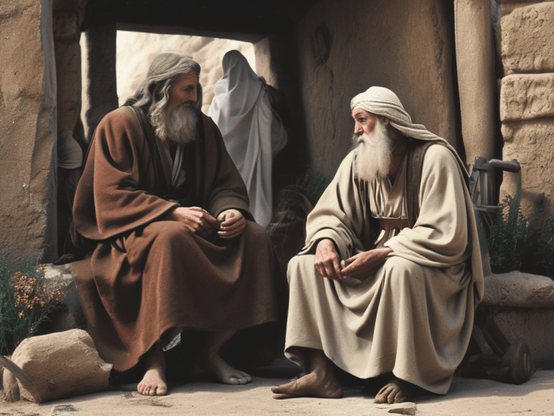
WHEN HE KNOCKED ON HEAVEN’S DOOR

In the Life of Christ

“Ask, and it shall be given you; seek, and ye shall find; knock, and it shall be opened unto you.” — Matthew 7:7

One of the most comforting realities I discover in the life of Jesus is how often He invited ordinary people to come to the Father with confidence. In Matthew 7:7–11, Jesus was not offering a cold religious formula. He was revealing the heart of God. The verbs “ask,” “seek,” and “knock” carry a continuing sense in the Greek language—keep asking, keep seeking, keep knocking. Christ painted a picture of persistent faith, not because God is unwilling to answer, but because prayer deepens our dependence upon Him. I often think about how Jesus Himself modeled this kind of trust during His earthly ministry. Before choosing the disciples, He prayed through the night. In the Garden of Gethsemane, He prayed with tears and surrender. Again and again, Jesus demonstrated that communion with the Father was not secondary to ministry; it was the very source of His strength.

What moves me most is the contrast Jesus gives between imperfect earthly fathers and the goodness of our Heavenly Father. Even flawed parents generally desire to care for their children. How much more does God delight in giving what is good and necessary to those who come to Him? The late commentator Matthew Henry wrote, “Prayer is the key of heaven, but the faith that unlocks the door is the hand that turns it.” That image stays with me because many believers pray timidly, almost apologetically, as though they are interrupting God rather than approaching a loving Father. Yet Jesus consistently welcomed desperate people who came seeking mercy. Blind Bartimaeus cried out repeatedly despite the crowd trying to silence him. The woman with the issue of blood pressed through fear and weakness simply to touch the garment of Christ. Their persistence was not arrogance; it was faith that believed Jesus was both able and willing.

I have also noticed something insightful in the ministry of Christ: sometimes the answer to prayer was immediate, while at other times the waiting itself became part of the transformation. Lazarus remained in the tomb four days before Jesus arrived. The disciples struggled against the storm for hours before Christ walked upon the water toward them. Heaven’s timing often stretches our trust before revealing God’s purpose. The word Jesus used for “good gifts” reminds us that the Father gives what is truly beneficial, not merely what is temporarily desired. There are moments when I ask for comfort, but God gives endurance. I ask for quick resolution, and He provides deeper faith. In hindsight, I often realize His wisdom protected me from lesser things so I could receive something eternal.

The invitation to ask, seek, and knock is ultimately an invitation into relationship. Jesus was not teaching us how to manipulate God into granting wishes. He was teaching us to live with confident dependence upon the Father. Persistent prayer reshapes the soul because it continually turns the heart toward Christ. The more I seek Him, the more I recognize that His presence is often the greatest answer of all. Charles Spurgeon once observed, “Whether we like it or not, asking is the rule of the Kingdom.” Prayer humbles self-sufficiency and reminds us that discipleship cannot thrive apart from abiding fellowship with God.

As I reflect on the life of Christ today, I am reminded that Jesus never turned away sincere seekers. Nicodemus came at night with questions. Peter cried out while sinking beneath the waves. The thief on the cross whispered one final plea for mercy. Each discovered that Christ responds to honest faith. The same Savior who welcomed them still invites us near today. No burden is too small, no failure too deep, and no longing beyond His compassion. When we ask in faith, seek with perseverance, and knock with trust, we discover that the Father’s door is never closed to His children.

FEEL FREE TO COMMENT, SUBSCRIBE OR REPOST SO OTHERS MAY KNOW


#askSeekKnock #lifeOfChrist #persistentPrayer #trustingGod

Faith That Refused to Walk Away

In the Life of Christ

There are moments in the life of Christ that surprise me because they seem uncomfortable at first reading. Matthew 15:21–28 is one of those moments. Jesus travels into the regions of Tyre and Sidon, Gentile territory far beyond the familiar borders of Israel. There, a desperate Canaanite mother cries out for mercy on behalf of her demon-oppressed daughter. What strikes me immediately is that Jesus appears silent. The disciples grow irritated. Even Christ’s words seem sharp when He says He was sent “to the lost sheep of Israel.” Yet the woman refuses to leave. She kneels before Him and pleads, “Lord, help me!” Her persistence reveals something insightful about genuine faith—it clings to Christ even when emotions, circumstances, and appearances seem discouraging.

As I reflect on this encounter, I realize the woman understood something many religious people often miss. She knew mercy was her only hope. She came without entitlement, without religious status, and without covenant privilege. Yet she believed Jesus was still good. When Christ spoke of children’s bread and dogs, she humbly responded, “Even the dogs eat the crumbs that fall from their master’s table.” Her answer was not bitterness but trust. The Greek word Matthew uses for faith is pistis, carrying the idea of confidence, reliance, and steadfast persuasion. Her faith was not shallow optimism; it was determined dependence upon Christ’s character. Habakkuk 2:4 echoes through this story: “The righteous shall live by his faith.” The prophet originally spoke those words during national uncertainty and judgment, yet the principle reaches into this Gentile mother’s suffering centuries later. Faith lives even when heaven seems silent.

I often think about how this moment connects to the broader mission of Jesus. Throughout the Gospels, Christ repeatedly reached beyond expected boundaries. He touched lepers, spoke with Samaritans, forgave sinners, and welcomed outsiders. This Canaanite woman becomes another reminder that the kingdom of God is entered not through ethnicity, achievement, or social standing, but through trusting faith. Warren Wiersbe wrote, “True faith cannot be discouraged because true faith will not deny itself.” That statement fits this woman beautifully. She had every reason to retreat in humiliation, yet she stayed near Jesus because she believed mercy still rested in Him.

The church today needs this reminder. Many people feel spiritually disqualified because of their past, their failures, or their distance from religious culture. Yet the life of Christ continually demonstrates that grace moves toward the humble and desperate. Charles Spurgeon once observed, “Whether we like it or not, asking is the rule of the Kingdom.” This mother kept asking. She kept believing. She kept kneeling. Her persistence was not arrogance; it was surrender mixed with hope. I believe many believers today stand at similar crossroads. We pray, hear silence, and assume rejection when God may actually be drawing faith deeper.

There is another important detail here. Jesus ultimately praised her publicly: “Woman, you have great faith!” Interestingly, Christ rarely used that phrase. Often He rebuked little faith among His own disciples. Yet this outsider displayed extraordinary trust. Sometimes those who know the least religious language understand dependence upon God the most clearly. Pain has a way of stripping away pride until only faith remains.

As I walk through this passage personally, I am reminded not to measure God’s love by temporary silence. The cross itself appeared like defeat before resurrection morning revealed victory. Christ’s mission and sacrifice opened the kingdom to every tribe, tongue, and people willing to come by faith. The Canaanite mother teaches me to remain near Jesus even when answers delay. She reminds me that mercy still flows from the Master’s table, and that no sincere cry for grace is ignored forever.

FEEL FREE TO COMMENT, SUBSCRIBE OR REPOST SO OTHERS MAY KNOW


#faithInChrist #lifeOfJesus #persistentPrayer

When Silence Is Not Rejection

On Second Thought

“Everyone who asks receives, and he who seeks finds, and to him who knocks it will be opened.”Matthew 7:8

There is something unsettling about persistent prayer when the answer does not come quickly. In Luke 18:1–8, Jesus tells the story of a widow who refuses to stop asking, knocking, and seeking justice. She presses forward not because she has power, but because she has nowhere else to go. The judge she confronts is indifferent, even dismissive. He does not fear God, nor does he regard people. Yet even this man eventually responds—not out of compassion, but out of exhaustion. The widow’s persistence wears him down. At first glance, the parable feels almost discouraging. Is this what prayer is? A weary attempt to persuade a reluctant authority?

But Jesus carefully redirects our thinking. The judge is not the model—he is the contrast. The Greek phrase Jesus uses, “akousate ti ho kritēs tēs adikias legei” (“hear what the unjust judge says”), draws attention to the absurdity of the comparison. If even an unjust judge responds to persistence, how much more will a righteous and loving God respond to His children? The issue is not whether God hears, but whether we trust Him enough to keep coming. This is where prayer moves beyond request into relationship.

The widow’s persistence reveals something deeper than desperation; it reflects dependence. She has no advocate, no social standing, no leverage—only her voice and her determination. In many ways, this mirrors our own position before God. We bring no merit that obligates Him. We stand only on His mercy and covenant love. Yet unlike the judge, God is not reluctant. Scripture consistently affirms His attentiveness: “The eyes of the Lord are upon the righteous, and his ears are open unto their cry” (Psalm 34:15). The delay we experience is not divine neglect but divine purpose.

This is where our understanding must shift. The delay in prayer is often the space where transformation occurs. The Greek verb makrothumeō, translated “bear long” in Luke 18:7, conveys patience, restraint, and long-suffering. It suggests that God is not ignoring us—He is working within a larger timeline that we cannot fully see. When I meditate on this, I realize that prayer is not merely about receiving answers; it is about being shaped in the asking. As we continue to seek Him, our desires are refined, our trust deepens, and our awareness of His presence grows.

Jesus Himself modeled this rhythm. In Mark 1:35, we see Him rising early, withdrawing to a solitary place to pray. This was not a moment of crisis-driven prayer, but a disciplined pattern of communion. His prayer life was not reactive; it was foundational. When we connect this to the parable of the persistent widow, we begin to see that persistence is not about intensity alone—it is about consistency. It is the steady return to God, day after day, regardless of what we feel or see. This is the essence of a lifestyle of meditation: allowing the Word and prayer to anchor us before the storm, not just during it.

There is also a subtle tension in the promise of Matthew 7:8: “Everyone who asks receives.” The Greek present tense verbs—aitōn, zētōn, krouōn—imply ongoing action: asking and continuing to ask, seeking and continuing to seek, knocking and continuing to knock. This is not a one-time transaction; it is a sustained posture. The promise is not disconnected from the process. Receiving is tied to remaining. Finding is tied to continuing. Opening is tied to persistence. This reframes how I approach unanswered prayer. It is not a closed door; it is an invitation to keep knocking.

Commentator William Barclay once noted, “Prayer is not an attempt to force God to do our will, but a humble attempt to bring our will into line with His.” That alignment often requires time. It requires returning to God again and again, allowing His Word to recalibrate our expectations. In this way, prayer becomes less about changing circumstances and more about being changed within them. The widow’s persistence was not just about justice—it was about refusing to let go of the only hope she had.

So when I find myself in seasons where God seems silent, I am reminded that silence is not absence. It is often the quiet space where faith is exercised most deeply. The delay does not diminish His care; it reveals His commitment to something greater than immediate relief. His priority is not simply to resolve my situation, but to draw me into a deeper relationship with Him. And in that relationship, I find something even more enduring than answers—I find Him.

On Second Thought

What if the delay in your prayers is not a barrier but a bridge? That is a difficult thought to hold, especially when the need is urgent and the silence feels heavy. We often assume that persistence in prayer is about convincing God to act, as though our repeated requests somehow increase His willingness. But what if persistence is actually about increasing our awareness? What if the act of returning again and again is not changing God’s posture toward us, but changing our posture toward Him?

There is a paradox here that challenges our assumptions. We pray because we believe God hears us, yet we continue praying even when it feels like He does not respond. That tension reveals something important: prayer is not sustained by answers alone, but by trust. The widow did not persist because she had evidence that the judge cared; she persisted because she had no other option. In contrast, we persist because we do have evidence—Scripture, the cross, the testimony of God’s faithfulness across generations. Yet we still struggle when answers are delayed.

Consider this: if God answered every prayer immediately, would we still seek Him as deeply? Would we linger in His presence, meditate on His Word, and develop a rhythm of communion? Or would prayer become transactional, reduced to requests and results? The delay, as difficult as it is, protects something sacred. It preserves the relationship. It draws us into a deeper dependence where we learn to value God not only for what He gives, but for who He is.

In that sense, persistence is not about overcoming God’s reluctance—it is about entering into His presence more fully. The knocking is not just at the door of heaven; it is at the door of our own understanding. Each prayer, each moment of seeking, each act of waiting reshapes us. It teaches us to trust beyond what we see, to hope beyond what we feel, and to remain anchored in the character of God rather than the immediacy of our circumstances.

So perhaps the real question is not, “Why hasn’t God answered yet?” but “What is God forming in me as I wait?” That shift does not remove the longing, but it reframes it. It allows us to see that even in the silence, something is happening. The righteous Judge is not ignoring your case. He is holding it, shaping you within it, and preparing an answer that aligns not only with your need, but with His eternal purpose.

FEEL FREE TO COMMENT, SUBSCRIBE, AND REPOST, SO OTHERS MAY KNOW


#ChristianSpiritualGrowth #Luke18ParableMeaning #persistentPrayer #trustingGodInWaiting

The 29th Sunday in Ordinary Time Year C teaches us about prayer, trust, and perseverance 🌿. Jesus calls us to pray without giving up. Moses, supported by Aaron and Hur, reminds us that faith is sustained in community 🙏.

Paul encourages us to hold on to scripture, which guides and strengthens us. Together, these readings show that God hears our prayers, supports us through others, and gives us hope in His timing ✨.

https://young-catholics.com/3669/29th-sunday-in-ordinary-time-year-c/

#SundayReflection #Faith #PersistentPrayer