
#papertime 🥳

Where we use a method originally used for AGN to answer the question whether
we can use variability in individual X-ray lines to probe the variable stellar wind.

And the answer is: yes, we can!

The paper (submitted not yet refereed) is:

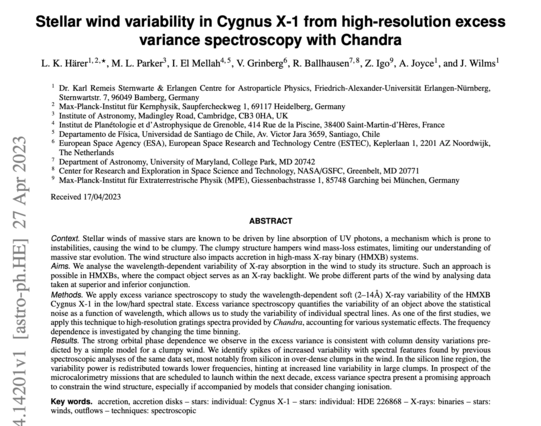
"Stellar wind variability in Cygnus X-1 from high-resolution excess
variance spectroscopy with Chandra" by Härer et al.
https://arxiv.org/abs/2304.14201

Let me disentangle what the title means: 1/6
#astrodon #BlackHole #VicisAstro #astronomy #SciArt

Stellar wind variability in Cygnus X-1 from high-resolution excess variance spectroscopy with Chandra

Stellar winds of massive stars are known to be driven by line absorption of UV photons, a mechanism which is prone to instabilities, causing the wind to be clumpy. The clumpy structure hampers wind mass-loss estimates, limiting our understanding of massive star evolution. The wind structure also impacts accretion in high-mass X-ray binary (HMXB) systems. We analyse the wavelength-dependent variability of X-ray absorption in the wind to study its structure. Such an approach is possible in HMXBs, where the compact object serves as an X-ray backlight. We probe different parts of the wind by analysing data taken at superior and inferior conjunction. We apply excess variance spectroscopy to study the wavelength-dependent soft X-ray variability of the HMXB Cygnus X-1 in the low/hard spectral state. Excess variance spectroscopy quantifies the variability of an object above the statistical noise as a function of wavelength, which allows us to study the variability of individual spectral lines. As one of the first studies, we apply this technique to high-resolution gratings spectra provided by Chandra, accounting for various systematic effects. The frequency dependence is investigated by changing the time binning. The strong orbital phase dependence we observe in the excess variance is consistent with column density variations predicted by a simple model for a clumpy wind. We identify spikes of increased variability with spectral features found by previous spectroscopic analyses of the same data set, most notably from silicon in over-dense clumps in the wind. In the silicon line region, the variability power is redistributed towards lower frequencies, hinting at increased line variability in large clumps. In prospect of the microcalorimetry missions that are scheduled to launch within the next decade, excess variance spectra present a promising approach to constrain the wind structure.

arXiv.org

"Stellar winds" - all stars, including our own Sun, have stellar winds.

Massive giant stars have especially strong ones, that can carry away a significant portion of a star's mass over its lifetime. These winds are highly structured and thus variable.

Understanding stellar winds is thus crucial to understanding the life of massive stars (who usually end their life spectacularly in an supernova explosion, producing a neutron star or a black hole). 2/6

"Cygnus X-1" is perhaps the most-known black hole (that we have updated the mass of: https://www.scientificamerican.com/article/astronomers-just-upsized-an-iconic-black-hole/).

But I'm also interested in its companion, a star of about 50 times the mass of the Sun, in a 5.6 day orbit with the black hole.

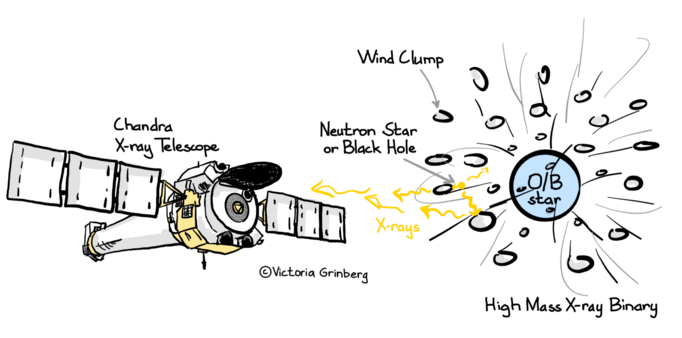
We can see lots of variability in the X-ray emission from the black hole - some is accretion physics close to the black hole, but a lot are clumps im the wind of the star passing in front of the black hole (see Fig. in first toot!)

Image credid: ICRAR

3/6

Astronomers Just Upsized an Iconic Black Hole

Cygnus X-1, the first black hole ever discovered, is significantly bigger than previously believed

Scientific American

"Excess variance" is the variance in a lightcurve above the expected statistical noise.

A lightcurve is a list of measurements of how bright the source is vs time; here, we make one measurement every 1.7 seconds. Excess variance then pretty much shows whether there is signal in the static noise.

By comparing excess variance for lightcurves at different energies, we can say at which energies have more or less signal to them.

4/6

"High resolution with Chandra" - @ChandraScience is an amazing X-ray telescope. If we use gratings on it, we are able to see details of lines from individual elements - this tells us what material is there but also how hot it is (as atoms are stripped of their electrons in especially hot or violent plasmas).

Here, we show that for a source as bright as Cygnus X-1, we can use Chandra to measure excess variable for individual ions. 5/6

How do we bring all these ideas together? We show that we can use excess variance and, comparing it to simulations that my colleagues I. El Mellah, I & collaborators have developed recently, use it to constrain wind properties.

This is a proof of concept paper, where we develop a new method and independently confirm its results. We also show that we need a proper treatment of ionization in the simulations in the future. So we'll get working on this soon!

6/6

#astrodon #BlackHole #astronomy

And the paper 👆 is now accepted! Took a while - not because of a bad referee report (it was both good and very useful, we ended up emphasising more why we try this new method which made the paper better!), but because everyone was so busy with other work. Done now and SO excited about the amazing work the first author has done here!

https://arxiv.org/abs/2304.14201

Stellar wind variability in Cygnus X-1 from high-resolution excess variance spectroscopy with Chandra

Stellar winds of massive stars are known to be driven by line absorption of UV photons, a mechanism which is prone to instabilities, causing the wind to be clumpy. The clumpy structure hampers wind mass-loss estimates, limiting our understanding of massive star evolution. The wind structure also impacts accretion in high-mass X-ray binary (HMXB) systems. We analyse the wavelength-dependent variability of X-ray absorption in the wind to study its structure. Such an approach is possible in HMXBs, where the compact object serves as an X-ray backlight. We probe different parts of the wind by analysing data taken at superior and inferior conjunction. We apply excess variance spectroscopy to study the wavelength-dependent soft X-ray variability of the HMXB Cygnus X-1 in the low/hard spectral state. Excess variance spectroscopy quantifies the variability of an object above the statistical noise as a function of wavelength, which allows us to study the variability of individual spectral lines. As one of the first studies, we apply this technique to high-resolution gratings spectra provided by Chandra, accounting for various systematic effects. The frequency dependence is investigated by changing the time binning. The strong orbital phase dependence we observe in the excess variance is consistent with column density variations predicted by a simple model for a clumpy wind. We identify spikes of increased variability with spectral features found by previous spectroscopic analyses of the same data set, most notably from silicon in over-dense clumps in the wind. In the silicon line region, the variability power is redistributed towards lower frequencies, hinting at increased line variability in large clumps. In prospect of the microcalorimetry missions that are scheduled to launch within the next decade, excess variance spectra present a promising approach to constrain the wind structure.

arXiv.org
The sad thing about this paper for me is that it's my last one with my friend M., who has left science still - it's not just a personal loss of a good collaborator and conference buddy for me, but also for the field, he was someone who really pushed new methods and made cool discoveries :( Alas, the academic job market is what it is especially if you want to have a life outside of science...
@vicgrinberg very cool! Good tidings!

@vicgrinberg I love the structure you have in the abstract, kinda want to steal it (and nice drawing!)

One question now when I skimmed through, why is the normalisation of F^2 sigmax^2 / bar(x)^2 in equation 2 using bar(x) squared?

@vicgrinberg Thank you for the inspiring description of how this research has carried on. I've had projects that go on forever, and I worry nothing will come of it. I appreciate your teams persistence.
@vicgrinberg I really do enjoy the drawings of yours. Hope the review goes well! 🙂