Alert : అంతర్వేది తీరంలో సముద్రం వెనుకంజ … ప్రజల్లో ఆందోళన

Alert : అంతర్వేది తీరంలో సముద్రం వెనుకంజ … ప్రజల్లో ఆందోళన అప్పటివరకు స్థానికులు ఆందోళనతోనే రోజులు గడపాల్సి వస్తోంది.

Vaartha Telugu

Plankton are changing their biology to survive a warming ocean. Their tiny adaptations may decide the fate of marine life. #OceanChange #PlanktonAdaptation #MarineScience

https://geekoo.news/how-marine-plankton-rewire-themselves-to-survive/

How Marine Plankton Rewire Themselves to Survive | Geekoo

Marine plankton are reprogramming their cell membranes to survive in changing oceans. A massive new lipidomics study reveals their strategies—and their impact on ocean life.

Geekoo

Gestern Abend berichtete Arved Fuchs in einem spannenden Vortrag in der Markthalle in #Delmenhorst über seine Reisen in die Arktis, die Herausforderungen und, am Wichtigsten, die drastischen Einflüsse des Klimawandels auf dieses hoch sensible Ökosystem.

Vielen Dank auch an den #LionsClub für die Organisation in dieser besonderen Umgebung.

#OceanChange #Geomar #AWI #DagmarAaen

❗❗ Check out our new paper on "Multifactorial effects of warming, low irradiance, and low salinity on Arctic kelps" led by Anais Lebrun and Cale Miller:
#Arctic #kelps #ClimateChange #OceanChange
https://bg.copernicus.org/articles/21/4605/2024/
Multifactorial effects of warming, low irradiance, and low salinity on Arctic kelps

Abstract. The Arctic is projected to warm by 2 to 5 °C by the end of the century. Warming causes melting of glaciers, shrinking of the areas covered by sea ice, and increased terrestrial runoff from snowfields and permafrost thawing. Warming, decreasing coastal underwater irradiance, and lower salinity are potentially threatening polar marine organisms, including kelps, that are key species of hard-bottom shallow communities. The present study investigates the physiological responses of four kelp species (Alaria esculenta, Laminaria digitata, Saccharina latissima, and Hedophyllum nigripes) to these environmental changes through a perturbation experiment in ex situ mesocosms. Kelps were exposed for 6 weeks to four experimental treatments: an unmanipulated control; a warming condition under the CO2 emission scenario SSP5-8.5; and two multifactorial conditions combining warming, low salinity, and low irradiance reproducing the future coastal Arctic exposed to terrestrial runoff under two CO2 emission scenarios (SSP2-4.5 and SSP5-8.5). The physiological effects on A. esculenta, L. digitata, and S. latissima were investigated, and gene expression patterns of S. latissima and H. nigripes were analyzed. Across all species and experimental treatments, growth rates were similar, underlying the acclimation potential of these species to future Arctic conditions. Specimens of A. esculenta increased their chlorophyll a content when exposed to low irradiance conditions, suggesting that they may be resilient to an increase in glacier and river runoff with the potential to become more dominant at greater depths. S. latissima showed a lower carbon : nitrogen (C : N) ratio under the SSP5-8.5 multifactorial conditions' treatment, suggesting tolerance to coastal erosion and permafrost thawing. In contrast, L. digitata showed no response to the conditions tested on any of the investigated physiological parameters. The down-regulation of genes coding for heat-shock proteins in H. nigripes and S. latissima underscores their ability to acclimate to heat stress, which portrays temperature as a key influencing factor. Based on these results, it is expected that kelp communities will undergo changes in species composition that will vary at local scale as a function of the changes in environmental drivers.

Diese Woche ist mir ein neuer Podcast unter die Ohren gekommen:

Expedition Ocean Change mit und von Arved Fuchs.

Fuchs ist mit seinem Segelschiff Dagmar Aaen mal wieder auf Segelexpedition.

Während dieser, und der anderen Reisen, wurde gebloggt und auch ein Podcast aufgenommen. Die Folgen sind natürlich alle hörenswert aber hier liste ich mal die Schottlandfolgen auf.

https://www.meinschottland.de/2023/08/27/podcast-empfehlung-expedition-ocean-change-von-arved-fuchs/

#OceanChange #ArvedFuchs #MeinSchottland #Schottland #Segeln #Podcast

Podcast-Empfehlung: Expedition Ocean Change von Arved Fuchs – Mein Schottland

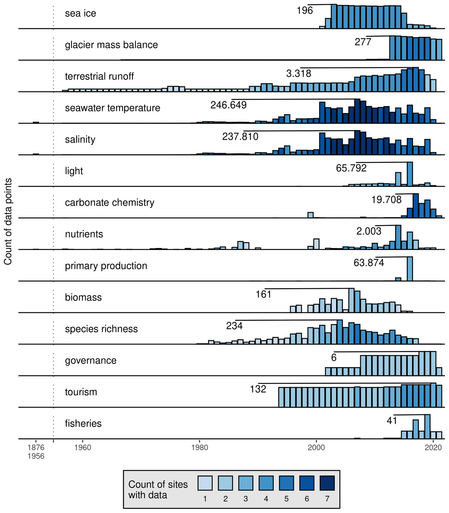
Check out our new paper led by #RobertSchlegel that describes a dataset for investigating socio-ecological changes in Arctic fjords.
#Arctic #OceanChange #climatechange #FACEIT
https://essd.copernicus.org/articles/15/3733/2023
A dataset for investigating socio-ecological changes in Arctic fjords

Abstract. The collection of in situ data is generally a costly process, with the Arctic being no exception. Indeed, there has been a perception that the Arctic is lacking in situ sampling; however, after many years of concerted effort and international collaboration, the Arctic is now rather well sampled, with many cruise expeditions every year. For example, the GLODAP (Global Ocean Data Analysis Project) product has a greater density of in situ sampling points within the Arctic than along the Equator. While this is useful for open-ocean processes, the fjords of the Arctic, which serve as crucially important intersections of terrestrial, coastal, and marine processes, are sampled in a much more ad hoc process. This is not to say they are not well sampled but rather that the data are more difficult to source and combine for further analysis. It was therefore noted that the fjords of the Arctic are lacking in FAIR (findable, accessible, interoperable, and reusable) data. To address this issue, a single dataset has been created from publicly available, predominantly in situ data from seven study sites in Svalbard and Greenland. After finding and accessing the data from a number of online platforms, they were amalgamated into a single project-wide standard, ensuring their interoperability. The dataset was then uploaded to PANGAEA so that it can be findable and reusable in the future. The focus of the data collection was driven by the key drivers of change in Arctic fjords identified in a companion review paper. To demonstrate the usability of this dataset, an analysis of the relationship between the different drivers was performed. Via the use of an Arctic biogeochemical model, these relationships were projected forward to 2100 via Representative Carbon Pathways (RCPs) 2.6, 4.5, and 8.5. This dataset is a work in progress, and as new datasets containing the relevant key drivers are released, they will be added to an updated version planned for the middle of 2024. The dataset (Schlegel and Gattuso, 2022) is available on PANGAEA at https://doi.org/10.1594/PANGAEA.953115. A live version is available at the FACE-IT WP1 site and can be accessed by clicking the “Data access” tab: https://face-it-project.github.io/WP1/ (last access: 17 August 2023).

“Vulnerability of blue foods to human-induced environmental change”
#OceanChange #food #ocean
https://www.nature.com/articles/s41893-023-01156-y
Vulnerability of blue foods to human-induced environmental change - Nature Sustainability

Global aquatic foods are a key source of nutrition, but how their production is influenced by anthropogenic environmental changes is not well known. The vulnerability of global blue food systems to main environmental stressors and the related spatial impacts across blue food nations are now quantified.

Nature

Mit #OCEANCHANGE möchte Arved Fuchs auf die Veränderungen in den Weltmeeren aufmerksam machen und junge Menschen für die Arktis begeistern. Wissenschaftlerin Marie Zingsheim begleitet ihn – an einen Ort, wo sich das Leben drastisch verändert hat. #planetE

https://www.zdf.de/dokumentation/planet-e/planet-e-abenteuer-arktis-100.html#xtor=CS5-433

planet e.: Abenteuer Arktis

Seit mehr als 40 Jahren reist der deutsche Polarforscher Arved Fuchs in die Arktis. Eine junge Agrarwissenschaftlerin teilt diesen Abenteuergeist und folgt ihm in die Polarregion.

planet e.