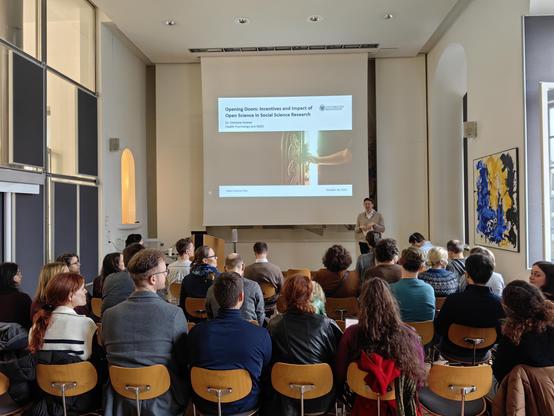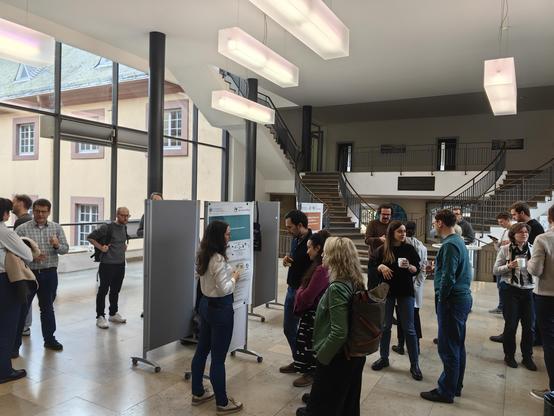
Huge thanks to those who attended our 7th annual #OpenScience Day last month at @unimannheim #OSDMA25. It was a pleasure to see you all there and to host alongside @BERD_NFDI

The slides from each session are now available on our website: https://www.bib.uni-mannheim.de/ihre-ub/ausstellungen-und-veranstaltungen/open-science-day-2025/

We look forward to seeing you in 2026, which will mark the 8th Open Science Day at @unimannheim (and 10th Open Access/Science annual event) and the 5th round of Open Science Grants since their inception in 2021.


@zuphilip

Open Science Day 2025

Open Science Day 2025

Thanks to everyone who came out to the Open Science Day at @unimannheim this year! We shared a bit about what we have achieved this year at the satellite meeting right after the official program. Thanks to Max for delivering in person and Susann for helping online.
Hope to see you next year again 🤓
#OSDMA25
the slides will be made available on the library's website soon: https://www.bib.uni-mannheim.de/ihre-ub/ausstellungen-und-veranstaltungen/open-science-day-2025/.
if you have any questions about #OSDMA25 please feel free to contact the #Mannheim #OpenScience office: https://www.uni-mannheim.de/open-science/open-science-office/
Open Science Day 2025

and with this #OSDMA25 comes to a close.
a big thank you to David Philip (@DPMorgan) & Philipp Zumstein (@zuphilip) and their colleagues for organizing this interesting #OpenScience day at @unimannheim! 🙏
from the discussion: is data in OpenAIRE directly part of the European Science Cloud? yes. #OSDMA25
the BERD datasets are now available in the EOSC Resource Hub (https://open-science-cloud.ec.europa.eu/resources/all), they are connected to resources in Zenodo (https://en.wikipedia.org/wiki/Zenodo), and they are being integrated with Galaxy Europe for data analysis (https://galaxyproject.org/eu/). #OSDMA25
Resource Hub | European Open Science Cloud - EU Node

BERD can also be linked to EOSC, the European Open Science Cloud (https://en.wikipedia.org/wiki/European_Open_Science_Cloud). this is important not only bc the German Science Council recommended integrating NFDI more closely into the European research landscape, participating in the EOSC development, and hence positioning NFDI as a an integral "node" of the EOSC. this could lead to a european "system of systems". #OSDMA25
European Open Science Cloud - Wikipedia

Klaus now focusses on the BERD portal – https://berd-platform.de/ – and how it can be connected to other services. being based on InvenioRDM (https://inveniosoftware.org/products/rdm/) the portal uses standards that make it possible to link it e.g. to other NFDI consortia, sections, and committees. this ensures a high degree of consistency with NFDI developments towards "oneNFDI".
#OSDMA25
BERD@NFDI Platform

"last in line" is Klaus Tochtermann, Leibniz Information Centre for Economics (ZBW), who will be talking about "The BERD Data Portal – Connected. National. European."
he puts BERD in the NFDI context, being one of 27 consortia: https://www.nfdi.de/, https://de.wikipedia.org/wiki/Nationale_Forschungsdateninfrastruktur (in German).
and speaking of #OpenScience BERD with its services addresses open scientific knowledge, open dialogue with other knowledge systems, open engagement of societal actors, and open science infrastructure, #OSDMA25
NFDI | Nationale Forschungsdateninfrastruktur e. V.