“Cultural Heritage at Conisbrough Castle: Expanding Resident Narratives, Public Education, and Aspects of Medieval Domestic Life for a Diverse Audience” by Emily Michelle Tuttle: https://doi.org/10.16995/olh.10303 Published today as part of the #OLHjournal "The Public Curatorship of the Medieval Past" Special Collection
Cultural Heritage at Conisbrough Castle: Expanding Resident Narratives, Public Education, and Aspects of Medieval Domestic Life for a Diverse Audience

<p>English Heritage Trust (EH) prides itself on communicating the histories of its sites through playful forms of engagement. In the recent scholarship of EH heritage managers David Sheldon (2011), Joe Savage, and William Wyeth (2020), new forms of creating play and providing site histories are considered alongside the challenges of updating signage and activities to meet visitor expectations. Expanding castle narratives beyond the Norman origins, increasing representations of women and lesser-known historic figures, and addressing the domestic function of castles are a priority for Sheldon, Wyeth, and Savage as they create case-by-case programs for their many properties. This paper considers what pedagogical methodologies are utilized at EH’s Conisbrough Castle, the selected story for presentation and why, and what display methods can be expanded to add to the visitor understanding of Conisbrough’s longer story through the Middle Ages. Using a mix of display boards, video, and text-based signage, managers at Conisbrough recall the de Warenne family narrative and recognize the Conisbrough keep’s domestic function. This is a successful recollection of this one resident’s story, however, only featuring this narrative limits Consibrough’s history to the Norman period. As EH seeks to grow their castle histories, I propose creating new engagements through the current display media that emphasize the importance of multiple tenant stories across time in castle spaces. Increased opportunities to relate to the past and retain information through play will assist visitors as they come to recognize the home as witness to both domestic activity and those events that occurred on the world stage.</p>

Open Library of Humanities
Read our collection of articles published as part of the #OLHJournal "Freedom After Neoliberalism" Special Collection, guest edited by Alexander Beaumont and Adam Kelly: https://olh.openlibhums.org/collections/429/ #fromthearchives
Open Library of Humanities | Collection:

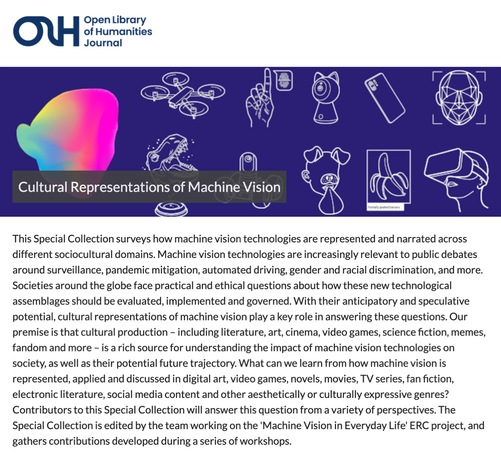
Read our collection of articles published as part of the #OLHJournal "Cultural Representations of Machine Vision" special collection, guest-edited by Jill Walker Rettberg, Gabriele de Seta, Marianne Gunderson and Linda Kronman: https://olh.openlibhums.org/collections/877/
Open Library of Humanities | Collection:

“The Lives Have It: Curating the Medieval Past at English Heritage Castles” by William Wyeth: https://doi.org/10.16995/olh.10355 Published today as part of the #OLHjournal "The Public Curatorship of the Medieval Past" Special Collection
The Lives Have It: Curating the Medieval Past at English Heritage Castles

<p>This paper outlines some of the challenges to the public curation of the medieval past at castles, as experienced in the author’s curatorial capacity at English Heritage. Echoing the work of recent scholarship on the heritage presentation of castles, this paper contends that the breadth of narratives explored on such sites has been limited to a national, male-dominated legacy. This paper outlines key stakeholders in the public curation of castles, as well as the media at the disposal of English Heritage curators, before presenting an approach which centres the historical narrative around people. It argues that, by placing people, past and present, at the centre of the public curation of medieval castles, obstacles and limitations from previous approaches can be overcome. This paper concludes with a critical reflection, outlining some ways in which these challenges have been overcome using this approach at a recent project at Warkworth Castle (Northumberland). The article emphasises the capacity of traditional curatorship interplayed with creative endeavours, to bypass obstacles to telling a compelling but also challenging public history of medieval castles.</p>

Open Library of Humanities
“Machinic Visibility in Platform Discourses: Ubiquitous Interfaces for Precarious Users” by Nuno Atalaia and Rianne Riemens: https://doi.org/10.16995/olh.10106 Published today as part of the #OLHjournal "Cultural Representations of Machine Vision" Special Collection
Machinic Visibility in Platform Discourses: Ubiquitous Interfaces for Precarious Users

Ubiquitous interfaces are becoming a key element in the promotional materials of tech companies. These new interfaces, normally associated with AR and VR systems, promise a future of frictionless technological interaction, allowing users to access any information and service from anywhere. Both factual and fictional, these systems are shown to enrich their users’ lives through machinic modes of vision and visualisation. In this paper, we frame promotional materials as elements in the discourses of Big Tech corporations that serve a strategic role in the expansion of their digital platforms. We analyse the symbolic role played by ubiquitous interfaces in the promotion of three digital platform services: Amazon’s Alexa Together, Microsoft’s Azure and Meta’s Metaverse. We claim that narratives of sensorial enrichment and empowerment—allowing people to not only see more, but better—are key in normalising the presence of platform interfaces in users’ lives. However, these narratives also advance what we call a regime of machinic visibility: a dependency of human vision on data processes and their visualisation. The imagined user of these services is a precarious one, unable to function or ‘see’ properly without a platform’s digital infrastructure. This precarity then justifies a relationship of dependence: the companies frame their products not just as enhancements, but as vital components of everyday life, implying that life itself is untenable without the intervention of platform companies. At the same time, Big Tech eschews criticism of its own role in undermining the social infrastructures and networks on which people depend.

Open Library of Humanities
“‘The Substance of Paint’: Class and Materiality in the Work of Ralph Balson” by Georgina O'Donnell Cole and Shane Michael Haseman: https://doi.org/10.16995/olh.10352 Out now in the #OLHJournal The Working-Class Avant-Garde Special Collection
‘The Substance of Paint’: Class and Materiality in the Work of Ralph Balson

<p>Ralph Balson (1890–1964) was an English plumber and house painter who emigrated to Australia in 1913 and subsequently became a key member of Sydney’s artistic avant-garde. He is credited with having the first solo exhibition of purely abstract painting in Australia in 1941. Despite his role in developing Australian non-objective painting, Balson remained principally a house painter, working on his art practice at weekends. In 1955 he retired on a state pension and became a full-time artist.</p><p>Balson’s artistic education and methods were critically shaped by his working-class background. He did not travel abroad until 1960 and was an avid auto-didact. His materials, palette, techniques and compositional strategies were likewise informed by his trade. Balson’s profession as a painter-decorator made him conspicuous within the predominantly middle-class Sydney art scene, though his painting partner Grace Crowley considered it an advantage in their pursuit of constructive painting. This paper explores the impact of Balson’s trade on his trajectory towards pure abstraction. While his art was at odds with the predominantly figurative mode of class-conscious art in Australian Modernism, we argue that it is embedded in the experience of class through its creative adaptation of labour into aesthetics.</p>

Open Library of Humanities
“Machine Vision and Tagging Aesthetics: Assembling Socio-Technical Subjects through New Media Art” by Nicola Bozzi: https://doi.org/10.16995/olh.10023. Published as part of the #OLHjournal "Cultural Representations of Machine Vision special collection" Special Collection
Machine Vision and Tagging Aesthetics: Assembling Socio-Technical Subjects through New Media Art

This paper builds on the concept of ‘tagging aesthetics’ (Bozzi, 2020b) to discuss new media art projects that combine machine vision and social media to address how different kinds of socio-technical subjects are assembled through AI. The premise outlines how the naturalisation of machine vision involves a range of subjects, juxtaposed along different conflictual lines: ontological (human-machine), biopolitical (classifier-classified), socio-technical (tech worker-data cleaner), political (AI-viewing public). Embracing the ambiguity inherent in the shifting boundaries of these subjects, I analyse works by different new media artists who approach one or more of these juxtapositions by engaging with diverse forms of tagging. The practice of tagging is often discussed through data-driven analyses of hashtags and how related publics can be mapped, but in my framework, tagging can encompass a wider spectrum of techno-social practices of connection (e.g. geotagging, tagging users). I discuss artworks by Kate Crawford and Trevor Paglen, Dries Depoorter and Max Dovey to illustrate how these practices can be leveraged artistically to make visible and even ‘stitch together’ the manifold subjects of machine vision. I explain how those taggings denaturalise processes of socio-technical classification by activating awareness, if not agency, through the sheer proximity they enact. Far from being a tool to map knowledge and essentialised identities, tagging aesthetics are ways to perform the techno-social and shape future cultural encounters with various forms of others. By exploring different approaches to tagging aesthetics – (dis)identification, semi-automated assembly and embodied encounter – this paper illustrates how tagging can be used to culturally negotiate the impact of machine vision in terms of issues such as surveillance and the performance of digital identity.

Open Library of Humanities
First article in a in a new special collection "The Public Curatorship of the Medieval Past" published this week at #OLHJournal > Read Fran Allfrey's “Early Medieval Language and Literature as Heritage: a Sutton Hoo Case Study”: https://doi.org/10.16995/olh.10211
Early Medieval Language and Literature as Heritage: a Sutton Hoo Case Study

<p>This article is both a reflection on the cultural, social, and political stakes of how early medieval literature and language functions as heritage in England, and on my practices as a museum educator. Language and literature in heritage contexts may enable rich emotional and intellectual engagement with early medieval stories, landscapes, and objects in ways which may unloose the early medieval from the grip of exclusionary narratives. I discuss how Old English language and literature may be understood within wider contexts of early medieval heritage, often called ‘Anglo-Saxon’ in English institutions, by sketching the overlapping public spaces of encounter with the past, and how we may read across them. With its longstanding links with Old English poetry across scholarship and public history, I suggest that Sutton Hoo provides an ideal case study for examining the enmeshment of early medieval literature, language, landscape, and archaeology as heritage categories. I discuss the planning and delivery of ‘Trade and Travel’, a temporary display and learning programme that I organised with the National Trust in 2017, and present findings from qualitative data I collected to suggest how people make sense of place, archaeology, and early medieval language and literature. Understanding language and literature as heritage, I show how visitors discover and create meaning through encounter and conversation. In heritage spaces, literature and language are sensory and emotional artefacts and experiences: observing visitor engagement reveals how both become integral to creative and identity-making work.</p>

Open Library of Humanities
“Hacking Surveillance Cameras, Tricking AI and Disputing Biases: Artistic Critiques of Machine Vision” by Linda Kronman: https://doi.org/10.16995/olh.10181 Published as part of the #OLHjournal "Cultural Representations of Machine Vision" Special Collection
Hacking Surveillance Cameras, Tricking AI and Disputing Biases: Artistic Critiques of Machine Vision

In the field of AI, troublesome machine behaviour is a recurring problem, and is particularly worrying when the governance of populations is externalised to machines. This article will focus on machine vision and explore whether hacking as a concept, a method and an ethic, as it has been appropriated by artists, makers and designers, offers ways for citizens to resist surveillant vision. By combining distant and close readings of art hacks in the ‘Database of Machine Vision in Art, Games and Narratives’ this article demonstrates a shift in resisting machine vision from hacking sensorial devices to tricking intellectual seeing. I call it the ‘intuition machine shift’ and argue that emergent with this shift is an art hacking strategy which specifically challenges biased machine vision. Drawing from critical making, tactical media and feminist theorisation of hacking, and adopting Mareille Kaufmann’s understanding of hacking as a form of disputing surveillance, this article outlines three artistic approaches to hacking machine vision: hacking surveillance cameras, tricking AI and disputing biases. The conceptual contribution of disputing biases is developed further to offer new nuanced understandings of risks and potentials of art hacks to resist biased machine vision.

Open Library of Humanities
“(Un)staþolfæstnes and its Problems: Grounding Minds in Early Medieval England” by Merel Veldhuizen: https://doi.org/10.16995/olh.9560 Published today as part of the #OLHjournal "Medieval Minds and Matter" Special Collection
<i>(Un)staþolfæstnes</i> and its Problems: Grounding Minds in Early Medieval England

<p>The Old English text <i>Solomon and Saturn</i> includes a list of materials from which Adam, the first man, is made. A pound of cloud constitutes his <i>modes unsta</i><i>ð</i><i>elf</i><i>æ</i><i>stnes</i> [mind’s unsteadfastness / instability]. Various other texts from early medieval England also refer to the <i>mod,</i> or mind, as an intrinsically unstable and changeable entity, using key terms such as <i>staðelfæst</i> [grounded / stable] and <i>staðolian </i>[to ground / stabilise]. In many of these texts, this instability is mentioned as an inherent quality of mind. Instability, contingency and change are regarded as integral and typical features of the mind but equally, there are warnings for the waywardness of the mind. The literature frequently encourages readers to ground and maintain control over their minds. Sources recommend restraining and training the mind to ‘govern’ and ‘steer’ it, and they even refer to the possibility of finding mental stability in another foundation. This article considers these seemingly contradictory portrayals of minds and instructions for grounding them, and delivers a more nuanced conception of what (physical) freedom early medieval people would imagine their minds to have, and what foundations they considered helpful for grounding them.</p>

Open Library of Humanities