I have uploaded a new paper to the arXiv, “Counting number-conserving cellular automata with radius 1“ (https://arxiv.org/abs/2605.31157).

The text is both a semi-brute-force calculation of the number of one-dimensional cellular automata with radius 1 and up to seven states, and an exercise in literate programming.

I call this a “semi-brute-force” calculation because, while it relies on my theory of one-dimensional number-conserving automata to speed up the calculation, there still remains an enormous number of individual cases that need to be computed and added up. It is by no means fast. The algorithm is also very specialised and works only for radius 1.

And literate programming means that the source code is a mixture of LaTeX and Haskell code, so that it (a) can be directly compiled by the Haskell compiler and (b) in the generated PDF, I can see each source code fragment together with the mathematical explanation what it does and why it does it. I did this in order to be (almost) absolutely sure that the program does what it was intended to do. The literate programming method works, but it is still quite an effort.

I do not think there is a journal that publishes such a text, but at least it is now in the arXiv.

#CellularAutomata #NumberConservation #LiterateProgramming #EnumerativeCombinatorics #Mathematics

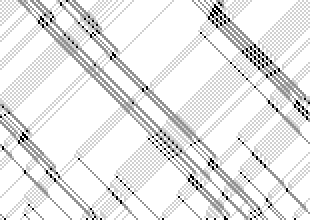
Counting number-conserving cellular automata with radius 1

This text is also a program that computes the number of one-dimensional number-conserving cellular automata with radius 1. At the end of the text, the numbers of such automata with up to 7 cell states are shown.

arXiv.org

Number-conserving cellular automata can be thought as simulating particle systems, like grains of sand or cars in a street.

I have just placed a text about one-dimensional number-conserving cellular automata into the arXiv (https://arxiv.org/abs/2308.00060). It is a kind of sequel to an earlier paper, in which I had derived a general construction scheme for all such automata. But a lot of things are still unknown, and the theory of such automata looks quite interesting. In my new paper I prove some new theorems, describe how to simulate the automata on a computer and how to find interesting rules, and I show images of a few rules I have found this way. Comments are welcome!

#CellularAutomata #NumberConservation

An Invitation to Number-Conserving Cellular Automata

Number-conserving cellular automata are discrete dynamical systems that simulate interacting particles like e.g. grains of sand. In an earlier paper, I had already derived a uniform construction for all transition rules of one-dimensional number-conserving automata. Here I describe in greater detail how one can simulate the automata on a computer and how to find interesting rules. I show several rules that I have found this way and also some theorems about the space of number-conserving automata.

arXiv.org