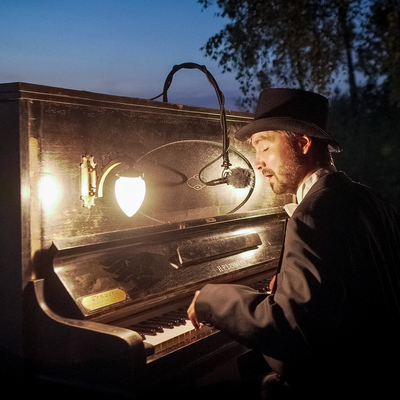
For those who understand #Slovak, I had the pleasure of talking with Romano fórum about my long-term research among Romani musical communities in Slovakia – specifically about my film #HopaLide, my project on #RomaniChords, the myth of Romani #MusicalBlood, and – last but not least – why Roma should have a stronger voice in researching their own culture.

Read the full interview here 👉
https://romanoforum.dennikn.sk/etnomuzikolog-peter-nuska-romovia-nemaju-hudbu-v-krvi-ale-ich-akordy-su-fenomenalne/

#RomaniStudies #RomaniMusic #Ethnomusicology #VisualEthnomusicology

Etnomuzikológ Peter Nuska: Rómovia nemajú hudbu v krvi, ale ich akordy sú fenomenálne – Romano fórum

Romano fórum

You can read the full article here =>

https://journals.sagepub.com/doi/10.1177/14687968251343781

… or an #OpenAccess preprint here =>

http://dx.doi.org/10.31235/osf.io/w5td8_v1

(you can also PM me, if interested)

Looking forward to your thoughts, comments, and questions on #MusicalBlood!

#Ethnomusicology

🧵17/17

So why not just debunk the myth on Romani musical blood completely?

Early in my research, I tried to challenge these stereotypes directly. But I learned something important: the idea of musical blood is too meaningful, complex, and deeply rooted to be simply dismissed as false.

It shapes real lives of my research participants in powerful ways.

#MusicalBlood #Ethnomusicology

🧵16/17

This reveals the paradox of musical blood clearly.

It’s a source of pride and economic opportunity, yet also a social constraint, dictating how Romani musicians are expected to act, perform, and even live.

It’s empowerment and limitation all at once.

#MusicalBlood #Ethnomusicology

🧵15/17

My long-term ethnographic fieldwork in Slovakia shows clearly how Romani musicians economically depend on non-Roma patrons who hire them for weddings and celebrations.

The stereotype of “natural” musical talent keeps demand high, but also restricts their professional and social roles.

#MusicalBlood #Ethnomusicology

🧵14/17

Musical blood can become a trap.

Romani musicians may feel pressured to embody stereotypes of emotional intensity and exotic natural talent, limiting their opportunities and shaping how they’re perceived and treated by non-Romani audiences.

#MusicalBlood #Ethnomusicology

🧵13/17

Romani musicians often proudly adopt these stereotypes, boosting their sense of identity and belonging. Such positive self-image can improve motivation and musical success.

But there’s another side to this story.

#MusicalBlood #Ethnomusicology

🧵12/17

I also distinguish two kinds of stereotypes that reinforce the idea about musical blood.

Heterostereotypes: ideas outsiders have about Roma (“They have music in their blood!”).

Autostereotypes: ideas Roma musicians embrace about themselves (“We have music in our blood!”).

Both strengthen the idea, but with very different consequences.

#MusicalBlood #Ethnomusicology

🧵11/17

When outsiders see Romani musicians performing impressively without formal education, they quickly assume it’s natural, “in the blood”.

Yet this idea obscures the skill, effort, and informal training behind these performances.

The myth becomes easier to accept than the reality of hard-earned musicianship.

#MusicalBlood #Ethnomusicology

🧵10/17

For example, in Western classical music, musical talent is seen as exceptional. Formal schooling and rigorous training are mandatory.

But in many Romani communities, musical skills develop informally through everyday activities, absorbed naturally through family and community life.

These contrasts often give rise to myths of innate musicality.

#MusicalBlood #Ethnomusicology

🧵9/17