GetMusicTools
Melody Scanner helps you transcribe music from recordings, audio files, or YouTube videos into accurate sheet music. Edit scores and export them as PDF, MIDI, or MusicXML for your projects. Perfect for composers and educators. https://getmusictools.com/melody-scanner #musictranscription #musiceducation #audiotools
AnthemScore uses AI to automatically transcribe audio files like MP3s and WAVs into sheet music. You can easily edit notes, customize for any instrument, and export your work as PDF or MIDI. Perfect for musicians looking to streamline their transcription process. Explore more at https://getmusictools.com/anthemscore #MusicTranscription #MusicTools
Klangio Transcription Studio allows you to automatically transcribe any song or audio into sheet music, MIDI files, and guitar TABs. It supports various instruments and even YouTube links. Perfect for musicians looking to quickly convert audio into notation. Explore more here: https://getmusictools.com/klangio-transcription-studio #musictranscription #musicianlife
If you're looking to transcribe music or learn tricky sections, Amazing Slow Downer lets you slow down audio without altering the pitch. Loop sections and adjust speed to fit your learning style. Check it out here: https://getmusictools.com/amazing-slow-downer #musictranscription #musicianlife
 Tarren van Ettinger
Fix for the #MuseScore doubled-duration problem I posted last night: I ended up copying the whole thing, then using "Paste half duration", with the keyboard shortcut ctrl-shift-Q. Then I highlighted the emptied measures and used ctrl-delete to get rid of them. #Music #MusicNotation #MusicTranscription
 hackaday unofficial
Pianolizer Helps Your Musical Projects Distinguish Notes
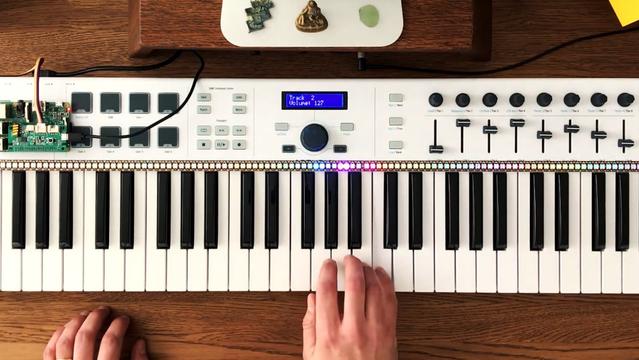
[Stanislaw Pusep] has gifted us with the Pianolizer project - an easy-to-use toolkit for music exploration and visualization, an audio spectrum analyzer helping you turn sounds into piano notes. You can run his toolkit on a variety of different devices, from Raspberry Pi and PCs, to any browser-equipped device including smartphones, and use its note output however your heart desires. To show off his toolkit in action, he set it up on a Raspberry Pi, with Python code taking the note data and sending color information to the LED strip, displaying the notes in real time as he plays them on a MIDI keyboard! He also created a browser version that you can use with a microphone input or an audio file of your choosing, so you only need to open a webpage to play with this toolkit's capabilities.
He took time to make sure you can build your projects with this toolkit's help, providing usage instructions with command-line and Python examples, and even shared all the code used in the making of the demonstration video. Thanks to everything that he's shared, now you can add piano note recognition to any project of yours! Pianolizer is a self-contained library implemented in JavaScript and C++ (which in turn compiles into WebAssembly), and the examples show how it can be used from Python or some other language.
[Stanislaw] also documented the principles behind the code, explaining how the note recognition does its magic in simple terms, yet giving many insights. We are used to Fast Fourier Transform (FFT) being our go-to approach for spectral analysis, aka, recognizing different frequencies in a stream of data. However, a general-purpose FFT algorithm is not as good for musical notes, since intervals between note frequencies become wider as frequency increases, and you need to do more work to distinguish the notes. In this toolkit, he used a Sliding Discrete Fourier Transform (SDFT) algorithm, and explains to us how he derived the parameters for it from musical note frequencies. In the end of the documentation, he also gives you a lot of useful references if you would like to explore this topic further!
What are you going to build with this? Maybe, a box that records you playing the flute and instantly turns it into sheet music? Or, perhaps, an AI that continues the song for you when you stop?
#musicalhacks #softwarehacks #fastfouriertransform #fft #fouriertransform #musictranscription #note #notes #piano #sdft #signalsprocessing #softwarelibrary