fly51fly (@fly51fly)
최적화기 옵티마이저의 ‘단순성 편향(simplicity bias)’이 실제 학습 성능과 선택의 유용성에 어떤 영향을 미치는지 분석한 연구입니다. Muon 사용의 장단점과 단순성 편향이 모델 학습 및 일반화에 끼치는 영향을 실험적으로 평가해 옵티마이저 설계와 선택에 대한 실무적 시사점을 제공합니다. (NYU 연구진, 2026)
fly51fly (@fly51fly)
최적화기 옵티마이저의 ‘단순성 편향(simplicity bias)’이 실제 학습 성능과 선택의 유용성에 어떤 영향을 미치는지 분석한 연구입니다. Muon 사용의 장단점과 단순성 편향이 모델 학습 및 일반화에 끼치는 영향을 실험적으로 평가해 옵티마이저 설계와 선택에 대한 실무적 시사점을 제공합니다. (NYU 연구진, 2026)
i have added a #muon build to #pkgconf CI. the goal of this is to allow us to begin thinking about deprecating the autotools-based build system.
this won't happen until next year, most likely, but muon is sufficiently complete at this point that i think it solves the bootstrapping problem enough that we can start thinking about getting rid of the autotools stuff, probably in pkgconf 3.1 or so.

The CosmicWatch Desktop Muon Detector (v3X) is a compact, low-cost, and portable device designed for detecting ionizing radiation, including cosmic-ray muons. Building on previous iterations, the v3X introduces significant hardware and firmware improvements that enhance sensitivity, usability, and data acquisition capabilities. The detector integrates a plastic scintillator and silicon photomultiplier (SiPM), custom designed electronics for signal processing, onboard data storage, OLED display, environmental sensors, and USB connectivity. With a total component cost under \$100 and a build time suitable for high school students, the v3X is ideal for education, outreach, and introductory research applications in particle and astroparticle physics. This paper details the design, performance, and potential use cases of the v3X, supported by example measurements demonstrating its functionality.
Students at #SNOLAB are starting to engage in our common orientation for research experiences. One particle that comes up really early is the #muon. Students often don't learn about subatomic particle properties other than #electrons, #protons, and #neutrons until late in university. I made this video explicitly to help early-career students get familiar with the muon and see how it was the first direct test of the #relativity of time:

#KnowledgeBit: The #Muon is one of the fundamental subatomic particles, the most basic building blocks of the universe as described in the Standard Model of particle physics.
Muons are similar to electrons but weigh more than 207 times as much. The muon is part of the lepton group.
So sánh Muon và AdamW trong đào tạo mô hình AI. Muon có thể underfit trong khi AdamW overfit. Cả hai mô hình đều đạt độ chính xác cao nhưng AdamW nhỉnh hơn. #Muon #AdamW #AI #MachineLearning #ĐàoTạoMôHình #TríTuệNhânTạo #Optimization #DeepLearning
https://www.reddit.com/r/LocalLLaMA/comments/1owa4ag/muon_underfits_adamw_overfits/
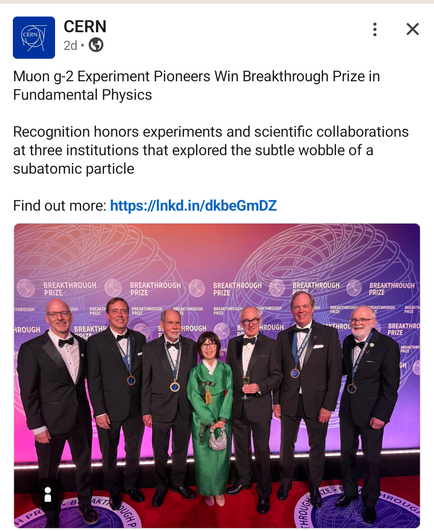
"After measuring the wobbles of 300 billion muons, the Muon g − 2 Collaboration has pinpointed with exquisite precision the internal magnetism of these subatomic particles. [...] In a somewhat surprising turn of events, the final results from the Muon g − 2 experiment line up with the most recent predictions, further validating the standard model of particle physics."