“Comparison of simulated and proxy-based climate reconstructions for Mid-Holocene Europe reveals high uncertainty”

A practice-oriented evaluation of time-continuous paleoclimate datasets by my co-authors and me, just published in The Holocene.

👉 https://doi.org/10.1177/09596836251366198

If you don’t have access, you’ll find the unformatted proof here: https://osf.io/2cbma/download
#paleoclimate #MidHolocene #palynology #paleoecology

@Sustainable2050 @gwagner

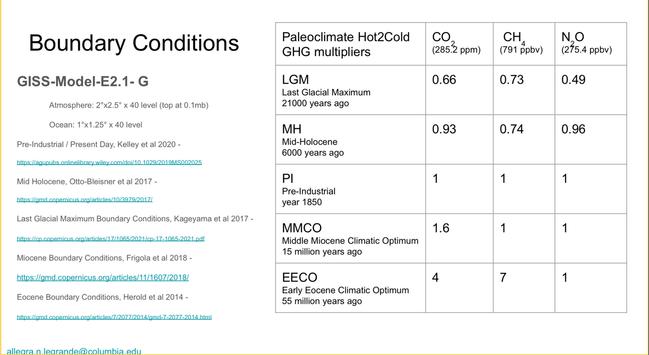
The new CO2 reconstruction for the last 65 Million years has put me in a sharing mood:
#NASA GISS E2.1-G (IPCC6 version) simulations for this range of CO2 values.
#Miocene #Eocene #LastGlacialMaximum #MidHolocene #Climate

#preprint from Shivangi Tiwari:

Greening The Sahel dries out The Amazon.

Fascinating from a #paleoclimate perspective. #MidHolocene

Instructive … feedbacks happen 1000’s of miles away

Convincing… 4 distinct models arrive at a similar conclusion — improving the simulation compared to observation.

Anyone interested in #Greening (converting desert landscapes into vegetated ones) as a #Geoengineering solution to #ClimateChange ?

https://www.essoar.org/doi/10.1002/essoar.10512838.1

On the remote impacts of mid-Holocene Saharan vegetation on South American hydroclimate: a modelling intercomparison

Proxy reconstructions from the mid-Holocene (MH: 6,000 years ago) indicate an intensification of the West African Monsoon and a weakening of the South American Monsoon, primarily resulting from orbit

Earth and Space Science Open Archive