
I did a thing!

Background

For years, I’ve had this itch:

What if I could build my own app experience on top of Dynamics 365 — something cleaner, faster, and more modern than a Model-Driven App?

Model-Driven Apps gave us structure.
Canvas Apps gave us freedom.
Power Pages brought external users into the mix.

But the truth?
Every time I looked over the fence at “actual code”, I would freeze and not have a single clue where to start….

This summer I opened VS Code, enabled GitHub Copilot, paired it with Claude, and suddenly… the digital barrier that had been there my whole life was gone🤯.
I didn’t magically become a full-stack dev — but AI gave me just enough superpowers to build what I used to only imagine.

So the next months I spent learning how to become a better prompter as this seems to be the key element to a good/bad AI Agent developer.

I wanted to experience that transition from the driver’s seat.

What

Let’s get this out of the way: I did everything wrong first.

I over-engineered front-end tech.
Played with services I had no business touching.
Tried Azure B2C.
Then B2B.
Failed authentication like a champion😆😆

Eventually, humility kicked in and I pivoted toward something more practical and more community friendly.

Netlify for hosting the frontend
Netlify Functions as my API + Auth proxy
React, because Claude told me to
Dataverse as my backend
GitHub + Copilot + Claude as my “coding superbrain”
Clerk.dev to handle identity

After weeks and weeks of late nights and swearing at the AI that seemed to never really understand what I actually was hoping to solve.. It finally worked👏👏.

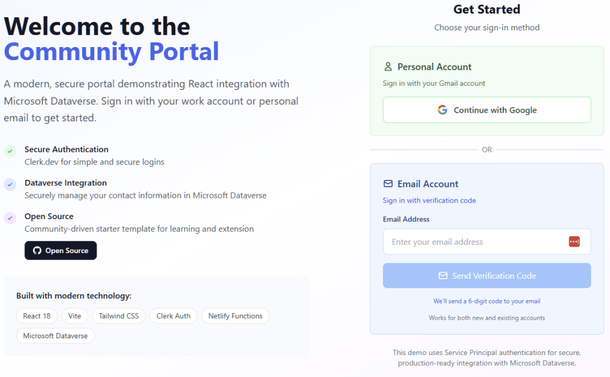
  • A portal.
  • Not over-engineered.
  • Just a clean, simple app that talks to Dynamics and feels… modern.

https://github.com/thomassandsor/CommunityPortal <- the project

Is it enterprise-ready?
🛑No🛑

Is it secure?
I sure hope so

Did it need to exist?
Probably not😆😆

But I made it.
And honestly, I love it💖💖💖💖

WHY?

I built this because I wanted to learn, not because the world needed “Thomas Portal v1”.

If I wanted speed (time to market), I would have stayed in Power Pages.
If I wanted stability, I would have stayed in Model-Driven land.
But I wanted to understand the future, and had to become a coder….. A coder with extreme backing of AI 😉

And here’s the real point:

The future of low-code isn’t “no code.”
It’s augmented code.
Makers will write code, guided by AI and that’s just something you need to get to terms with.

Microsoft is already opening up the AI generated code for editing, so it’s just a matter of time before the hybrid experience of real dev with AI dev working in “harmony”.
When these 2 worlds align, the difference between a maker and a developer becomes simply: curiosity and willingness to try.

Curiosity is the only qualification I had when I started this.

So now I’m sharing my journey not to show off, but to give others a trailhead.

If you’ve ever thought,
“Could I build something real outside of Dynamics/Power Platform”?
The answer is YES.

All you need is VS Code, some stubbornness, and an AI that believes in you more than your JavaScript error messages do.

Going forward

And now, with Microsoft’s latest announcement where Copilot can build apps and workflows from natural language prompts it’s even clearer:

Low-code isn’t dying.
It’s evolving into augmented coding
#Dynamics365 #Dynamics365CRM #MicrosoftCRM #PowerPlattform

Mandando e-mail✉️ e invite de reunião📅 do Outlook/Exchange com do Microsoft Dynamics 365 Sales (CRM) https://youtu.be/arh2SvJgfkE

#Dynamics365 #CRM #MicrosoftDynamics #OutlookExchange #MicrosoftCRM #D365Sales #CRMparaVendas #TecnologiaEmpresarial #AutomaçãoComercial #Produtividade

Mandando e-mail✉️ e invite de reunião📅 do Outlook/Exchange com do Microsoft Dynamics 365 Sales (CRM)

YouTube

Low Code Vibezzz: Can Power Platform Catch the Vibe Coding Wave?

What If Microsoft Could Start Over with Power Platform?🤔

The world didn’t change overnight when AI arrived at our doorstep—it’s been creeping in for years. Quietly embedding itself into release notes, keynote demos, and C-level posts about copilots. But something has shifted recently. It’s not just about AI anymore. It’s about how we build.

Enter Firebase Studio—Google’s latest tool that reimagines app development in an AI-first world. You type a prompt. You get a working app. No need to understand frontend or backend development to get going.

To be honest, it’s not no-code or pro-code. It’s something new:
Vibe coding—live-coding an app while vibing with an AI.

But it raises a big questions:

If Microsoft could rebuild Power Platform today from scratch—would they? Should they?

🧱 Power Platform: An amazing Low-Code product from Microsoft

Let’s be clear—Power Platform is a success. It has matured into a serious contender in enterprise low-code. It integrates deeply into Microsoft 365, Azure, and Dynamics. It empowers organizations to build apps fast, with governance and security built-in. That’s huge💪🏼

But like every long-running platform, it carries legacy and complexity that customers unfortunately need to understand.

  • Canvas vs. model-driven.
  • Custom pages vs. screens.
  • ALM pipelines that almost work well, but are still too complex for makers.
  • Two devs working on the same app? Still tricky.

Power Platform is constantly evolving, but having a hard time reinventing. Features are added, yes. Power FX, Copilot, co-authoring (kind of). But it’s like adding smart tech to a legacy car. You still feel the steering pull.

🤖 Vibe Coding: The New Developer Mindset

Firebase Studio isn’t just impressive because of what it can do—it’s impressive because of how it makes you feel while building. You’re not clicking through menus or configuring controls—you’re coding through conversation. It understands intent, backend structure, and front-end flow. It speaks your developer language.

That’s vibe coding.

And it changes the entire mental model of app development. It doesn’t feel like low-code—it feels like the fastest way to get real code out of your head and into a product.

Microsoft’s Copilot in Power Apps made an early push in this direction, but the experience felt more like autocomplete than a creative partner. There’s still a gap between vision and execution—and that’s what vibe coding is beginning to fill.

🍎 Are We Even Comparing the Same Fruit?

This is where we need to slow down. Comparing Power Platform to Firebase isn’t really apples-to-apples.

Power Platform is primarily about apps within organizations. It’s designed for internal users—business analysts, operations teams, HR, finance etc etc. The goal is to automate, digitize, and streamline internal processes, not launch a consumer product.

Firebase, on the other hand, is focused on external-facing apps. Think: public apps, customer portals, mobile-first products. It’s optimized for scale, authentication, telemetry, and UX polish.

So when people ask which platform is “better,” maybe we’re asking the wrong question. These tools are solving different problems for different audiences.

But here’s the thing: what if Power Platform could serve both?

🌍 Should Microsoft Blur the Lines?

Right now, if you want to build an external-facing app with Power Platform, your path usually leads to Power Pages—a separate product, with its own learning curve and licensing model. But what if Power Apps could evolve to let you publish customer-facing apps without leaving the platform?

💡Could Power Platform adopt more external scalability features?
💡Could it support richer public UX design options natively?
💡Could it blur the line between internal tool and external product?

If Microsoft wants to meet the expectations of the next generation of developers—raised on vibe coding, AI chat loops, and fast product delivery—these are questions worth asking.

💸 Pricing Models: A Mindset in Disguise

Firebase’s pricing is based on usage—you pay for authentication, reads, writes, bandwidth. It feels like you’re scaling your cost with your success.

Microsoft’s Power Platform pricing has historically been harder to navigate: per user, per app, per plan, per… something. Recent changes have simplified this somewhat, especially with the Developer Plan and Pay-As-You-Go licensing. But many organizations still feel that cost becomes a question before innovation can even begin.

This difference isn’t just a billing structure—it’s a reflection of platform philosophy. Microsoft monetizes the potential to build. Google monetizes the outcome of building.

💡 Power Platform: Building the Bridge Between Low-Code and Pro-Code

So here’s where we land.

Power Platform has done incredible work empowering business users to build. But the future of app development won’t be about choosing between low-code and pro-code—it’ll be about combining them, in a seamless, AI-driven workflow.

That’s what vibe coding hints at.

If Microsoft can continue to build that bridge—bringing Copilot closer to being a real dev partner, simplifying collaboration, supporting external users natively, and making the pro-code experience feel native, not bolted on—then Power Platform won’t just keep up… It will lead.

Because the real challenge ahead isn’t just catching up to new tools.
It’s embracing a new way of thinking about what an app is—and who it’s for.

#Dynamics365 #Dynamics365CRM #MicrosoftCRM #PowerApps #PowerPlattform