Stephen
Reconsidering the Folklore of Daniel JeanRichard
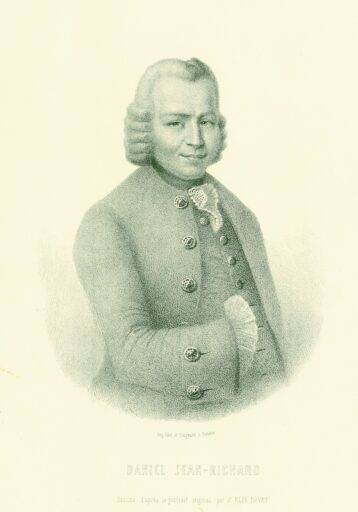
Portrait of Daniel JeanRichard (c. 1830) from Wikimedia CommonsThe history of Swiss watchmaking is filled with stories that blend fact with legend, and none is more emblematic than that of Daniel JeanRichard. Credited as the first watchmaker of the Neuchâtel Mountains, his story has been told for centuries as a tale of boyish genius, miraculous invention, and the birth of an industry. Yet when examined closely, much of what we know about him rests on a foundation of myth, embellished by chroniclers eager to celebrate a local hero. Still, beneath these exaggerations lies a deeper truth: JeanRichard was not only a craftsman of talent but also a figure who embodied the adaptability, resourcefulness, and entrepreneurial spirit of his region. To understand his legacy, we must first retell his story as it has been passed down, then place it in the context of his time, and finally consider his most lasting contribution—the system of établissage that defined Swiss watchmaking for generations.
The Legend of the English Watch
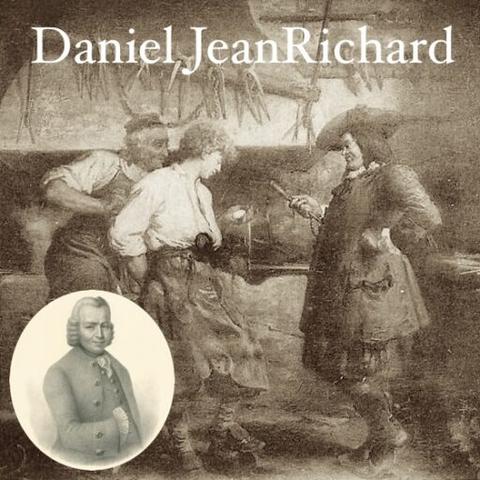
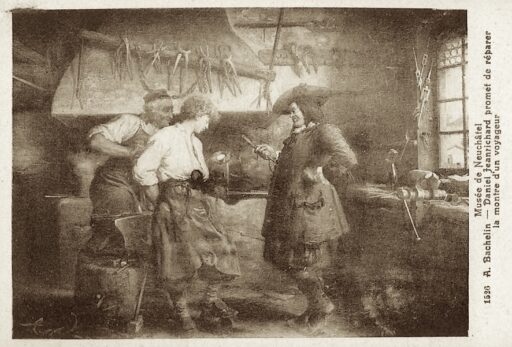
Daniel JeanRichard is credited today with establishing watchmaking among the resourceful but isolated farmers of the Swiss Jura mountains. According to tradition, the pivotal moment came in 1679 when a traveling horse dealer named Péter brought an English watch to La Sagne. Damaged on the journey, the watch was entrusted to young Daniel JeanRichard, who had never seen such an object before. Inspired, the boy supposedly set about building a similar piece from scratch, inventing the tools, forging the components, and finishing his own working watch within a year and a half. His neighbors, astonished by this feat, began placing orders, and JeanRichard soon became the first watchmaker of the mountains.
Daniel JeanRichard promises to repair a visitor’s English watch in this classic postcardThis tale was well-known in the 19th century, with the earliest telling attributed to Frédéric Samuel Ostervald’s 1766 “Description of the Mountains and Valleys that are part of the Principality of Neuchâtel and Valangin.” It has endured as the foundational legend of watchmaking in Neuchâtel and the Jura triangle, and is commonly repeated as fact to this day. But the inconsistencies are obvious. Depending on his (disputed) birth date, young Daniel could be as young as seven years of age and fourteen at most. Some versions say Péter first approached Daniel’s father, a gunsmith, who passed the incredibly rare and valuable object in the hands of his young son. Some suggest that Daniel or his father was a locksmith already adept at repairing clocks, while others suggest he was just a boy tinkering with metalwork. What unites them is the desire to portray him as a mechanical prodigy, the “spark” that ignited an entire industry.
Yet the historical record shows that watches were hardly unknown in the Jura at the time. Estate inventories from Le Locle in the 1660s list pocket watches alongside clocks, hourglasses, and sundials. By 1680, watches were common among the English bourgeoisie, and ties between Neuchâtel and England were already strong, with Swiss officers in the British army and Swiss pastors serving in London. It is plausible that a horse dealer brought a watch to La Sagne, but it was not the first watch ever seen in the region. And it is not at all incredible that a talented clockmaker and gunsmith like Daniel’s father, David JeanRichard, would have been able to repair a watch. The myth exaggerates the young boy’s involvement and isolation to emphasize his genius.
Daniel JeanRichard in Context
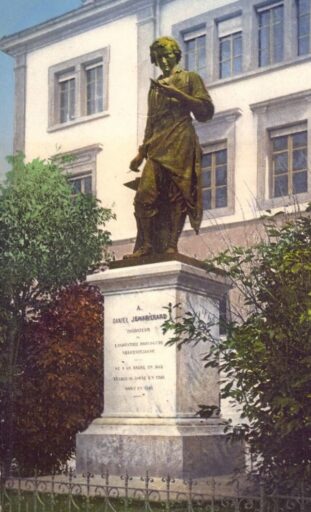
This colorized postcard shows the statue of Daniel JeanRichard, which still stands in the center of Le LocleEven if we subtract these legendary elements, Daniel JeanRichard’s career remains remarkable. Born around 1670 (various sources confidently claim 1665 or 1672), the son of David JeanRichard, who we know to be a master gunsmith and clockmaker, Daniel grew up in a household steeped in mechanics. His father repaired clocks, forged weapons, and even designed machinery for silk weaving. Such an environment provided the young Daniel with the technical grounding that made watchmaking a natural extension of existing skills.
Early records describe Daniel JeanRichard variously as a locksmith, goldsmith, and watch case maker before he was recognized as a watchmaker. By 1692 he was named a “master clockmaker,” and in 1703 an apprenticeship contract called him “honorable and expert Sir Daniel JeanRichard, master maker of pocket watches, Communier of La Sagne.” He lived for a time in La Neuveville, a town influenced by Geneva artisans, where he likely learned the techniques of small-scale watch and case production. Returning to Le Locle, he brought these skills back to the mountains, laying the groundwork for a local industry.
What stands out in JeanRichard’s life is his dual role as craftsman and teacher. Chroniclers name Jacob Brandt-dit-Gruerin (an auspicious and recognizable family name in watchmaking) among his apprentices, and many others soon followed. His influence extended through families such as Courvoisier, Perrelet, Jaquet-Droz, and Robert, all of whom became central to Swiss watchmaking. Whether or not he was the literal first watchmaker of the Jura, he was undeniably the one who trained and inspired the region’s future masters.
The Etablissage System
JeanRichard’s most lasting contribution was not the watches he produced but the structure of production he helped establish. The établissage system, which became the backbone of Swiss watchmaking, was a decentralized method in which different parts were made by specialized craftsmen (often working from their own homes) before being assembled by an établisseur.
This model fit perfectly with the social and economic environment of the Jura Mountains. Farming families faced long winters when agricultural work was scarce, and they turned to artisanal trades to supplement their income. Metalworking skills were widespread in the isolated region, and these jobs could be performed in cottages, often by entire families. The établisseur coordinated their work, collected components, and ensured the final watch came together. It was a system built on trust, cooperation, and the flexibility of part-time labor, which made it more adaptable than the centralized workshops of France or England.
A 1925 sketch by artist Eduard Kaiser showing a historic watchmakerJeanRichard, who himself began with multiple trades (gunsmithing, locksmithing, and goldsmithing) understood the power of dividing work into manageable specialties. His role in teaching apprentices and spreading the skills of case making, engraving, and assembly mirrored the way the établissage system would later function. In this sense, his personal experience foreshadowed the structure of the industry. He was not just a solitary genius but the nucleus around which an ecosystem of craftsmen organized themselves.
A Teacher Who Inspired An Industry
The tale of the horse dealer’s watch and the boy who invented horology from scratch is less a factual record than a symbolic tribute to the ingenuity of the people of the Swiss Jura mountains. Yet when placed in context, Daniel JeanRichard’s true achievements are no less impressive. He inherited a mechanical tradition from his family, absorbed new techniques from Geneva artisans, and established himself as both a craftsman and teacher in Le Locle. More importantly, he helped shape the établissage system that allowed watchmaking to spread through the Jura, transforming the economy of the mountains and laying the foundation of Swiss horology.
JeanRichard’s genius lies not in a single act of miraculous invention but in the way he embodied and transmitted the mechanical spirit of his time. By training others, organizing production, and proving that watches could be made in the mountains, he created an enduring legacy. The legend may be embellished, but the truth is equally powerful: Daniel JeanRichard was the man who turned the possibilities of the Jura into a tradition that would last for centuries.
Note: This article was inspired by my research into the early history of watchmaking in the Swiss Jura, which included re-reading many of the classic historical essays written in the late 19th and early 20th century. A series of articles by Dr. Marius Fallet in La Fédération Horlogère in the 1920s was the direct inspiration for this article. I recommend reading his original article on the topic, which is available in the collection of the Watch Library.
#DanielJeanRichard #EduardKaiser #etablisseur #folklore #LeLocle #MariusFallet