Stephen
Pacotille and Counterfeits: Swiss Junk Watches of the 19th Century
It was a difficult time for buyers and dealers of watches: Cheap imports were flooding the market, built by unskilled peasants and even children working in substandard conditions, with little care for functionality or longevity. And making matters worse, many were designed with the appearance and even the name of famous and respected companies. How could respectable companies fight back? How could consumers protect themselves?
Incredibly, I am not describing the current state of the Amazon-Temu world, or even the so-called quartz crisis. This is a description of the flood of Swiss watches on the American market in the middle of the 19th century, a period of chaos that nearly wrecked the Swiss watchmaking industry before it truly began. Ill-finished and semi-functional watch movements were sold abroad in bulk containers, and Swiss companies specialized in counterfeit watches in the Glashütte, English, and American style. The situation was so bad that one 1868 commentator lamented that the Swiss were “imposters and cheats” who had ruined the reputation of their country’s products!
How did it come to this and why has this been forgotten? It was the rise of mechanical production colliding with international conflicts and the loose control of international trade. Once these issues were resolved, Switzerland rose to dominate watchmaking in the 20th century by abandoning the ideals of Daniel JeanRichard and taking mass production further and faster than its originators in England and America.
Daniel JeanRichard’s Accidental Legacy
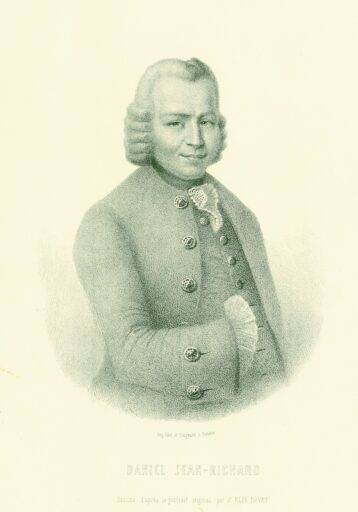
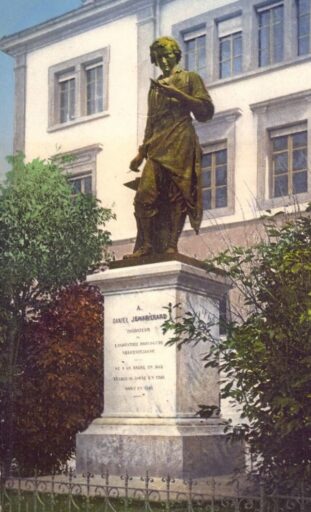
It may seem cruel to begin this story by recalling Daniel JeanRichard, but his legacy of hand-made piece-work by rural farmers in the Swiss Jura was a blessing and a curse. We tend to romanticize it today, but there is no doubt that the etablissage tradition flooded the market of poor-quality watch components. It was only the crushing success of industrial watchmaking in Switzerland that gave the nation its current reputation for precision and quality. And this came despite vigorous opposition from the watchmaking establishment.
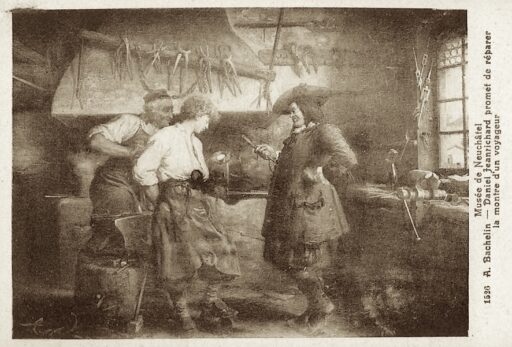
JeanRichard could never have foreseen any of this. As I recently described, he was a gifted craftsman who applied existing techniques in gunsmithing, metalworking, and clockmaking to build the first Swiss watches. When he and his apprentices were active, in the early 18th century, this was the only means of production. And their incredible skill established the remote Swiss Jura mountains as a credible competitor to the hand-made watches of Geneva, Paris, and London. But perhaps the craft of watchmaking was too-broadly adopted in the region.
Japy and Fontainemelon began producing plates and bridges in volume, standardizing on a few simple component sets, even though true interchangeability was a century away. So demand rose for the components needed to turn these ebauches into watch movements.
Between 1750 and 1850, thousands of craftsmen in the Swiss Jura began producing watch components at home. Each specialized in wheels, springs, pinions, or other components, producing sacks of rough parts. It’s not that the Swiss Jura craftsmen were unskilled: The story of the farmer and his family making watches through the winter has largely been debunked. But these metalworkers were paid based on the volume of their production and they were not involved in final assembly. So it is no surprise that these wheels and springs weren’t ready for use.
These were collected and brought to centers like Le Locle, La Chaux-de-Fonds, Fleurier, and Neuchâtel. The best components were painstakingly re-finished and fitted at the shops of the etablisseurs to create functional watches. The jobs were numerous, fueling the growth of these cities: Demonteurs disassembled the watches, planteurs re-drilled the pinions, repasseurs adjusted the timing, and remonteurs re-assembled the movement. This in addition to the expected graveurs, guillochers, doreurs, and acheveurs needed to finish the watches.
The opportunity brought by the etablissage system flooded the market with watch components, many of which were of dubious quality. Although the Swiss Jura produced many excellent movements, the bulk of the output was barely functional and required serious re-work before it could be sold.
Barrels of Worthless Trash
The worst of the worst was literally tossed in a chest or barrel to be exported in volume as pacotille. This word simply means “junk” in French, but it has important historic connotations. The barrels of beads and trinkets that were traded around the world by conquerers, profiteers, and swindlers for native furs, metals, and other commodities were also called “pacotille.” In the same way, the bulk of Swiss watchmaking output was shipped to other countries for local watchmakers to try to piece together. And even in Switzerland these questionable watch movements were called by the same name.
The resulting watches were “worthless trash”, according to William Keith, apprentice to pioneering American watchmaker Luther Goddard. They “exhausted the pockets and patience of the owners, and in a ten-fold greater degree, the patience of the watch repairer,” reported Keith. “Impatient under the torment,” Luther Goddard would regularly groan and set aside his work, telling his apprentice that “Job was not a watch maker.” Keith merrily reported that frustrated buyers would eventually pass these watches on to peddlers, who would melt them down for the scarce gold and silver they contained.
As poor as these watch components were, they served to stifle local production in America. Numerous English, French, and German clock and watch makers migrated to America before the Revolution in 1776, but very few ever attempted to build their own watches. Instead, they assembled watches from widely-available components, mostly in the bulky English verge and fusee style. The surviving examples mainly use high-quality parts imported from England rather than anything made in the colonies or Switzerland.
American Industry Rises to the Challenge
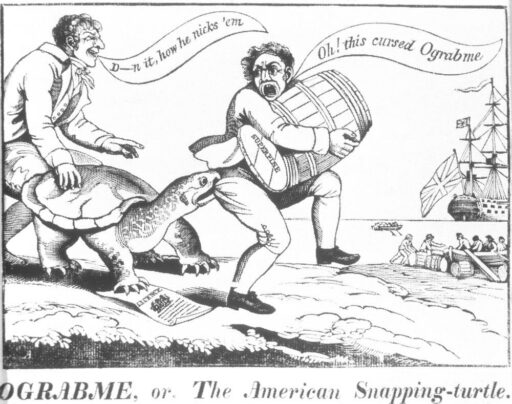
Thomas Jefferson’s Embargo Act of 1807 and the following War of 1812 changed everything. With foreign imports restricted, Luther Goddard seized the opportunity to produce watches at his workshop in Shrewsbury, Massachusetts. In just 5 years, the Goddards were able to produce over 500 watches, with many of the components produced in the forge and tools of their own shop. This was America’s first watch factory. Production stopped in 1817, when the Treaty of Ghent ended the war and the embargo, but Goddard inspired a generation of American watchmakers.
This 1807 cartoon shows how the embargo turned around to hurt everyone, just as the word is reversed as “ograbme”!American industrial watchmaking rose to become the best in the world in just a single generation. Goddard’s first apprentice, Jubal Howe, witnessed this first-hand, graduating to become the leading watchmaker in Boston. Howe saw the potential in a young man from Maine, Aaron Dennison, his own apprentice in Boston who traveled to England to learn from the best watchmakers there. Dennison was inspired by the Springfield Armory in central Massachusetts, which began producing muskets on an industrial scale based on common machine-made parts.
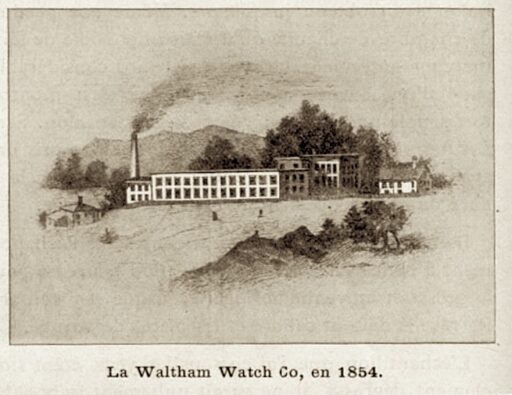
Dennison’s dream of mass-produced watches came to fruition thanks to his partnership with Boston clockmaker Edward Howard and watchmaker and entrepreneur William Keith, the Goddard apprentice mentioned above. Together they founded the great watch factory in Waltham, halfway between Shrewsbury and Boston, which applied the principles of mass production to watchmaking. The American Civil War drove massive demand for rifles and watches, and the Springfield Armory and Waltham Watch Company rapidly scaled production in the 1860s.
The Waltham factory was the first in the world to apply industrial techniques to the production of watchesThe Swiss delegation to the 1876 Centennial Exposition in Philadelphia was astonished to see what the Waltham factory was capable of. Théodore Gribi and Jacques David of Longines issued urgent warnings to their counterparts at home, and factories there rapidly adopted the techniques of mass production. But the Swiss were not as foolish as this story suggests: The Waltham factory was barely 20 years old by this point, and only the factories in Elgin and Springfield were operational, according to David’s report. Back in Switzerland, the ebauche factories in Corgémont, Sonceboz, Cortaillod, Grenchen, and Madretsch were already producing movements using machinery, drawing the ire of traditional etablisseurs.
Swiss Clones and Counterfeits
Industrial-produced American watches were so good and so cheap that demand for hand-made imports quickly dried up. Machine tool technology advanced quickly near the end of the 19th century, spurring entrepreneurs to open new watch factories across the United States. Waltham and Elgin dominated the market by 1890, but Keystone, Waterbury, Dueber, Rockford, and others were also producing watches in volume.
The same process of industrialization was happening in Switzerland, despite vigorous opposition by the “old guard” etablisseurs. Bienne and Grenchen welcomed these new factories, as did smaller towns along the French/Swiss border. But Americans still preferred the heavy and rugged English-style watches produced by domestic factories to the more-refined products of Switzerland. And they were less familiar with Swiss watchmakers and brands. Switzerland quickly faced a new crisis of over-production, falling prices, and failing factories.
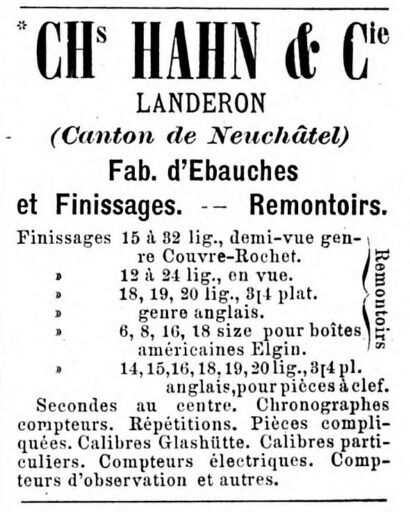
Charles Hahn’s new factory in Le Landeron produced watch movements in various styles for English, American, and German consumers, as seen in this 1895 advertisementSeeking to better compete abroad, Swiss factories began producing watches more suited to the demands of local consumers. Along with fine Swiss crown-winding movements, they offered Glashütte three-quarter plate movements, English key-winding movements, and heavy calibers in American sizes. These were exported to be cased, finished, and sold by watchmakers and jewelers in America, Europe, and Asia.
Although some vendors proudly advertised these Swiss movements, many were sold in a less-honest manner. By 1885, the American publication Jewelers Circular wrote that “it has been known for some time that imitation American watches were being sold in Europe, in South America and some of the British Colonies.” It continued to point out that “the watches were made in Switzerland, and bore the name of the American Watch Company, Waltham.” Unsurprisingly, many of these found their way to American dealers as well. These journals published frequent stories of the discovery of counterfeit American watches at pawnbrokers, often discovered when local jewelers informed the factory representatives of cheaper suppliers.
“Imitation” American watches are common even today and are approached in a matter-of-fact manner at swap meets and by local collectors. An excellent 1960 article by Wesley R. Hauptman in the NAWCC Bulletin details a dozen such counterfeits spanning 19th century products from Goddard to Elgin, and a similar article by Jerzy Ganczarczyk appeared in 2003. The widespread acceptance of these fakes and forgeries speaks to just how common they were.
The issue of Swiss imitations and counterfeits was well-known even while it was happening. In the 1871 3rd edition of his book, “The Watch”, Henry-F. Piaget wrote of the “great mistake” made by Swiss watchmakers who put “English and fictitious names upon their watches, instead of their own.” This lead to their being unknown in America and “stigmatised as imposters and cheats, so that their watches, or at least many of them, were looked upon as disreputable pieces of workmanship, and the Swiss very nearly lost their American trade, and the reputation of being an upright nation.” Piaget recommended that Swiss companies proudly put their name on their best watches and develop real demand in export markets. And this is exactly what companies like Omega, Longines, Zenith, Vacheron & Constantin and many others did!
You would probably also enjoy my article, “The Curious Case of the “Pateck” Counterfeiter“
From Imitation to Imitated
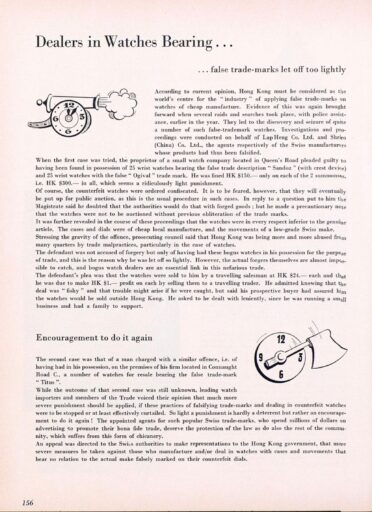
This 1955 article from Europa Star discusses the growing concern about Asian counterfeiting of Swiss watchesWe all know what happened next: The Swiss makers embraced precision manufacturing and industrial production as well as their own branding. Swiss cartels like Ebauches SA and ASUAG fought over-production and dumping of components overseas. Two world wars interrupted production in Germany, France, and America. American firms lost their advantage in manufacturing and the industry consolidated.
By the 1970s, once-proud American factories had closed, with most companies now focused on electronic watches. This too proved short-lived, as Japan, Hong Kong, and mainland China rose to conquer the mainstream watch market. By the 1980s, it was clear that branding was the most successful way to market watches, and the Swiss names were dominant. Today, a fight is underway over provenance of these once-proud brands, with the biggest consolidated into luxury groups and most of the rest being little more than a name. Who would have guessed that Hamilton would become a Swiss company while Movado and Invicta would be American brands? And the fight against junk and counterfeits remains just as pertinent today as it was in Luther Goddard’s time!
The Swiss government and industry has been focused on crushing counterfeits for over a century. As Europa Star discussed in this 1984 article, this was sometimes taken very literally!#AaronDennison #counterfeit #DanielJeanRichard #etablisseur #EuropaStar #HenryFPiaget #Landeron #LutherGoddard #LuxuryBrands #NAWCC #UniversalExposition #Waltham #WilliamKeith