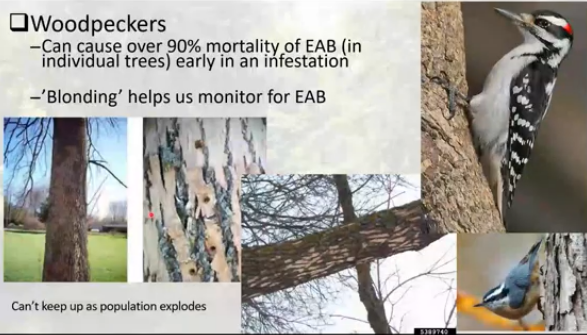
So, I missed the #EAB update from #MaineDACF, but since I registered for the event, I was sent the link to the video update. One thing I learned is that #Woodpeckers are #EmeraldAshBorer's natural enemy. But once EAB sets in, it's too much for the woodpeckers to handle. But if it's an early infestation, they *might* be able to control it! Just another reason to #GardenForBirds and #FeedTheBirds in the winter (and my woodpecker friends LOVE the wormy suet I make for them).

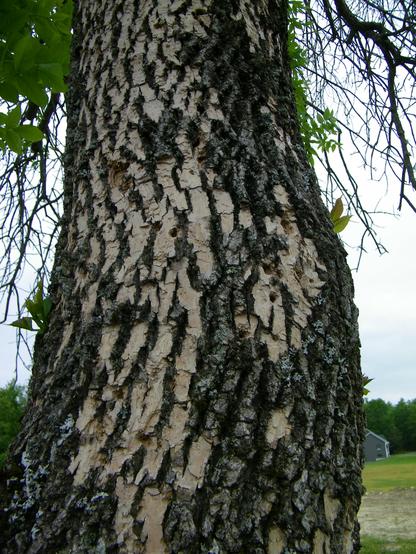
Here's a screenshot from the presentation. Also, the term "blonding" mentioned in the image refers to the process of older gray bark falling off an ash tree that has an EAB infestation, leaving behind lighter-colored newer bark.

The full video can be viewed at this link (includes transcript):
https://www.youtube.com/watch?v=1ogbMReBx38

#InvasiveSpecies #AshTrees
#SaveTheForests #ProtectTheTrees #ProtectTheSacred #Stewardship #Wabanaki #Basketry #SolarPunkSunday #Biocontrol #MaineTrees #MaineForestryService #MDIFW

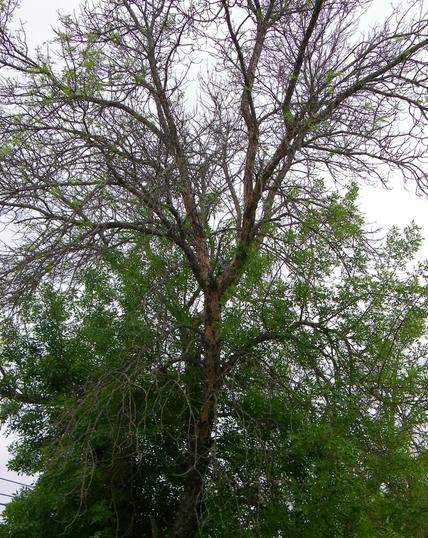
So, I heard back from #MDIFW about #EAB in our area. Apparently, my town is one that was recently identified to have Emerald Ash Borer outbreaks. They gave me information about treating the #GreenAsh trees (or taking them down), and an arborist friend of mine down the road was recommended to deal with infested trees. #MDOT may be responsible for taking down the ones by the road that are too far gone, but I'll let them know that there's someone nearby who they could hire to do that. I'll be talking to the neighbors who have the tree that might be saved about pesticide application. The #WhiteAsh tree by the #SacoRiver (which I don't think is infected), would be tricky to deal with, since pesticides could get into the river (though it's not like the Saco is potable water anyways -- but still. And it flows into the ocean). Anyhow, I have a plan of action. I'll provide updates on the trees as needed.

#MaineTrees #CitizenScience
#EmeraldAshBorer #SaveTheTrees #InvasiveSpecies #ProtectTheTrees #Stewardship #YorkCountyMaine

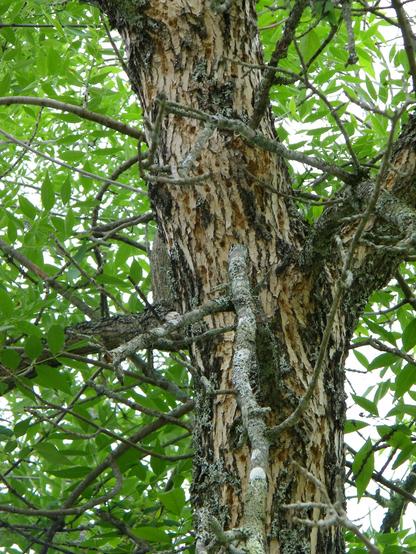
#AshTree update. I went down to the Saco River and positively identified a White Ash tree that might *not* have #EAB (Emerald Ash Borer). It did have a lot of invasive vines choking it out (Oriental Bittersweet being one), so I did my best to cut and remove the vines. The tree also had some sprouty bits emerging. Not sure what that means. I'm wondering if I could safely remove those and get them to root, but I'll leave them alone until I find out. I still have to report the infected Green Ash trees down the street to #MDIFW, and find out what should be done with them (not on our property, but a parcel that's about to be developed). I want to make sure the owners know to how to dispose of them safely without spreading more EAB.

#MaineTrees #CitizenScience #EmeraldAshBorer #SaveTheTrees #InvasiveSpecies #ProtectTheTrees #Stewardship

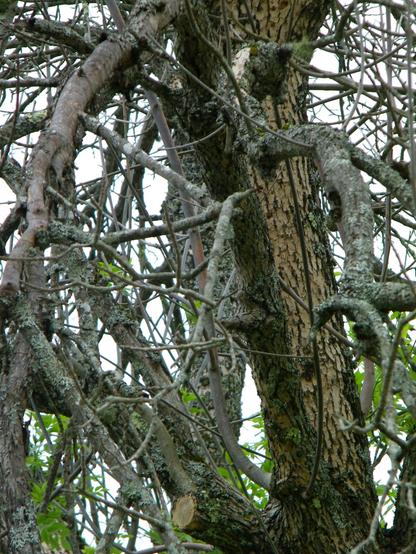
So, I identified two of the nearby #AshTrees -- they are both green ash -- and both of them are not doing well. I saw evidence of something digging holes into them, but not 100% certain it's #EAB. I'll be taking another picture when it's sunny to send off to #MDIFW for positive ID. A friend said there might be two more nearby that are in better shape. Checking those out later this week...

#EmeraldAshBorer #MaineTrees #InvasiveSpecies #CitizenScience #Stewardship #ProtectTheTrees

Ugh. Well, it seems two of the local ash trees may have EAB. Documenting the damage and reporting it to #MDIFW. Going to look at another tree down the road and see if it's been affected.

#EmeraldAshBorer #TreesAreSacred #AshTrees

So, I signed up for "alerts" from the #MaineDepartmentOfAgriculture, and they sent me an update about #BirdFlu here in #Maine. Oh boy... It's here.

SITUATIONAL REPORT: Highly Pathogenic Avian Influenza [#HPAI]

Date: Tuesday, February 11, 2025

Prepared by: Maine Department of Agriculture, Conservation and Forestry

Current Situation: The Maine Center for Disease Control and Prevention (Maine CDC), the Maine Department of Agriculture, Conservation and Forestry (#DACF), and the Maine Department of Inland Fisheries and Wildlife (#MDIFW) are urging agricultural stakeholders to take precautions following recent confirmations of highly pathogenic avian influenza (HPAI) in multiple wild birds in York and Cumberland Counties. While no cases have been detected in domestic flocks since March 2024, the virus remains in the environment."

Recent HPAI Activity

- MDIFW confirmed HPAI in multiple #WildBirds, including Canada geese, red-tailed hawks, and a great horned owl.
- Cases have been reported in Kennebunk, Kittery, Ogunquit, South Berwick, South Portland, and York.
- Four New England states have reported recent HPAI cases in domesticated #poultry.
- Officials have raised the risk level and strongly encourage #flock owners to implement strict #biosecurity measures.
- While HPAI has the ability to infect people and cows, there are no known infected persons or dairy herds in Maine and New England.

Biosecurity and Flock Protection Measures

To minimize the risk of HPAI transmission, all commercial and backyard poultry owners are urged to:

- Keep birds indoors or in enclosed outdoor spaces to limit contact with wild birds.
- Maintain strict biosecurity, including sanitizing equipment, wearing clean clothing, and washing hands before and after handling birds.
- Avoid equipment sharing and disinfect tools between uses.
- Provide clean drinking water from municipal or well sources—avoid surface water that may be contaminated.
- Store feed securely to prevent access by wild birds and #rodents.
- Minimize farm visits and avoid areas where birds congregate.
- Monitor flocks for signs of illness and report any unusual cases.

Signs of HPAI in Birds

- Sudden death without prior symptoms
- Decreased energy and appetite
- Drop in egg production or misshapen eggs
- Swelling and discoloration of head, comb, wattles, and legs
- Nasal discharge, coughing, sneezing, or diarrhea
- Neurological symptoms such as incoordination

Reporting Sick or Dead Birds

- Dead or sick wild birds should be reported to MDIFW at (207) 287-8000 or via the online wildlife disease reporting form.
- Three or more dead birds in a localized area are of particular concern for statewide surveillance efforts.
- If you handle dead birds, use gloves and masks, dispose of birds properly, and wash hands immediately afterward.
- Sick or dead domestic poultry should be reported to USDA, 866-536-7593.

Public Health and Food Safety Considerations

"The human health risk from HPAI remains low, but precautions should be taken:

- Avoid contact with sick or dead birds and use personal protective equipment (PPE) if exposure is necessary.
- Cook poultry, eggs, and beef to safe internal temperatures to eliminate bacteria and viruses.
- Choose pasteurized milk and dairy products for added safety.
- Monitor for respiratory symptoms if exposed to potentially infected birds or environments.

Source:
https://content.govdelivery.com/accounts/MEDACF/bulletins/3d1cb0a
#HPAINews #AvianInfluenza #NewEngland #BirdFlu

Highly Pathogenic Avian Influenza SITUATIONAL REPORT – February 11, 2025

Maine Department of Agriculture, Conservation and Forestry