 UniversoMotor
Metal esculpido a mano, cuero 3D y abalorios bordados: Rolls-Royce convierte el salpicadero del Phantom en una galería de arte móvil 🎨✨ #RollsRoyce #Bespoke #LondonCraftWeek
 Sam at BLAG
Very late to the party, but if anyone in London (UK) is at a loose end tomorrow, then there are some top-notch craftspeople involved in this day of demonstrations as part of London Craft Week:
https://londoncraftweek.com/events/restoration-revival-elevation-of-the-hand-crafted-surface/
#Craft #LondonCraftWeek #Gilding #Marbling #Graining #FauxFinishes #DecorativeArts

Restoration & Revival: Elevation of the Hand-Crafted Surface - London Craft Week
The Painter-Stainers’ Livery Company will be running demonstrations and short talks that showcase the expertise and professional experience of a selection of members, whose various practices range across the whole spectrum of craft, decoration and restoration. Lucia Scalisi will feature in a panel discussion on the art of restoration.
 dezeen (unofficial)
Pyton Place exhibition shows how the Bauhaus influenced Norwegian design
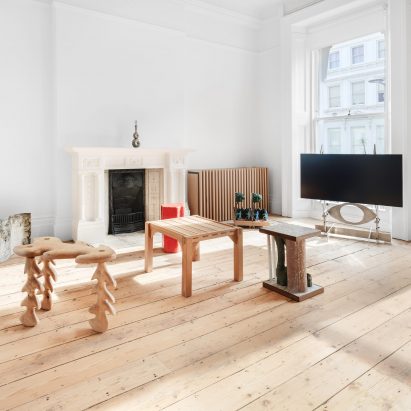
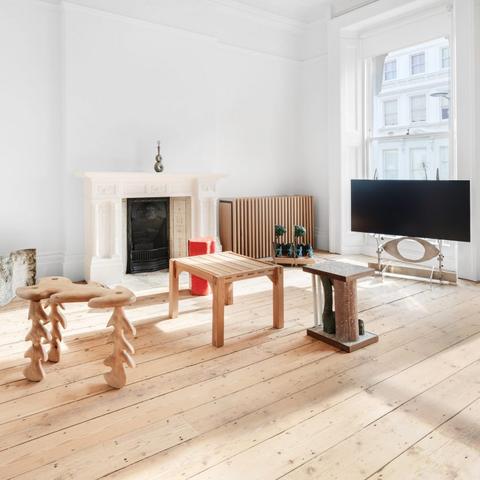
Oslo-based collective Pyton showcased more than 50 examples of Norwegian art, design and craft at the Pyton Place exhibition during London Craft Week.
Pyton Place set out to tell the story of how modernism impacted traditional craft practices created in Norway, and the objects that were produced as a result.
The exhibition was organised like a home
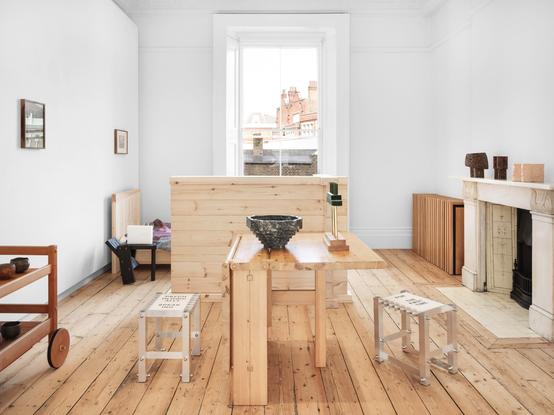
Presented in Cromwell Place from 11-15 May, the exhibition paired the distinctive pine furniture of mid-century Norwegian designer Edvin Helseth with objects and artworks by the likes of Sigve Knutson and Tron Meyer.
According to Richard Øiestad and Are Blytt, the two Pyton members behind Pyton Place, the aim was to show that the modernist movement was not just a generic style, but also resulted in a range of diverse, highly crafted works.
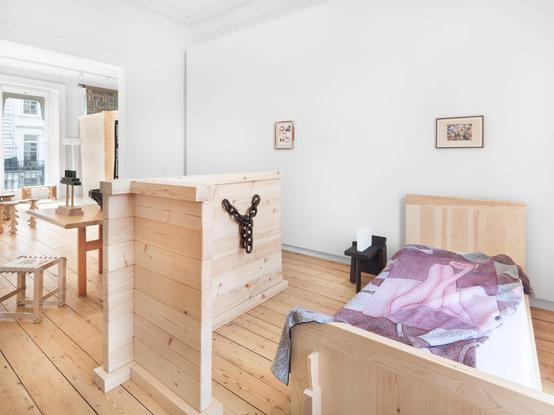
A "faux-Norwegian-cabin-style" wall system divides the space into zones
"For us, this show is about artists and object makers working primarily with unique pieces," they told Dezeen.
"It is the relationship between their chosen materials and their intellectual concepts, and the connections all these have to the world around us."
Sculptural stools by Sigve Knutson, Julia K Persson and Sverre Gullesen were featured
The exhibition references its setting – a Georgian apartment – by organising the objects in relation to the rooms they occupy. There are five zones: sleep, eat, lounge, work and arrive.
This arrangement references the manifesto of Hannes Meyer, the second director of the Bauhaus school, which set out 12 motivations for how living spaces should be organised.
Pine furniture by mid-century designer Edvin Helseth features throughout
The Bauhaus played an important role in Norway's adoption of modernism, Øiestad and Blytt explained.
In the early 20th century, when the country had a strong social-democratic political stance, young Norwegian designers were attracted to the innovative spirit of the Bauhaus.
[
Read:
Fold Oslo designers look to the future of furniture in Ny Normal exhibition
](https://www.dezeen.com/2021/10/05/fold-oslo-ny-normal-furniture-design-exhibition/)
Many of those that left to study returned to become professors for a post-war generation of students. Among those students was Helseth, who combined his modernist learnings with carpentry skills taught by his family.
"Helseth is a designer that all the members of Pyton have been fascinated with for a long time," said Øiestad and Blytt, "due to his very modern and unique way of making modernist furniture in pinewood."
Artworks include a tapestry by textile artist Elisabeth Haarr
"His furniture designs have a brutalist appearance, continued Øiestad and Blytt. "At the same time, they have a hint of refined Japanese wood craftsmanship; assembled with no glue or screws, they are held together with only wooden plugs or joints."
Helseth's designs were featured throughout Pyton Place. They included a folding dining table, a modular shelving system, an elaborate desk and a simple tea trolley.
Lina Viste Grønli's All The Pens flanks a desk by Edvin Helseth
To complement these works, Øiestad and Blytt designed a "faux-Norwegian-cabin-style" wall system that helps to clearly divide the five different zones.
They then added a range of sculptural and functional objects and artworks, both historic and contemporary, revealing the scope of creativity that Norway has produced over the past 100 years.
Works by Henrik Ødegaard and Nebil Zaman dominate the entrance zone
Historic pieces included a range of pewter objects by Gunnar Havstad, including a bottle described as "perfect in its shape and proportions", and a tapestry by textile artist Elisabeth Haarr.
"Elisabeth Haarr's tapestry from 1973 is something that really bonds with us intellectually; a sharp work of art in itself, but at the same time a historical timepiece of feminist history within the Norwegian art scene," said the curators.
Oda Iselin Sønderland presents a watercolour painting, Hespetre
Contemporary works on show included some pieces by Pyton members, including an aluminium television stand with an eye detail by Øiestad, a pair of graphical stools by Blytt and bird-inspired furniture pieces by Henrik Ødegaard.
Other highlights include a mouth-shaped stool by ceramist Julia K Persson, a pen-covered curtain by artist Lina Viste Grønli and Oda Iselin Sønderland's watercolour painting, Hespetre.
"Oda Iselin Sønderland's mystic motives blend elements of dreams with crafting," said the curators. "Her works connect with growing up, youth culture, and the life circles through drawing."
A trolley by Edvin Helseth displays a tea set by John Skognes
The exhibition was supported by Norwegian Crafts and was one of the headline events during London Craft Week. Øiestad and Blytt hope that visitors left with "a lust for a less-generic-living".
"We hope this show could help people to remember that culture should be included in our daily lives," they added.
Pyton Place was staged as part ofLondon Craft Week, which took place from 9-15 May 2022. See Dezeen Events Guide for an up-to-date list of architecture and design events taking place around the world.
The post Pyton Place exhibition shows how the Bauhaus influenced Norwegian design appeared first on Dezeen.
#all #exhibitions #interiors #instagram #bauhaus #londoncraftweek
Bureau de Change creates architectural tiles using glass made from mussels
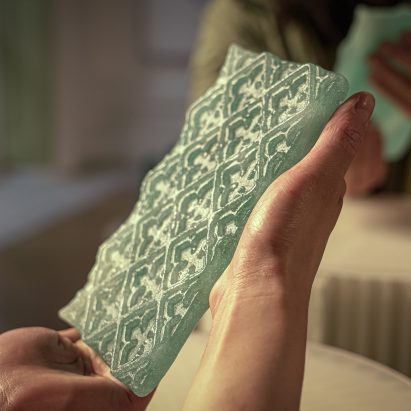
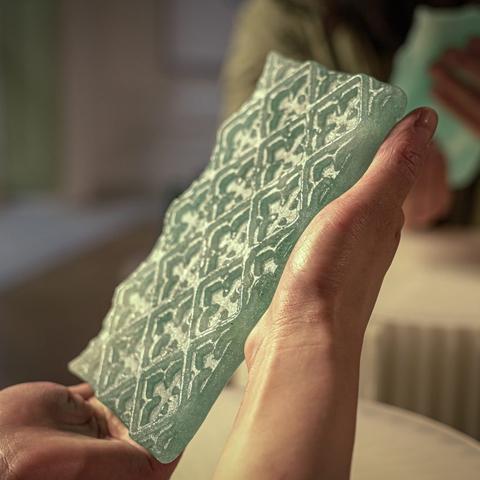
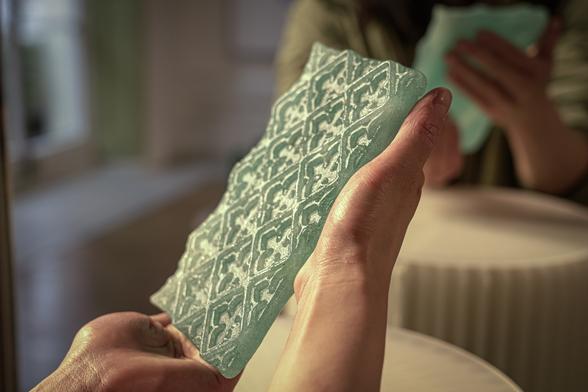
London architecture studio Bureau de Change has produced a range of patterned tiles using Thames Glass, a biomaterial created by artist Lulu Harrison from mussel shells.
Harrison – a student on the Material Futures masters at Central Saint Martin's – creates her bio-glass using the ground-up shells of quagga mussels as a substitute for sand.
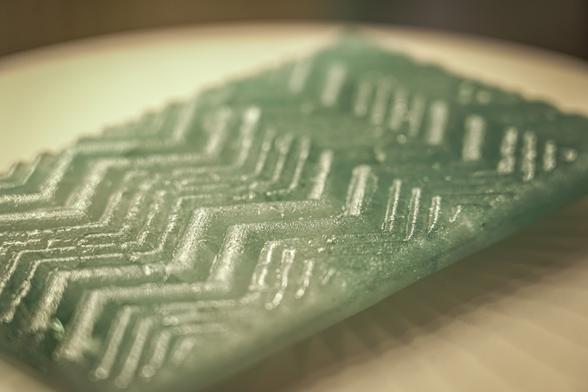
Bureau de Change has created four tile designs using Lulu Harrison's Thames Glass
Bureau de Change founders Katerina Dionysopoulou and Billy Mavropoulos have worked with Harrison to explore whether this material could be used to create an eco-friendly cladding for buildings.
Together they have created a series of cast glass facade tiles, featuring patterns inspired by 19th-century terracotta chimney pots.
The designs were exhibited during London Craft Week
They presented the results in the exhibition Beautility: How Fusing Beauty and Function Can Change the World, which took place as part of London Craft Week.
"Thames Glass has the potential to become a sustainable cladding material in the future," Mavropoulos told Dezeen.
The tiles are intended as an architectural cladding material
"Glass as a material is already sustainable, as it is infinitely recyclable," he said. "Thames Glass offers an even more sustainable alternative, because it uses local waste materials."
Quagga mussel shells often end up in landfill in the UK. This is because the invasive, non-native species causes blockages in Thames Water transfer tunnels and has to be removed.
Harrison developed Thames Glass for her masters at Central Saint Martin's
Thames Glass came about through a collaboration between Harrison and the utility company, to find a way to give this natural material a second life.
Harrison's experiments in this material resulted in a series of blown-glass vessels, including carafes, tumblers, jugs and vases.
However, the collaboration with Bureau de Change – whose portfolio includes an intricate bronze elevator and a terrazzo-filled house extension – allowed the glass artist to learn how this material might be used on an architectural scale.
The material uses quagga mussel shells instead of sand
The design that Dionysopoulou and Mavropoulos developed is intended to draw on London's architectural history.
The architects looked back at the Royal Doulton, which manufactured the city's water pipes in the mid-19th century, as well as the city's ornamental terracotta chimney pots.
[
Read:
Five designers in Mexico exhibit new uses for biomaterials
](https://www.dezeen.com/2022/04/19/mexico-space10-biomaterials-deconstructed-home-exhibition/)
The cast glass tiles replicate some of the same intricate 19th-century patterns.
In line with this concept, Bureau de Change has constructed a narrative to revive three of London's lost Thames-side pubs and inns, and using Thames Glass tiles to give each one a unique, illuminated facade.
Bureau de Change imagines using the tiles to bring back three lost London pubs
"Scavenging the antiquities of the Thames marshland led us to discover the lost architectural enigmas of riverside public houses," said Mavropoulos.
"We have re-imagined these lost forms of the waterside district, creating illuminated architectural silhouettes constructed of cast glass tiles," he said.
"These structures will exploit the material properties of glass, acting as a beacon and serving its historic purpose as a place of gathering and useful landmarks for both sides of the Thames."
Glazed facades would allow these buildings to glow from a light within
Thames Glass was one of three collaboration projects to feature in the Beautility exhibition, which was curated by design studio Here. Each brought a Material Futures student together with an industry partner to create future visions of everyday objects.
Mavropoulos believes the eco-glass could have a real future in architecture – although there would be challenges.
The handmade nature of the bio-glass means that each tile is unique in colour and finish, and imperfections are common. It would be hard to test and certify in terms of safety and durability.
The tile patterns draw on ornamental chimneys from the 19th century
However, Mavropoulos believes the naturally occurring texture and unique colouration are the material's best qualities and are what makes the tiles so effective.
"Each tile has its own micro-texture that beautifully interacts with light," he added. "Together with the material grain, the traces of the casting process create depth and enhances the Victorian motifs."
Beautility: How Fusing Beauty and Function Can Change the World took place as part of London Craft Week, which took place from 9 to 15 May 2022. SeeDezeen Events Guide for an up-to-date list of architecture and design events taking place around the world.
The post Bureau de Change creates architectural tiles using glass made from mussels appeared first on Dezeen.
#all #products #design #glass #craft #tiles #bureaudechange #biomaterials #londoncraftweek