 Andy Arthur - Threadinburgh
The Rule of the Strap: the thread about the peculiar corporal punishment of Scottish education
On April 2nd 1982, Lothian Region Council implemented a ban on corporal punishment in its schools, making it the first Scottish authority to do so. Some other regions were less enlightened however and would hold on to the practice until a UK-wide ban came into force in 1987. In Scotland, corporal punishment in schools almost universally meant hitting the upturned palms of children with an official instrument that is variously called the belt, the strap, the tawse or the Lochgelly. So what is this device, why and how did it evolve, how did it meet its end? (and, importantly for this sites locale of interest, what part did Edinburgh have to play?)
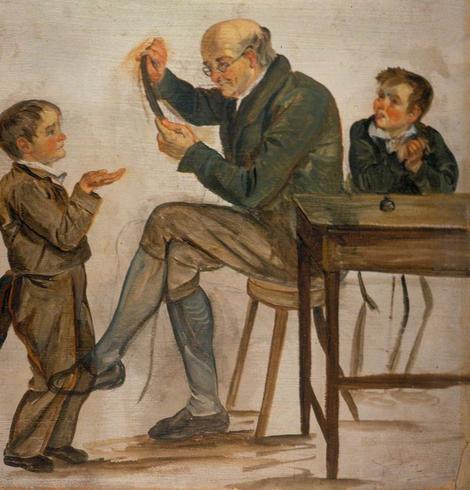
The maker’s stamp of a Lochgelly tawse. Photo © SelfTawis or tawes is a Scots word going back to the 16th century and was a plural for a leather belt or strap. This word in turn came from the Middle English tawe, for leather tanned so as to keep it supple. A strap or belt across the palms or buttocks was long the favoured instrument of corporal punishment in Scottish education. In the mid-19th century illustration below we see the schoolmaster (Dominie) flicking his leather strap towards the upturned palms of his fearful-looking victim; the boy behind is rubbing his already leathered hands to try and soothe them.
“The Dominie Functions”, George Harvey, mid-19th c. © The Stirling Smith Art Gallery & Museum via ArtUKIn 1848, George Mckarsie sued Archibald Dickson, schoolmaster of Auchtermuchty parish, for assaulting his son without provocation with a tawse “severely on the head, face and arms to the effusion of his blood and to the loss, injury and damage of the pursuer“. £200 in damages were sought and although the court found in the pursuer’s favour he was awarded only a shilling and had to pay all expenses of the defender! English education in contrast favoured birch rods or canes for classroom punishment and so where Scottish education was influenced by English practice (e.g. in Roman Catholic schools, or preparatory schools modelled after the English system) these devices could also be found in use in Scotland. They were also the form of judicial corporal punishment of minors in Scotland; the belt or strap was somewhat unique to the education setting.
A schoolmaster preparing to dispense classroom justice with his cane. 1870 engraving.In 1860 the master of a private boarding School in Eastbourne, Thomas Hopley, shocked the Victorian world when he beat a 15 year old pupil, Reginald Cancellor, to death with a skipping rope and walking stick as the boy “refused to learn“. Hopley administered the “severe corporal punishment” with the full permission of the boy’s father to try and force him to learn. Reginald had been written off as unteachable and an imbecile; he was quite probably suffering from hydrocephaly and undiagnosed learning difficulties. In the subsequent trial that was sensationalised by the press, Hopley was convicted of manslaughter and sentenced to four years in prison. In summing up however, Chief Justice Alexander Cockburn stated that parents or schoolmasters were legally authorised to administer “moderate and reasonable corporal punishment” for the purpose of “correcting what is evil in the child“. As a result, the death of Reginald Cancellor became a test case for defending the use of educational corporal punishment. It also also set the Victorian educational establishment thinking about how it could formalise and legitimise the practice, rather than leave it to the individual devices of potentially sociopathic teachers
Ne’er wield the tawse, when a gloom will dae the trick
Scottish proverb, from “The dominie : a profile of the Scottish headmaster ” by William F. HendrieNorth of the border, in 1872 the Education (Scotland) Act had made education mandatory for all between the ages of five and thirteen, putting it largely under the control of city, burgh and parish School Boards. These bodies could issue their own regulations on the use of corporal punishment and it was in the Fife town of Lochgelly where the ultimate instrument of Scottish school discipline would appear around the year 1884. Saddler Robert Philp made a pair of tawse to his own design for his son and daughter, pupil teachers1 at the East Public School in the parish. His creation was split into a pair of thongs at the “punishment end” and was both stiff enough to stand up straight but flexible enough to swoosh through the air and make a good contact with the target, ideally wrapping around the hand to cause maximum effect. He rounded off the edges of the leather and used no stitching in order that his instrument would leave no permanent scars.
A two-thonged Lochgelly-pattern Tawse. The punched hole was for hanging it on a wall (in full view of a class).It is hard to the modern mind to imagine, but this was genuinely felt by the establishment to be a more humane and progressive form of discipline than the rod or cane. But the tawse was no soft option; Albert Morris wrote in the Scotsman that it “stung like a serpent and bit like an adder“, literary historian David Daiches saying “I was astonished at the amount of real pain inflicted and the length of time it lasted“.
When other teachers saw the custom tawse used by Catherine and David Philp, they soon wanted their own, and their father started taking orders. The leather for the Tawse came from Edinburgh, it was specially “dry tanned” to prevent cracking but remain both stiff and flexible. And so it was that 102 Main Street in Lochgelly became the birthplace of a profitable and unlikely Fife industry in the manufacture of devices with which to hurt children.
102 Main Street, LochgellyRobert’s son, Robert W., was apprenticed to his father and the firm became Robert Philp & Son. The latter would continue the business when his father died in 1926. There were imitators such as Brownlee of Bathgate or Campbell of Renfrewshire, but the Philp’s had much of the market and Lochgelly became a common name for all education tawse in Scotland. When Robert W. Philp died, the business was bought over by its senior journeyman leatherworker, James Heggie, who continued to trade under the established name. He kept a stock of 300 in the shop in Lochgelly of single, double and triple-thonged types in a variety of weights and lengths, suitable for both male and female teachers and for belting children of all ages with progressively stronger effects with age.
Tawse stamped with the mark of R. Philp & Son, Makers, Lochgelly.When Heggie retired in 1948 he sold the business to an established local saddlery and ironmongery firm, G. W. Dick & Son, who had been producing their own Lochgellies since 1942. George W. Dick (who was married to a cousin of Jimmy Shand) concentrated the tawse business at his shop at 150 Main Street, Lochgelly. His son, John J. Dick, in turn bought him out when he retired in 1950. The “miniature school straps” listed at the bottom of the page are something one of the Dicks had produced for a child as a toy for playing schools and which had caught on. Teachers bought them for their children as a plaything; one imagines they were meant to beat their teddies. They were also popular retirement trinkets for teachers, something to remember the good old days.
John J. Dick price list for Tawse from 1971By this time, Lochgelly was reckoned to account for probably 70% of all tawse production in Scotland. An exception to its dominance was in Glasgow, where the school authorities were particularly strict around its use and mandated the locally made, triple-thong Black Straps of lighter weight, thinner, black leather (which is softer than that used by the Lochgelly). Many teachers used the genuine item regardless of these regulations.
J. G. Stevenson manufacturer’s stamp on a Glasgow “black strap”.But regardless of where the strap was made or if it was black or brown, the tawse was “the dominie’s rod of office“, indeed the ubiquity of its use may well be the origin of the phrase “getting leathered“. The education system believed firmness of discipline equated to the quality of teaching. Wherever the Scottish education system influenced those of the colonies and dominions, orders would be sent back to Lochgelly for its tool of classroom discipline. The tawsemakers took out adverts in teaching journals and sent their salesmen to the education colleges to take orders. James Heggie would get orders of 20 or more at a time whenever a new school opened. Junior teachers were encouraged by their seniors to give children the belt as soon as they could so that the class knew they meant business and to earn the respect of both children and parents. Some new teachers didn’t want to be marked out as a rookie with a shiny new tawse and so wrote into the wanted section of the newspapers asking to buy a visibly well worn second hand one, as did R. McKinnon to the Sunday Post in September 1965
In use the tawse was held over the shoulder and rapidly flicked forwards. Teachers were encouraged to practice on a piece of chalk on the desk – a successful strike got a puff of white dust. This became a trick of many experienced hands to try and scare children into compliance. But while judicial corporal punishment was abolished in 1948 with the authorities recognising it just didn’t work as a deterrent, the educational establishment hung on doggedly to their legal right to apply it to children right down to the age of 4 as they saw fit. As a result, business remained good in Lochgelly, indeed in 1974 John J. Dick moved his premises to Cowdenbeath to concentrate on the tawse and updated the process by investing in a metric cutting press and a blocking machine with a heated stamp. When suitably heavyweight leather from cattle hides began to decline as a result of changing farm practices, Dicks started using Buffalo Butts instead to meet demand, which is actually horse leather.
Support for corporal punishment in education was publicly and officially high, but was certainly not universal. However, it was hard to speak up in an educational and political establishment that did not readily tolerate dissenting voices. But as early as 1931, Moderate councillor for George Square in Edinburgh, Charles Mackenzie, tried to have it banned by the city Education Committee. He said education “should not be thrashed in” and noted a school nicknamed “the butcher’s shop” on account of the strength of beatings. He was voted down 14-3 by the rest of the committee, with former teachers and a church minister who sat on it speaking up firmly in favour of the practice and to “uphold teachers’ rights“.
In 1959, the Edinburgh Education Committee issued restrictive rules for corporal punishment in children’s homes – it could only be inflicted by a matron, house-mother or house-father, men could not punish girls, there could be no more than 3 strokes to each hand and only by the tawse. By the 1960s, a new generation of post-war born, progressively-minded teachers was coming into the system with new ideas. Dissent slowly began to grow within the teaching establishment and there was a recognition that there were alternatives to trying to simply beat children into compliance or knowledge into them. But while the Educational Institute of Scotland (EIS, the principal teachers’ union) accepted change was inevitable regarding corporal punishment in schools, it took something of a “circle the wagons” approach that it was up to the profession alone to regulate it and not the authorities.
In Edinburgh in 1970 it was reported some schools strapped any child who was late more than three times. Education Committee chairman Councillor Malcolm Knox fretted this might make children run across the road but his Progressive party colleague Councillor Cornelius Waugh defended the idea, otherwise it might “open the door to malingerers“. In February 1972, a relatively new member on the Committee, Councillor George Foulkes (that’s Baron Foulkes of Cumnock these days) tried to have a ban on corporal punishment instituted in primary and special schools – and severe restrictions put on its use in secondary schools – but was voted down. The local EIS branch was having none of this challenge; they “deplored the fact that the committee had adopted the anti-corporal punishment resolution without first consulting teachers“. Its position was steadfast that it was the teachers and teachers alone who “were the sole judges” of when conditions had been achieved for any forms of restriction. One parent wrote into the Scotsman in response with the astute observation that teachers had never consulted parents over their right to belt children.
“Edinburgh EIS want strap kept meantime”. Scotsman – Tuesday 14 March 1972The following month, Foulkes instead had the committee agree to explore options as to how to achieve the phasing-out of corporal punishment in the city’s schools. Bailie John Bateman (a senior Progressive councillor) criticised Foulkes and those in his party who motivated his position as “a few young hotheads with a bee on their bonnets“. But others on the Progressive side, including former committee chairman Malcolm Knox, supported him. By November 1972 the Corporation of Edinburgh was under control of a Labour administration for the first time and the Education Committee passed a vote by 16-9 which compelled headteachers to keep a log of all occasions on which children were belted in the city’s schools. The EIS – described in the Scotsman as “the body most vehemently opposed” to this idea – and four other teaching unions (the Association of Head Teachers, Scottish Schoolmasters Association, Diploma College Education Association and Scottish Secondary Teachers Association) sent unsuccessful deputations against it. A year later, November 1973, the Education Committee finally took a vote on abolition of corporal punishment. The EIS threatened to take legal action, stating that 98% of its membership supported it and that a ban would result in children attacking each other with broken bottles and stones in the playground. Eric Thompson, “a teacher of 20 years” wrote to the papers to state that such a ban would “result in anarchy in many of our schools“. Faced with such challenges, Foulkes replied “as long as I am receiving complaints from parents of terrorisation by teachers in the classroom I think this is an excellent reason for getting rid of corporal punishment“.
Despite the vocal nature of the official opposition, on November 19th, the Committee voted by the slim margin of 14-13 to progressively ban corporal punishment. From 1974 it was to be banned from Primary 1-4; in Primary 5-7 from 1975; in Secondary 4-6 in 1975-6 and Secondary 1-3 in 1976-77. But this ban never materialised. Why was that? Between 1974-75, the Local Government (Scotland) Act 1973 abolished the old Corporation of the City of Edinburgh and split its powers and functions between the new Lothian Regional Council and Edinburgh District Council. Education went to the much larger body of Lothian Regional Council, which also included what is now Mid, West and East Lothian, and Edinburgh’s recent unilateral ban fell by the wayside.
https://www.flickr.com/photos/peteredin/2426922759
But the ball against corporal punishment in schools had started to roll and despite this setback it began to gather pace. In 1976 Grace Campbell, whose son attended St. Matthew’s in Bishopbriggs and Jane Cosans, whose son attended Beath High in Fife, lodged an action in the European Court of Human Rights against the British government, objecting to its use on the grounds that it was against parental human rights to go against their wishes for their children not to receive corporal punishment. (Jeffrey Cosans had been told to receive punishment with the tawse for taking a short-cut home from school through a cemetery but with his parents’ approval had been told to refuse to accept it. The school excluded him on this basis and aged just 15, he never returned to education) Although this case however would not begin to progress within the ECHR until 1980 and would not start hearing until late 1981, it was followed closely and assumptions began to be made based on the likely outcome. Returning to 1977, George Foulkes – by now Chairman of Lothian Region’s Education Committee – was “flabbergasted” to find out the tawse was being used in the Region’s special schools. “I find this barbaric, abhorrent and amazing” he said and ordered the Region’s Director of Education to assure him it would cease henceforth. The response was that the Director did not know if he had the legal powers to prevent its use and so a 17-member working group was established to evaluate options.
The working group, supported (and in part, driven) by organisations such as the Scottish Council for Civil Liberties and STOPP (Society of Teachers Opposed to Physical Punishment), commissioned the first thorough survey on the use of the tawse in schools, based on the logging that had been instituted in Edinburgh way back in 1973. While it was found that some primary schools were not using it at all (around 10 in Lothian had informally given it up), it also reported that only 1 in 20 boys could expect to get through their schooling without receiving the tawse and that it was disproportionately used against boys as opposed to girls. But there was one, perhaps unlikely, secondary school which was bucking the trend – Craigroyston. This was a former junior secondary which the council had repeatedly threatened to close and whose pupils came from some of the most deprived housing schemes in the city. Under an enlightened, reformist headteacher, Hugh Mackenzie, the school had seen a 95% decline in the use of corporal punishment during the study period. Mackenzie was determined to steer his school away from authoritarianism and to an institution for simply maintaining discipline until children could be kicked out the door into one that would instead give hope and respect to children otherwise labelled by the system as failures.
Hugh Mackenzie, from his autobiography “Craigroyston Days, 1972-93”Mackenzie had relaxed policies on uniform, realising his students came from families who could ill afford it.He was careful tried to include and build consensus with both his staff and his students when it came to policy-making and literally “threw open the front door” to the latter; previously they had not been allowed to use it. In August 1980, he put it to the staff that they should withdraw the use of the tawse completely, for 1 session, on a trial basis. The staff debated the idea and supported their head. At the end of the trial, it was the staff themselves who raised the motion to ban it completely. And so it was in August 1981 that Craigroyston High formally voted to ban the use of Corporal Punishment within its walls, the first in Scotland to do so. It is notable that this ban came from within the teaching establishment itself, showing how much things had changed.
Craigroyston Community High School, 2009, prior to demolition of the old buildings. CC-by-SA 2.0 Denna JonesOver in the west of the country, Strathclyde Regional Council was being rather less enlightened. In 1980 it took Margaret Mcguire to court over as 13-year old son Danny had not been at school for 14 months since refusing to accept the Black Strap. The boy had been caught playing tig in a corridor and had been sent to the headmaster for punishment; when he refused to accept this he was sent home. His parents supported him in this refusal and asked the school to withdraw the punishment; when this in turn was refused, the school excluded him until such time as he would submit to the belting. The first court case fell apart when it was found that it was Danny’s father (and not mother) who had initially supported him in his act of defiance and therefore the wrong parent was in court. It then failed on appeal when Lord Emslie was ruled that it was the school which had excluded the boy, rather than his parents refusing to ensure he attended. This was something of a watershed as it effectively removed the unchallengeable right of the local authority to apply the corporal punishment against parental wishes.
On January 20th 1982, Lothian Regional Council took the bold step and voted to abolish corporal punishment in all its schools – the first local authority in Scotland or the UK to do so. The vote was put forward by Labour Councillor John Mulvey and went through despite opposition from the Conservative grouping and the EIS. Henry Philip, chairman of the regional branch, said “young people would roam the streets” if it was banned, that teachers would not accept it and that they would take the Region to court. The case of Campbell and Cosans vs. The United Kingdom at the ECHR in Strasbourg would make its landmark ruling 5 days later that it was against parental human rights for the authorities to apply corporal punishment to a child against their wishes. Lothian’s ban came into effect on April 2nd 1982. Strathclyde had voted in favour of a ban around the same time, but this did not come into effect until August. Conservative Councillor Leonard Turpie said the “decision would haunt the council for years to come.”
In anticipation of the ECHR judgement Scottish Secretary George Younger had issued advice (but not an order) that all Regions should consult on the phasing out corporal punishment in the 1983-4 teaching session. The previous year, Younger had rejected a move to ban corporal punishment on children with special needs when confronted with the example of an eleven year old boy with one hand who was to be given “six of the best” on each palm but instead received the whole punishment on his sole hand and that of an eight year old girl strapped on a hand that had suffered a recent finger amputation. In the face of Younger’s refusal to take a hard line on the issue, some of the Regional Councils set a course of defying the Scottish Secretary. In 1983, Grampian voted against banning corporal punishment in its schools. In January 1984, Borders did likewise, against the recommendations of its own Education Committee. David Steel MP, leader of the Liberal Party, wrote to Younger in February to ask him if he would overrule the hold-out authorities by introducing legislation. When he declined to do so, Tayside Regional Council sensed weakness and reversed their previous decision to ban the belt. Tom Daveney, Rector of Monifieth High, said “phasing-out corporal punishment without adequate safeguards could jeopardise freedom to teach and learn“, a prime example of the entrenched position of many in the teaching profession which equated education and physical discipline.
The demolition of Tayside House, Tayside Regional Council’s HQ, in 2013. CC-0 LaerolGrampian Region now joined the pile-on. Their Education Vice Convenor, Conservative Harry Sim, said he was “quite convinced that [corporal punishment is] the wish of the majority of the parents“. But his Region also let it be known they might consider changing their position if more money was made available to them; George Younger declined, unsurprisingly. The dominoes continued to tumble in the face Younger; Western Isles reversed their decision to ban the belt in secondary schools in June 1984 after representations from the EIS and retained a limited use policy instead. Faced with such defiance, in July Younger finally declared that a partial ban would be introduced, in line with what Borders, Tayside and Grampian wanted. By January 1985, all except those hold-out authorities and Western Isles had moved to introduce a voluntary phase-out. In September that year, the Labour grouping in Grampian attempted to force a ban through. At this time the belt was still in use in about half the secondary schools in the area, but the council voted by a resounding 26-6 vote against any change to the status quo.
Down in Westminster, in an attempt to comply with the letter but perhaps not the spirit of the ECHR judgement, the Conservative Government had moved to bring in a bill for a partial ban for all of UK state-sector education, but one complete with various opt-outs. Labour and the Liberal Alliance refused to support this, or anything other than a full ban. Despite the hold outs of some Scottish local authorities and parts of the teaching establishment, on July 1st 1986 the matter was resolved by Westminster – by a single vote – with the introduction of a complete ban in all (state) schools on corporal punishment. This came into effect in August 1987.
But that wasn’t quite the end of our story, or the tawse. These devices were still in demand for domestic use and in private schools (where corporal punishment was allowed until 1998 in England, 2000 in Scotland and 2003 in Northern Ireland). There was also a substantial adult market and kink magazines carried adverts such as this:
Advert for Lochgelly and Glasgow straps, “Wildfire Catalogue”.The tawse has also spawned a whole sub-genre of lascivious of fiction, including the fictionalised memoirs of a Miss Mary Mackenzie, “Mistress in a Scottish Girl’s Corrective Institution“.
“The Rule of the Strap by Mary Mackenzie”In 1986, a rather embarrassed cobbler on St. Stephen Street in Stockbridge – Wladyk Borak – admitted to the reporter of the Scotland on Sunday that the tawse he was making and selling in his shop had a dedicated following; “people use them privately, to chastise… each other“
Wladyk Borak’s tawse for sale, Scotland on Sunday – 10th November 1996In an odd finale to our story, in 2000 the daughter of the late John J. Dick, tawsemaker of Lochgelly, returned to the family craft of leatherworking and now once again makes Lochgelly tawse for sale in Fife. Again, for the appreciation of curious and consenting adults only…
If you have found this useful, informative or amusing, perhaps you would like to help contribute towards the running costs of this site – including keeping it ad-free and my book-buying budget to find further stories to bring you – by supporting me on ko-fi. Or please do just share this post on social media or amongst friends.
Explore Threadinburgh by map:
Travelers' Map is loading...If you see this after your page is loaded completely, leafletJS files are missing.
These threads © 2017-2026, Andy Arthur.
NO AI TRAINING: Any use of the contents of this website to “train” generative artificial intelligence (AI) technologies to generate text is expressly prohibited. The author reserves all rights to license uses of this work for generative AI training and development of machine learning language models.
#Lochend #Logan #Restalrig #StMargaret