I wrote a blog post about a lecture introducing stability in ODE models and their numerical solution. The lecture transcript and code for figures are included.

https://nadiah.org/2025/12/04/mxb261

#mathematicalEcology #ODEs #stability #mathematics #lectureNotes #populationDynamics

Lecture notes on stability in the dynamics and Euler’s method

This semester, I had the opportunity to do 7 weeks of “interactive lectures” at QUT for MXB261 Modelling and Simulation Science, as well as one guest lecture on evolutionary game theory. In this blog post, I’ll talk about my experiences, share the first half of one of the lectures I gave, and provide the code, to generate the figures, in case any of that is useful to anyone.

Nadiah Pardede Kristensen

Sinh viên tạo ứng dụng ghi chú bằng AI để không bỏ l nội dung bài giảng. ng dụng giúp ghi chú tự động, tiết kiệm thời gian. #AI #GhiChú #ngDụng #SinhVien #LectureNotes #NoteTaker #ArtificialIntelligence #GhiChúTựĐộng

https://www.reddit.com/r/SideProject/comments/1p5re66/i_kept_missing_things_in_lectures_so_i_built_a/

Peter Shor - 8.370/18.435 Lecture Notes 2022

Again late in writing up my lecture notes, but: for me, the highlight of @fabiociotti's talk in January in Leipzig was his first analogy for understanding LLMs: maybe they are something like Lotman's semiosphere, some sort of collective intellect representing all culture, with all its inherent contradictions and non-alignments.
#lectureNotes #LLMs #semiosphere
I'm releasing lecture slides and related demos (Jupyter notebooks) for my classes in open-source form on Github:
https://andreask.cs.illinois.edu/lecture-slides-and-demos-released-as-open-source/ 🗨️ 🎓 📖 🧑‍🏫 #teaching #scicomp #opensource #lecturenotes
Lecture Slides and Demos Released as Open Source

Taking #lecturenotes #effectively by #StanfordUniversity
1. Be selective with your notes
2. Use cue words
3. Look for key connections
4. Develop the intention to learn
5. Listen for clues
6. Sit up front and participate
7. Compare notes with peers
8. Prepare before the lecture
9. Test your understanding
https://www.msn.com/en-in/news/techandscience/9-tips-to-effectively-take-lecture-notes-according-to-stanford-university/ss-AA1rzBjF?ocid=msedgntp&pc=U531&cvid=3721cff8d27e4174b71666b342c81828&ei=45#image=6
MSN

Fernando Quevedo, Andreas Schachner, "Cambridge Lectures on The Standard Model"

Abstract: These lecture notes cover the Standard Model (SM) course for Part III of the Cambridge Mathematical Tripos, taught during the years 2020-2023. The course comprised 25 lectures and 4 example classes. Following a brief historical introduction, the SM is constructed from first principles. We begin by demonstrating that essentially only particles with spin/helicity 0,1/2,1,3/2,2 can describe matter and interactions, using spacetime symmetries, soft theorems, gauge redundancies, Ward identities, and perturbative unitarity. The remaining freedom lies in the choice of the Yang-Mills gauge group and matter representations. Effective field theories (EFTs) are a central theme throughout the course, with the 4-Fermi interactions and chiral perturbation theory serving as key examples. Both gravity and the SM itself are treated as EFTs, specifically as the SMEFT (Standard Model Effective Field Theory). Key phenomenological aspects of the SM are covered, including the Higgs mechanism, Yukawa couplings, the CKM matrix, the GIM mechanism, neutrino oscillations, running couplings, and asymptotic freedom. The discussion of anomalies and their non-trivial cancellations in the SM is detailed. Simple examples of calculations, such as scattering amplitudes and decay rates, are provided. The course concludes with a brief overview of the limitations of the SM and an introduction to the leading proposals for physics beyond the Standard Model.

https://arxiv.org/abs/2409.09211

#physics #lectureNotes

Cambridge Lectures on The Standard Model

These lecture notes cover the Standard Model (SM) course for Part III of the Cambridge Mathematical Tripos, taught during the years 2020-2023. The course comprised 25 lectures and 4 example classes. Following a brief historical introduction, the SM is constructed from first principles. We begin by demonstrating that essentially only particles with spin/helicity $0, \frac{1}{2}, 1, \frac{3}{2}, 2$ can describe matter and interactions, using spacetime symmetries, soft theorems, gauge redundancies, Ward identities, and perturbative unitarity. The remaining freedom lies in the choice of the Yang-Mills gauge group and matter representations. Effective field theories (EFTs) are a central theme throughout the course, with the 4-Fermi interactions and chiral perturbation theory serving as key examples. Both gravity and the SM itself are treated as EFTs, specifically as the SMEFT (Standard Model Effective Field Theory). Key phenomenological aspects of the SM are covered, including the Higgs mechanism, Yukawa couplings, the CKM matrix, the GIM mechanism, neutrino oscillations, running couplings, and asymptotic freedom. The discussion of anomalies and their non-trivial cancellations in the SM is detailed. Simple examples of calculations, such as scattering amplitudes and decay rates, are provided. The course concludes with a brief overview of the limitations of the SM and an introduction to the leading proposals for physics beyond the Standard Model.

arXiv.org

Note: Code for this post is available on github here.

Tuning scales is about ratios. We multiply the root frequency by a given ratio to get a note in the scale. In Equal Temperament, all ratios are equal, the 12th root of 2. Which is 21⁄12. We multiply a frequency by that to get the next frequency in the scale. When we’ve gone through all 12, we get the octave. (21⁄12)12 = 2.

Let’s say we want the 3rd note in the chromatic scale. We have the root and multiply by the ratio for the second and then for the third. For the fourth, we do it three times. For the fifth, four times. Therefore, for any chromatic scale step 𝘯, we multiply the root by 2(𝘯-1)⁄12

But, especially when we’re using computers, we can try out putting the notes in different places! What if we have 10 steps per octave? Then our ratio is Which is 21⁄10. The composer William Sethares has written music using 10 tone equal temperament and in other unusual tunings, which you can listen to on his web page.

We can even forego octaves entirely. The Bohlen-Pierce scale is based on divisions of 3, rather than 2. When people use equal temperament with that scale, they typically have 13 steps in the octave, which makes their ratio 31⁄13. The composer Elaine Walker is one of many who has written music using Bolhen Pierce and you can find examples on her website.

We can also try out different tunings ourselves! Below, you can try out different Equally Tempered scales. Change the steps value for the number of divisions you want. If you want to try out Bohlen-Pierce, change the octave ratio to 3. Or try whatever tickles your fancy.

Base Frequency:
Octave ratio:
Number of chromatic steps:
Calculate ratio Listen to your tuning Compare to 12tet

Your tuning ratio is 21⁄12, which is equal to 1.0594630943592953

12tet’s ratio of 21⁄12 is equal to 1.0594630943592953

It can sometimes be difficult to hear the differences in pitches just going up and down a chromatic scale. Modes like major and minor are very strongly tied to a 12 note chromatic scale and it doesn't make sense to try to, say, play a 10 note major scale. However, the octatonic scale is a mode that can potentially work for any tuning. It alternates whole and half steps. Perhaps listening to the octatonic versions of your scale and 12tet will demonstrate the differences more clearly.

Listen to your tuning in octatonic Compare to 12tet octatonic

Or we can try a phrase by Debussy:

Debussy in your tuning Debussy in 12tet

https://www.celesteh.com/blog/2024/04/19/try-out-different-equal-temperaments/

#lectureNotes #Octatonic #scienceOfSound #tuning

ET-demo.html

GitHub Gist: instantly share code, notes, and snippets.

Gist

Frequency

Previously, we talked about wave length and frequency. We measure frequency in Herz, abbreviated as Hz. A 1Hz sine wave goes through a complete cycle one time per second. A 440Hz sound wave goes through a complete cycle 440 times per second. The frequency is the reciprocal of the duration. A single cycle of a 440 Hz sine wave is th of a second.

We also talked about the speed of sound, which is 340 m/s at 20 degrees celsius. If we have a 1 Hz wave, travelling at 340m/s, it takes one full second to get through the complete cycle. Which means that the front of the sound wave is 340 metres away from the back. The wavelength is 340 metres.

A 2 Hz sine wave also travels 340m/s. The time it takes to get through each cycle is half a second. In half a second, the front has travelled 170 metres, which is to say that’s the wave length.

A 10 Hz sine wave lasts th of a second, so the wave length is , which is to say 34 metres.

A 100 Hz sine wave is metres. The octave higher, 200 Hz, is 1.7 metres. The wave length is the speed of sound ( in the formula) divided by the frequency.

Tuning

We mentioned 440 Hz in the first paragraph. If that sounds familiar, it’s because it’s also the frequency of most tuning forks. It’s the defined frequency for A.

We also know that if we double the frequency to 880, that’s also and A. Or if we halve it to 220.

110 Hz, 55 Hz and 27.5 Hz are also As. As we get lower the frequencies get closer together and as we get higher they’re farther apart. 7040 Hz and 14080 Hz are also As.

Figure 3: Diatonic scale notes graphed by frequency. The curve of the notes is exponential. By SharkD, Public domain, via Wikimedia Commons.

We know that all As are 440 multiplied or divided by a power of 2. We also know that doubling any frequency gives us an octave of that frequency. We can generalise from this to come up with a formula for a one note scale based on the octave. Where is frequency, . It’s obvious here that x is 2.

What if we want a two note scale that uses Equal Temperament? This is a system where all the notes are equally distant from each other perceptually. We know that this has to be based on multiplication. We want an equal ratio between all the notes. Therefore to get from the bottom note to the next one, we need to multiply by some number x. And then to get from the middle note to the octave, we multiply by x again. We can simplify those two xs. And divide both sides by f. Solving for x: . Our two note scale is 440, 622.25, 880. This is because and

What about a three note scale? Which means and so To work out this scale, , , and .

If we want a 4 note scale, we can use or for a five note scale . But for a piano, we want 12 notes, including all the white and black keys.

Figure 4: A one octave keyboard by Lauri Kaila CC BY 3.0 https://creativecommons.org/licenses/by/3.0, via Wikimedia Commons

Therefore, the tuning used by the piano, called “12 Tone Equal Temperament” (or 12tet) uses .

We know that the frequencies are exponential, but perceptually, the difference between a C and and A is the same in any octave. Our scales and keyboards and the musical concept of pitch is linear. Every octave may double in frequency, but it’s always only 12 semitones.

Figure 5: “Logarithmic plot of frequency in hertz versus pitch of a chromatic scale starting on middle C.” via https://en.wikipedia.org/wiki/Musical_note. Image by Jono4174, public domain via Wikimedia Commons.

You now know enough to work out the frequency for every single note on the piano. (Or, you can look it up on wikipedia.) You can also work out the wavelength for every frequency on the keyboard. If the lowest note is A0, the frequency is 27.5 Hz, so the wavelength 12.4 metres. And the highest note, C8 is 4186 Hz, so 0.081 metres. What a range! And that’s not even the highest note we can hear!

Going Further

Not all scales are based on octaves! The Bohlen-Pierce scale is based on multiplying frequencies by 3. How could you compute an equally tempered scale for Bohlen Pierce? If you wanted the scale steps to be roughly the same size as 12tet, how many scale steps would you use?

https://www.celesteh.com/blog/2024/04/18/science-of-sound-week-2/

#lectureNotes #scienceOfSound #tuning

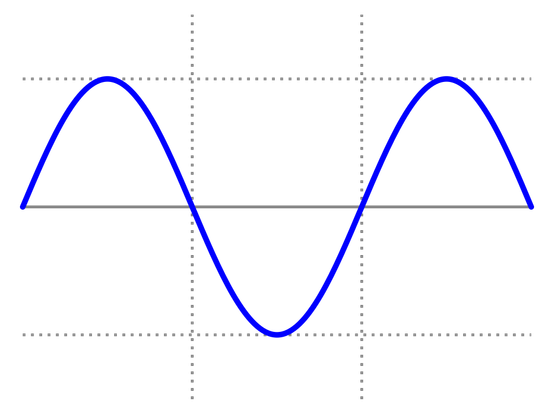
What if we want to graph the pressure changes in air made by somebody playing the flute? The graph might look a bit like this:

Figure 1: A sine wave by Omegatron CC BY 3.0 <https://creativecommons.org/licenses/by/3.0>, via Wikimedia Commons

The vertical axis is pressure and the horizontal axis is time. We can see the pressure increase, decease and increase again. The idealised wave form shown here is a sine wave. This wave has exactly one frequency in it and is the simplest possible wave form.

If you generate a sine wave in your DAW and then zoom way in, you’ll see exactly the same shape, but in that case, the Y axis is how much the speaker cone will offset when we play back the sound. This makes sense. The speaker needs to push the air to make the sound wave. If we were looking at an analogue signal to the speaker via an oscilloscope, the Y axis would be the amount of voltage.

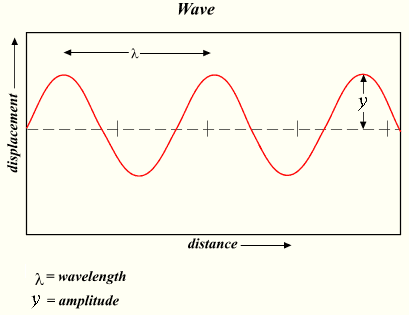
If the wave is taller, the speaker moves more air and the sound is louder. The height of the wave is the amplitude.

Figure 2: Wave, wavelength and amplitude CC BY 3.0 <https://creativecommons.org/licenses/by/3.0>, via Wikimedia Commons

The distance from one peak to another, λ, is the wavelength. If the wavelength is shorter, the speaker cone moves faster. A faster movement and a shorter wavelength means a higher frequency.

We’ve measured from the peaks, but we could measure from any point along the curve, for instance, from the zero crossings, as long as the wave has been through a complete cycle.

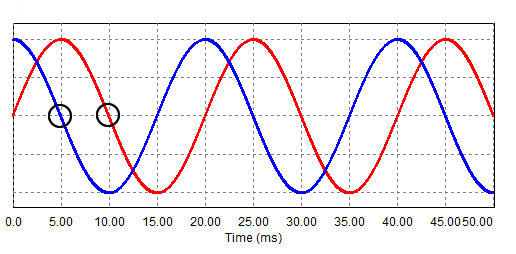
Figure 3: Phase by Baskurtf at Turkish Wikipedia., CC BY-SA 2.5 https://creativecommons.org/licenses/by-sa/2.5, via Wikimedia Commons

If waves start at different points but have the same wavelength, we say they are the same frequency but have different phases. In figure 3, the red line starts at zero and is a sine wave. The blue line starts at 1 and is a cosine wave. They both are the same frequency.

Figure 4: Sine and Cosine wave by Lucas Vieira, Public domain, via Wikimedia Commons

In figure 4, we can see an animation of the cosine and sine wave moving at the same frequency and how they are related to each other.

Summary

In the last three posts, we learned that sound is made up of tiny pressure waves which travel at 340 m/s. When these strike our ear drums, this in turn causes our basilar membrane to vibrate. Distinct vibrations on the membrane are heard as distinct frequencies.

We can graph the pressure waves of the sound. This is the same as the waveform graph in our DAW and is the same as the change in voltage of the signal going to our speakers. All signals going to our speakers have an amplitude, where taller is louder. Periodic sounds, like sine waves, also have a frequency, where a shorter wave length is a faster vibration and a higher pitch.

Waves can have the same frequency but be out of phase with each other, so their peaks and troughs do not line up.

Supplementary Reading

Everest, F.A. and Pohlmann, K.C. (2015). Master Handbook of Acoustics. Sixth edition. New York: McGraw-Hill Education. – Chapter 1

Activity

Materials

  • Audacity
  • Sonic Visualiser
  • A Microphone
  • An audio interface (or other way to get microphone input into your computer.)
  • A quiet corridor with a wall some meters distant
  • A tape measure
  • Optional: a room thermometer

Method

Place your microphone so it points at the wall. Start recording into Audacity. Stand behind the microphone. Clap. Stop recording.

Check your recording. You should have two impulses on the recording. One is the loud clap and the second is the echo of the clap. If these are too close together, move further from the wall.

Once you have a clean recording, export it as a WAV file and open it in Sonic Visualiser. Use the tape measure to measure how far you are from the wall.

Listen for when the first echo appears, and see if you can measure the distance in milliseconds using the display.

You might need to experiment a bit with the zoom controls, and possible other controls in Sonic Visualiser to make it clearer to see where the echo appears.

Also, it won’t necessarily be an exact point, so you may have to use your judgement.

Remember that the sound has to travel to the wall and back, so the total distance is double what you measured.

What was the speed of the sound. Is it what you expected? If you were able to measure the temperature, how much impact did that have on the speed?

https://www.celesteh.com/blog/2024/04/10/waves/

#lectureNotes #scienceOfSound