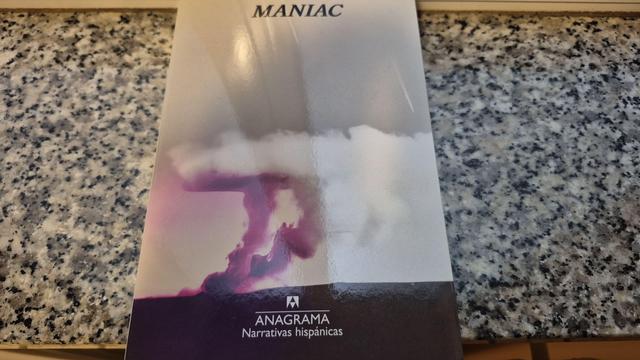
📖 #Maniac, muy buen libro de #Labatut. Las grandezas y desvaríos de grandes (de)mentes reflejadas en unas páginas que avanzan con una fluidez, sencillez, tan difícil de encontrar como beneficiosa para estas historias. 7/10.
#Literatura.

@the_roamer @TeaKayB

Although it refers to a book that is only partly about maths, you might be interested in a recent post of mine (in response to an article about Grothendieck - regarded by many as the greatest mathematician of recent times) - it is certainly a book you read for pleasure...

"Interesting article - https://www.theguardian.com/science/article/2024/aug/31/alexander-grothendieck-huawei-ai-artificial-intelligence - but I'm surprised it doesn't mention the story told by Benjamin Labatut, In his book 'When We Cease To Understand The World', about the Japanese mathematician Shinichi Mochizuki, who had worked on Grothendieck’s papers, and who in 2012 published online a 600 page mathematical proof nobody has yet been able to understand.

In 2014 Mochizuki went to Montpelier. He returned to Japan a changed man, left his post at the University of Kyoto, took down the proof and everything else he had published, just leaving the statement that in mathematics, some things must remain hidden 'for the good of all of us'.

Nobody knows what happened in Montpelier, but a nurse maintains that on his death bed in Montpelier hospital, Grothendieck’s only visitor was a Japanese man, who spent 5 days there. A few days later, a Japanese man was caught trying to set a fire outside the locked room in Montpelier University that contained the boxes of Grothendieck’s papers that he had left to the University - on the condition that they were never opened."

#mathematics #grothendieck #mochizuki #labatut

‘He was in mystic delirium’: was this hermit mathematician a forgotten genius whose ideas could transform AI – or a lonely madman?

In isolation, Alexander Grothendieck seemed to have lost touch with reality, but some say his metaphysical theories could contain wonders

The Guardian

Interesting article - https://www.theguardian.com/science/article/2024/aug/31/alexander-grothendieck-huawei-ai-artificial-intelligence - but I'm surprised it doesn't mention the story told by Benjamin Labatut, In his book 'When We Cease To Understand The World', about the Japanese mathematician Shinichi Mochizuki, who had worked on Grothendieck’s papers, and who in 2012 published online a 600 page mathematical proof nobody has yet been able to understand.

In 2014 Mochizuki went to Montpelier. He returned to Japan a changed man, left his post at the University of Kyoto, took down the proof and everything else he had published, just leaving the statement that in mathematics, some things must remain hidden 'for the good of all of us'.

Nobody knows what happened in Montpelier, but a nurse maintains that on his death bed in Montpelier hospital, Grothendieck’s only visitor was a Japanese man, who spent 5 days there. A few days later, a Japanese man was caught trying to set a fire outside the locked room in Montpelier University that contained the boxes of Grothendieck’s papers, that he had left to the University on the condition that they were never opened.
#mathematics #grothendieck #mochizuki #labatut

‘He was in mystic delirium’: was this hermit mathematician a forgotten genius whose ideas could transform AI – or a lonely madman?

In isolation, Alexander Grothendieck seemed to have lost touch with reality, but some say his metaphysical theories could contain wonders

The Guardian
Un oggetto quantistico non ha proprietà intrinseche. Un elettrone non si trova in nessun luogo fisso finché non lo si misura: appare soltanto in quell’istante.Prima della misurazione non possiede alcun attributo; prima dell’osservazione non lo si
può nemmeno pensare.Esiste in modo determinato solo quando viene rilevato da un determinato strumento. Tra una misurazione e l’altra non ha alcun senso chiedersi come si muove, cos’è o dove si trova. (#Labatut,Quando abbiamo smesso di capire il mondo)
Secondo Heisenberg, di nessun fenomeno subatomico si poteva più parlare con assoluta certezza. Dove prima c’era una causa per ogni effetto, adesso esisteva un ventaglio di probabilità. Nel sostrato più profondo delle cose, la fisica non aveva trovato una realtà solida e inequivocabile come quella a cui ambivano Schrödinger e Einstein, regolata da un dio razionale che muoveva i fili del mondo, ma un regno di stupore e stranezza (#Labatut, Quando abbiamo smesso di capire il mondo) #libri #letture
L'indeterminazione di Heisenberg mandava in frantumi la speranza di coloro che avevano creduto nell’universo a orologeria promesso dalla fisica di Newton. (#Labatut, Quando abbiamo smesso di capire il mondo) #libri #letture
.... era impossibile «vedere» un’entità quantistica per la semplice ragione che non aveva un’identità sola. Fare luce su una delle sue proprietà significava oscurarne un’altra. La migliore descrizione di un sistema quantistico non era un’immagine o una metafora, ma una serie di numeri. (#Labatut, Quando abbiamo smesso di capire il mondo) #letture #libri
E all’opposto era la stessa cosa! Se l’elettrone presentava una quantità di moto esatta, la sua posizione risultava talmente indeterminata da poter essere nel palmo della tua mano così come dall’altra parte dell’universo. Queste due variabili erano matematicamente complementari: se si fissava l’una, si dissolveva l’altra. (#Labatut, Quando abbiamo smesso di capire il mondo) #libri #letture
Le due prospettive erano mutualmente esclusive e antitetiche, ma complementari: né l’una né l’altra era un riflesso perfetto del mondo, ma solo un modello. Sommate, ci davano un’idea più completa della natura. (#Labatut, Quando abbiamo smesso di capire il mondo) #libri #letture
Ciò che Einstein detestava, però, non era l’ermetismo delle formule, ma qualcosa di molto più essenziale: il mondo che Heisenberg aveva scoperto contraddiceva il senso comune. La meccanica delle matrici non descriveva oggetti normali – ancorché incredibilmente piccoli –, ma un aspetto della realtà che le parole e i concetti della fisica classica non potevano nemmeno nominare (#Labatut, Quando abbiamo smesso di capire il mondo)