 Bernd von Mallinckrodt 🦋
Materie …
#Universum.
Neue Analysen des #KiloDegreeSurvey zeigen, dass die #MaterieImAll weniger stark gebündelt ist als vom Standardmodell der Kosmologie vorhergesagt, was auf mögliche Lücken im Verständnis #dunklerMaterie oder der #AllgemeinenRelativitätstheorie hindeutet.🖖
 In the Dark
The KiDS Legacy
What with all the cosmological goings-on of the past couple of weeks – see here, here and here – I quite forgot to mention another important set of results. These are from the final data release Kilo-Degree Survey known as KiDS for short and represent a final analysis of the complete dataset. For those of you not in the know, KiDs is a weak lensing shear tomography survey and its core science drivers are to map the large scale matter distribution in the Universe and constrain the equation of state of Dark Energy. The results can be found in three papers on arXiv, which you can add to your reading list:
- KiDS-Legacy: Redshift distributions and their calibration (Wright et al.)
- KiDS-Legacy: Cosmological constraints from cosmic shear with the complete Kilo-Degree Survey (Wright et al.)
- KiDS-Legacy: Consistency of cosmic shear measurements and joint cosmological constraints with external probes (Stölzner et al.)
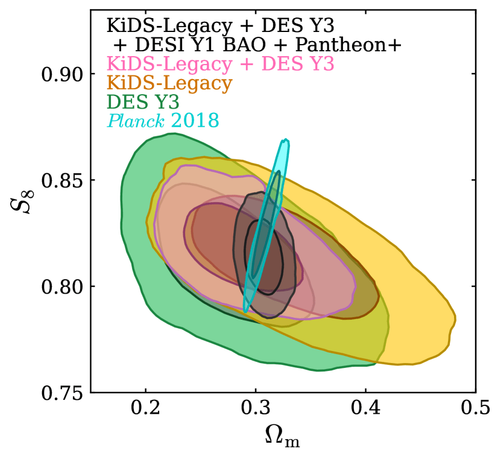
As far as I’m concerned, the main result to leap out from the cosmological analysis, which primarily constrains the clumpiness of matter in the universe, expressed by the density parameter Ωm and a fluctuation amplitude σ8 in the combined parameter “S8“, which is constrained almost independently from Ωm. The value obtained for this parameter by KiDS has previously been “in tension” with values from other experiments (notably Planck) ; see here for a discussion. The new results, however, seem consistent with the standard cosmological model. Here is a figure from the last paper in the above list that illustrates the point:
As is often the case, there’s also one of those nice Cosmology Talks videos that discusses this and other aspects of the KiDS Legacy results to which I refer you for more details!
https://www.youtube.com/watch?v=PIQKe-tW1xQ
#arXiv250319440 #arXiv250319441 #arXiv250319442 #DarEnergy #GravitationalLensing #KIDS #KiloDegreeSurvey #KilodegreeSurvey #weakGravitationalLensing

 RTN
RTN
 Kuuke's Sterrenbeelden
 readbeanicecream