 In the Dark
It’s a small world.
This year I am supervising an undergraduate project student who is looking at approximations to probability distribution functions. This project was inspired by a nice paper on the arXiv by Elena Sellentin, Andrew Jaffe and Alan Heavens about the use of the Edgeworth series which I blogged about here.
It turns out that the student who picked this project hails from a place very close to Edgeworthstown in County Longford. I’ve been through there on the train going to and from Sligo, but I never thought much about the possible connection, assuming the name was a coincidence. When I met my project student yesterday for our weekly discussion, however, he told me he had looked into it and the results are very interesting.
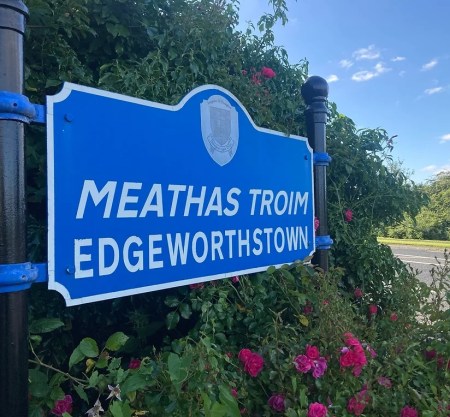
The Edgeworth series was invented by Francis Ysidro Edgeworth (1845-1926) who was a political economist and philosopher was born in Edgeworthstown. He was the grandson of the Richard Lovell Edgeworth (1744-1817) who had no fewer than 22 children (including the novelist Maria Edgeworth) and was a founder member of the Royal Irish Academy. In a manner not untypical of the Anglo-Irish landed gentry, the Edgeworths renamed the local town from Meathas Troim (anglicized form Mostrim), c.f. Parsonstown.
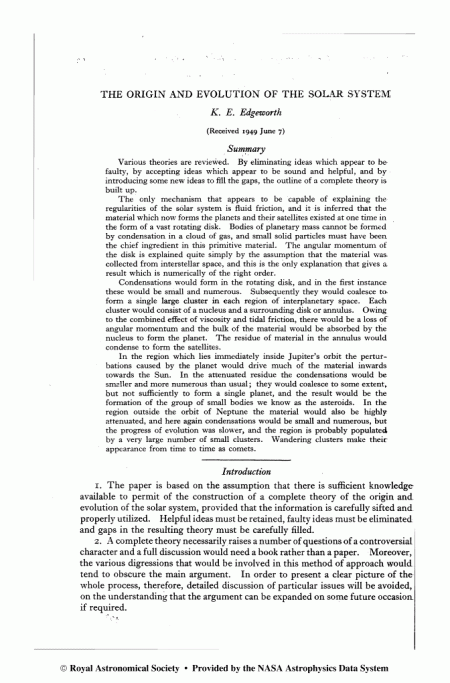
There is a directly astronomical connection with the Edgeworth family too. Kenneth Edgeworth (1880-1972) was another member of the Edgeworth dynasty, `one of ‘the archetypal gentleman literary and scientific families’ who had sufficient private income to be able to pursue a diverse range of interests. Kenneth Edgeworth was an independent theoretical astronomer, best known for proposing the existence of a disc of bodies beyond the orbit of Neptune in the 1930s. Observations later confirmed the existence of this structure, often called the Kuiper belt or, especially in Irish circles, the Edgeworth-Kuiper belt.
Here’s the front page of one of his astronomical publications:
Anyway, what’s the probability that a student would randomly pick a project involving a method invented a person born just a few miles away from his family home?
https://telescoper.blog/2024/10/25/edgeworth-connections/
#EdgeworthSeries #EdgeworthKuiperBelt #Edgeworthstown #FrancisYsidroEdgeworth #KennethEdgeworth #KuiperBelt

On the use of the Edgeworth expansion in cosmology I: how to foresee and evade its pitfalls
Non-linear gravitational collapse introduces non-Gaussian statistics into the matter fields of the late Universe. As the large-scale structure is the target of current and future observational campaigns, one would ideally like to have the full probability density function of these non-Gaussian fields. The only viable way we see to achieve this analytically, at least approximately and in the near future, is via the Edgeworth expansion. We hence rederive this expansion for Fourier modes of non-Gaussian fields and then continue by putting it into a wider statistical context than previously done. We show that in its original form, the Edgeworth expansion only works if the non-Gaussian signal is averaged away. This is counterproductive, since we target the parameter-dependent non-Gaussianities as a signal of interest. We hence alter the analysis at the decisive step and now provide a roadmap towards a controlled and unadulterated analysis of non-Gaussianities in structure formation (with the Edgeworth expansion). Our central result is that, although the Edgeworth expansion has pathological properties, these can be predicted and avoided in a careful manner. We also show that, despite the non-Gaussianity coupling all modes, the Edgeworth series may be applied to any desired subset of modes, since this is equivalent (to the level of the approximation) to marginalising over the exlcuded modes. In this first paper of a series, we restrict ourselves to the sampling properties of the Edgeworth expansion, i.e.~how faithfully it reproduces the distribution of non-Gaussian data. A follow-up paper will detail its Bayesian use, when parameters are to be inferred.