#JustOut 1st #openaccess paper from the PhD thesis of Abderrahim Bouhenache and from our new long-term experiment 👏!

Intra-seasonal #rainfall patterns and #extremes drive maize 🌽 #productivity and #nitrogen use in sub-humid Zimbabwe 🇿🇼

https://authors.elsevier.com/sd/article/S0378-4290(25)00391-0
#JustOut Check out our new #openaccess study led by Emily Pappo in collaboration with many colleagues

https://www.nature.com/articles/s43247-025-02574-w

#JustOut Enhancing “4 per 1000” initiative implementation through region-specific agricultural and forestry practices.
An #openaccess paper with colleagues from the Scientific and Technical Committee of the 4p1000 Initiative #soilcarbon
https://doi.org/10.1016/j.soilad.2025.100057

#JustOut A very nice first #openaccess paper of Illiana Kwenda, MPhil student at University of Zimbabwe 👏 !

Combining two years of on-farm experiments & modeling with the STICS soil-crop model, we showed that land productivity benefits of maize-cowpea #intercropping can be maintained in conditions of high water and nitrogen stress

https://doi.org/10.1016/j.fcr.2025.109890

#JustOut Modeling carbon sequestration in soils and biomass in heterogeneous #agroforestry systems? See our new study:

A novel approach to use the DayCent model for simulating agroforestry systems with multiple components

https://link.springer.com/article/10.1007/s10457-024-01127-y

A novel approach to use the DayCent model for simulating agroforestry systems with multiple components - Agroforestry Systems

Agroforestry can offer carbon sequestration, higher system productivity and biodiversity. However, a limited number of field experiments exist to study their feasibility and trade-offs for large scale deployment. Agroecosystem models could represent a valuable tool for their ex ante assessment. Here, we present ZonalCent, a novel approach to use the DayCent model to simulate multi-component agroforestry systems by splitting them into several independent zones, and simulating each zone individually. We used six agroforestry sites in France to evaluate how well ZonalCent represented carbon sequestration in tree biomass, soil organic carbon stocks and in the total system. This proved promising because with the default parameter set of DayCent, ZonalCent was highly suitable to represent tree carbon sequestration (Nash–Sutcliffe modelling efficiency; NSE of 0.86), and suitable for total system carbon sequestration potential (NSE of 0.55), despite a tendency to overestimate SOC stocks (NSE of 0.38). Only one site had yield data and there, ZonalCent approach could approximate the mean yield reduction—yet more detailed evaluation is necessary. Negative correlations showed that simulated yield was most strongly affected by (a) shading by mature trees and (b) the loss of arable area due to grass strips. While more detailed models may be needed for a detailed process understanding, ZonalCent includes the most important interactions (light, water, nutrients, temperature) in a simple but effective way and can be readily used—because it is based on DayCent—to estimate the potential carbon sequestration of agroforestry systems at larger scales.

SpringerLink

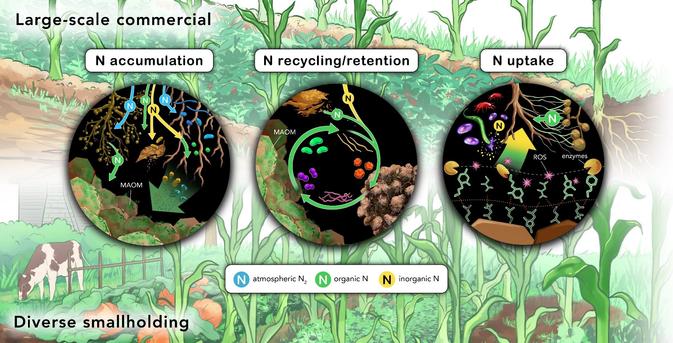
Santa Claus🎅 is early this year 🤩#justout paper published in One Earth and led by Stuart Grandy

"A microbial framework for nitrogen cycling solutions in agroecosystems"

Permanent link here:
https://doi.org/10.1016/j.oneear.2024.11.018

50 days' free access here:
https://authors.elsevier.com/c/1kIZ79C~Iu3~St

#JustOut Congrat Vira Leng for this 1st PhD #openaccess paper in the EGU SOIL journal 👏! A nice study on 13-year-old trials in 🇰🇭 with cassava, maize🌽or soybean #conservationagriculture #soilorganiccarbon #soilfractions #MAOM #POM

https://soil.copernicus.org/articles/10/699/2024/

Diachronic assessment of soil organic C and N dynamics under long-term no-till cropping systems in the tropical upland of Cambodia

Abstract. No-till (NT) cropping systems have been proposed as a strategy to combat soil degradation by storing soil organic carbon (SOC) and total nitrogen (TN). We quantified the impacts of NT cropping systems on the changes in SOC and TN stocks and in particulate and mineral-associated organic matter fractions (POM and MAOM), to 100 cm depth, from three 13-year-old experiments in a tropical red Oxisol in Cambodia using diachronic and equivalent soil mass approaches. Established in 2009 and arranged in a randomized complete-block design with triplicates, the experiments included maize (MaiEx)-, soybean (SoyEx)-, and cassava (CasEx)-based cropping systems. Each experiment comprised three treatments: (1) mono-cropping of main crops (maize, soybean, and cassava) under conventional tillage (CTM); (2) mono-cropping of main crops under NT systems with the use of cover crops (NTM); and (3) bi-annual rotation of main crops under NT systems with the use of cover crops (NTR), with both crops being presented every year and represented by NTR1 and NTR2. Soil samples were collected in 2021, 10 years after the last sampling. All the NT systems significantly (p<0.05) increased SOC stock in the topsoil in SoyEx and MaiEx and down to 40 cm in CasEx. Considering the whole profile (0–100 cm), the SOC accumulation rates ranged from 0.86 to 1.47 and from 0.70 to 1.07 Mg C ha−1 yr−1 in MaiEx and CasEx, respectively. Although SOC stock significantly increased in CTM at 0–20 cm in MaiEx and CasEx, it remained stable at 0–100 cm in all the experiments. At 0–5 cm, NTR systems significantly increased TN stock in all the experiments, while, in NTM systems, it was only significant in MaiEx and SoyEx. At 0–100 cm, TN stock in all the experiments remained stable under NTR systems, whereas a significant decrease was observed under NTM systems in SoyEx and CasEx. Although C-POM stock significantly increased under all NT systems limited to 0–10 cm in MaiEx and SoyEx, all the NT systems significantly increased C-MAOM stock in the 0–10 cm layer in MaiEx and SoyEx and down to 40 cm in CasEx. All the NT systems significantly increased N-POM stock at 0–10 cm in MaiEx and SoyEx, while a significant decreased in N-MAOM stock was observed below 5 cm in CasEx and below 40 cm in MaiEx and SoyEx. Our findings showed that long-term NT systems with crop species diversification accumulated SOC not only on the surface but also in the whole profile by increasing SOC in both the POM and MAOM, even in the cassava-based system. This study highlights the potential of NT systems for storing SOC over time but raises questions about soil N dynamics.

#JustOut #openaccess Towards a modular, multi-ecosystem monitoring, reporting and verification (MRV) framework for #soilorganiccarbon stock change assessment

https://www.tandfonline.com/doi/full/10.1080/17583004.2024.2410812

#JustOut Check out our Letter to the Editor in Global Change Biology ⬇️

Soil #N2O emissions during dry fallow periods

https://doi.org/10.1111/gcb.17403