 Richard Martin-Nielsen
I am reading and loving @adapalmer #InventingTheRenaissance and it is - within my mind - in (mostly gentle) discourse with #JoWalton’s #Lent and #GuyGavrielKay’s #ABrightnessLongAgo, both of which I read years ago, and which I now want to re-read. #bookstodon
 joep schuurkes
You know it's a good book when it has a footnote clarifying that someone was not the first pirate cardinal. #InventingTheRenaissance
 Christiaan Janssen
Just got a nice history book for reading this spring. First chapter already contains the quote:
"Machiavelli: WTF?!?!"
😄 it's going to be good.
 Jules
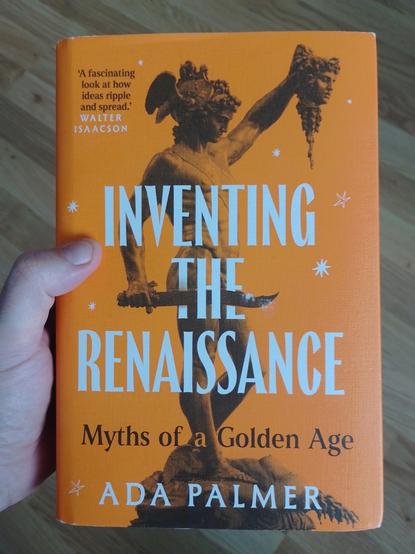
JulesSo, Ada Palmer's "Inventing the Renaissance". A very readable and funny, if dense, book for general audiences. It kind of sets out to answer two questions: "was the Renaissance a Golden Age™?" and "were the Renaissance Men™ thinking like we moderns do?". The answer is a resounding "it's complicated, but no", backed up by evidence that gives fascinating insights into how historians work.
(1/n)
We also see genuinely new things happening then, and Renaissance people being conscious of that, and actively trying to legitimize their power by claiming they were working towards a Golden Age. We see that the Renaissance was both similar to and different from the Middle Ages, and from our own times.
We see that and how it started things that led to modernity; to colonialism and nationalism, and to ideas of equality and freedom of religion.
(3/n)
By reviewing both events that happened during the Renaissance and their later reception, but mostly by following the interconnected lives of (mostly) famous people who lived through it, we get to see how to arrive at this conclusion.
We get to see the Renaissance as a mess of political chaos, war, and diseases; and Renaissance people being religious and spiritual hardliners.
(2/n)
Maybe there are no Golden Ages, but there are fruitful beginnings, and the book ends on that hopeful note: we can influence the course of history for the better.
(So, *did* a singularity happen then? Sort of yes! There was new information technology, and the world afterwards looks *very* different from the world before. But singularities are unevenly distributed if you live through them, so it may not have felt like it.)
(4/n, n=4)
Another thought: yes, the author acknowledges that she's writing about Italy because that's where we have the most sources, but - she centers some people we don't have much material on, too.
So why not include Jews and Muslims, their thoughts and perspectives? There must be *some* sources!
Still thinking about this "that the hero who shaped us must have been like us", apparently a common wish.
It's a thought only the maximally privileged could entertain, I think. Everyone else knows they wouldn't have been allowed to shape the world of ideas because of their gender, class, race; wouldn't have been able to because of their disability; and so on.
The past is not only a foreign country, but hostile territory for many of us.
"The printing press also spread exponentially, so—like anything exponential—growth was slow at first."
Exponential spread, both of tech and knowledge and a new information distribution network, you say?
I told you there a was a Renaissance singularity!!!