BENEDMO: buff.ly/NMteBNU BRODhub: buff.ly/HH1fmxQ CEDMO, CEDMO SK: cedmohub.eu DE FACTO_UE: buff.ly/BfeysCs EDMO Belux: buff.ly/qpmJ87F German-Austrian Digital Media Observatory (GADMO): gadmo.eu/en/ HDMO: www.hdmo.eu #Iberifier: iberifier.eu

(4/8) La muestra fueron un montón de desmentidos publicados por las principales agencias de verificación ibéricas, a saber:

🇪🇸 EFE Verifica, @malditaes, @Newtral y Verificat
🇵🇹 Poligrafo

Todas ellas son parte de #iberifier, proyecto en el que se enmarca nuestro trabajo

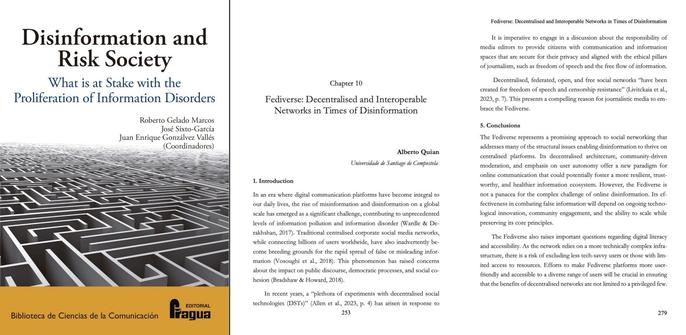
🚀 Fresh off the press! I’ve just received the printed edition of 'Disinformation and Risk Society. What is at Stake with the Proliferation of Information Disorders', a collective effort to dissect the complexities of today’s information landscape. And guess what? The Fediverse takes center stage in my contribution!

In my chapter, 'Fediverse: Decentralised and Interoperable Networks in Times of Disinformation', I explore how this decentralized, community-driven ecosystem is reshaping the digital public sphere. While centralized platforms struggle with disinformation and algorithmic manipulation, the Fediverse offers a radical alternative—one built on transparency, user autonomy, and federation protocols like ActivityPub.

🔍 Key topics I explore:

🔹 The roots and evolution of decentralized online social networks (DOSNs).
🔹 The Musk Effect—how Elon Musk’s Twitter takeover fueled a migration wave to Mastodon.
🔹 The promise (and challenges) of community-driven moderation.
🔹 How the Fediverse can empower ethical, independent journalism in an era of algorithmic chaos.

This book is part of the IBERIFIER project, funded by the European Commission, and brings together top researchers tackling disinformation from multiple angles.

A huge thanks to the editors and fellow contributors for making this project a reality!

🔗 Check it out here: https://lnkd.in/dbexg4-M

🎥 Note: The video I’m sharing was generated with AI.
#Book #Fediverse #Decentralization #Disinformation #IBERIFIER #DigitalMedia #Journalism #Media #Mastodon #SocialNetworks #EthicalTech #PublicSphere #MuskEffect #EuropeanCommission #DOSNs
LinkedIn

This link will take you to a page that’s not on LinkedIn

Enfrentamos la desinformación bulo a bulo... pero en esta batalla necesitamos explainers contra sus narrativas

🎓 Publicada en Revista Mediterránea nuestra última investigación, en el seno de #iberifier con Roberto Gelado, Santana Poch y Guillermo de la Calle

https://www.mediterranea-comunicacion.org/article/view/28237

Hoax hunters or disentanglers of disinforming narratives? Iberian fact-checking and the fight against disinformation

The recent proliferation of information disorders has drawn significant academic attention to the tools designed to counter their harmful effects, with fact-checking emerging as one of the key forms to fight disinformation. This article proposes an investigation that triangulates between quantitative and qualitative approaches to shed light on the verification activities carried out by Spanish and Portuguese fact-checkers integrated in the IBERIFIER hub (EFE Verifica, Maldita.es, Newtral, Poligrafo, and Verificat) –all of which abide by the IFCN standards. A series of in-depth exploratory interviews to representatives of the aforesaid fact-checking institutions were conducted at an initial stage with an aim to orient the subsequent statistical analysis of the database of verified stories published in 2022 and 2023 (N=3,697), put together by those fact-checkers following criteria and categories agreed upon by all of them. The quantitative approach was later complemented by a discourse analysis aimed at clarifying fact-checking trends and further discussing disinforming narratives in the Iberian context. The results of this investigation indicate that, while Iberian fact-checkers identify the need of transcending the debunking of individual stories through 'explainers', which aim at the overarching disinforming narratives rather than simply fact-checking specific hoaxes, their production in the last two years has focused on the latter rather than the former. As a possible way to improve that, we suggest not only an increased use of the ‘explainer’ category when debunking disinformation but also redefining such category to clarify its specific aim at the disarticulation of disinforming narratives.

Revista Mediterránea de Comunicación
'#Fediverse: Decentralised and Interoperable Networks in Times of #Disinformation' is my contribution to the #book 'Disinformation and Risk Society. What is at Stake with the Proliferation of Information Disorders', the latest outcome of the European project #IBERIFIER, funded by the European Commission and published by Fragua. Here, I’m sharing the book cover, the first page of my chapter, and the first page of my conclusions. If you would like a copy of my chapter, feel free to send me a message.

Publicada en Revista Latina de Comunicación Social la última investigación académica en la que he participado, esta vez junto a Santana Poch, Roberto Gelado y Guillermo de la Calle en el seno de #iberifier

https://doi.org/10.4185/rlcs-2025-2318

Fact-checking en procesos electorales y campaña permanente. Un análisis comparado entre España y Portugal

Introducción: La presente investigación propone estudiar el fact-checking desde una doble perspectiva comparada: de un lado, geográfica, con España y Portugal como marcos de análisis; y, del otro, temática, analizando patrones verificadores —y, por extensión, desinformadores— en periodos electorales y fuera de ellos. Metodología: Se propone, a tal efecto, un estudio que triangula entre el análisis estadístico y de discurso de una población de estudio compuesta por más de 2.500 verificaciones (N=2.635), y las cinco entrevistas en profundidad a verificadores de todas las agencias de fact-checking integradas en el hub IBERIFIER, que financia la Comisión Europea a través del European Digital Media Observatory (EDMO). Resultados: La política es el eje temático predominante en los contenidos verificados en España (el periodo electoral acentúa, además, esta tendencia), no así en Portugal. La tipología de desinformación verificada más frecuente es el contexto falso y tanto redes sociales (principalmente Facebook en Portugal y Twitter/X y Facebook en España) como plataformas de mensajería (WhatsApp) son los canales de donde más extraen los fact-checkers los contenidos verificados. Discusión: Se observan similitudes en los patrones discursivos (narrativas importadas, recurrencia de grupos como los inmigrantes o el colectivo LGTBI entre los sujetos pasivos de la desinformación). Conclusiones: Los procesos electorales incrementan la vulnerabilidad de los públicos a la desinformación y pueden, además, copar la actividad de las agencias de fact-checking hasta el punto de que éstas se queden sin recursos suficientes para dar cobertura a otras áreas sobre las que sí trabajarían en campaña permanente.

Revista Latina de Comunicación Social