 Grant_H
One more small feature, and some housekeeping, and I will have a "minimum viable product" of a higraph editor!
(This picture was directly copied and pasted from the tool - not a screenshot 🤓)
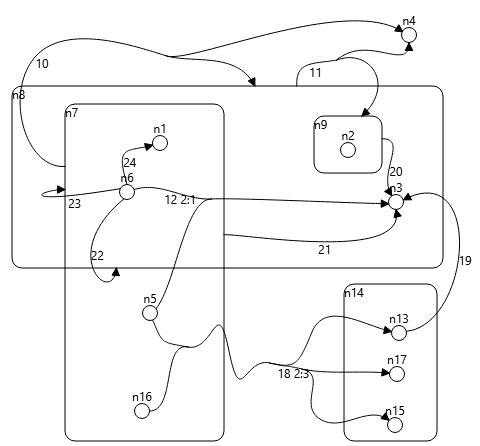
One more small feature, and some housekeeping, and I will have a "minimum viable product" of a higraph editor!
(This picture was directly copied and pasted from the tool - not a screenshot 🤓)
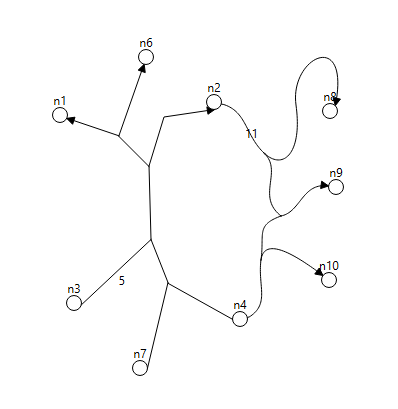
#Higraph update:
#Hyperedges can now be straight lines or hermite splines.
Heading towards "minimum viable product" quite quickly now!
#Higraph progress!
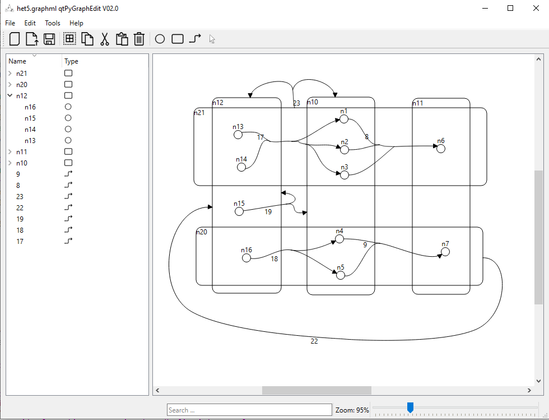
Still got lots to do, but hyperEdges can now be saved & loaded in modified #graphml files. The "model tree" on the left highlights items in the graph on the right.
I can see "minimum viable product"!
The #hyperedge structure is both graphically and algebraically accessible. I'm not aware of anything else that does this, pretty certainly not in #Python
#graphTheory #VisualFormalism
#Higraph update.
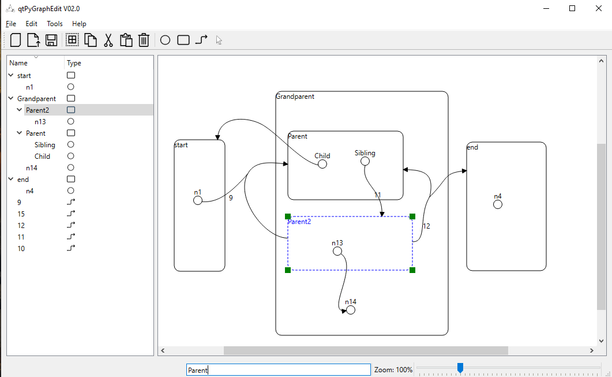
My wife has been squashing bugs and added an awesome hierarchical view of the blobs (sets).
#Hyperedges still need work, but this is getting tantalisingly close to a usable tool!
You asked, and here it is: #hyperedges are basically working. 1200 lines of code & changes in 2 weeks - about 50 odd hours of coding. This was not trivial, but hyperedges are a thing.
There are still some features to add (deletion, XML serialisation), and bugs to squash, but the hard work is done.
😁
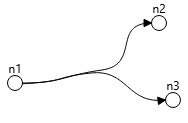
This image is of a simulation of a simple directed #hypergraph , but using an n-ary line rather than a set for the #hyperedge
I have written a working #graphTheory editor for binary edges, where nodes are extended to sets (a #Higraph) , and am contemplating the complexity of n-ary edges with increasing apprehension. It requires refactoring just about the entire edge drawing codebase - 100's of changes across ~2000 lines of #Python.
Is it worth it? Please comment/ vote in the poll below
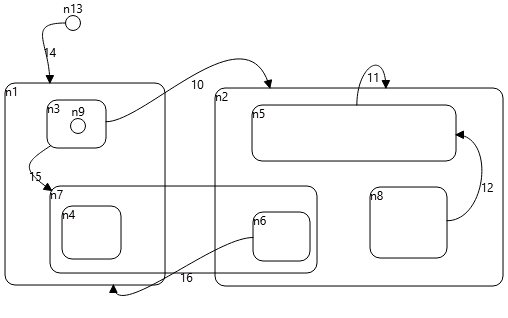
A #Higraph milestone: Blobs (nodes as sets) now work! Grab a 'parent' blob, and all the children move. Edges connect anywhere on the blob, and default to be orthogonal to the point of contact. graphML read and write working.
Now on to proper hyperedges!
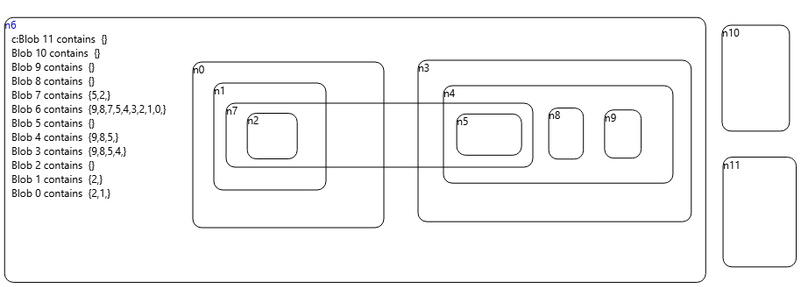
Hi #Mathstodon - a #GraphTheory question:
Given the following visual set containment, I can obtain the total containment of every item as a list (text on the left). This intuitively seems sufficient information to derive the containment graph (almost a tree - n7 breaks that).
Are there any 'standard' techniques to apply to this?
Boosts, partial ideas, discussion all welcome.
#Higraph
If I did everything right, I have a public alpha release of my graph (nodes and edges) editor
With source and windows binary !
(I hope)
It's a rolling chassis, to explore the design patterns for the ultimate goal of a #higraph editor.
https://github.com/ghillebrand/qtPyGraphEdit/tree/v0.0.0-alpha
