Oerknal Ensemble portrays Lewis Nielson, a ‘thinking man’s composer’

I must confess: when I opened the envelope containing the new CD Canto by the Oerknal ensemble, I was completely surprised. I had never heard of Lewis Nielson, to whose music the disc is dedicated.

That his name did not immediately ring a bell is not really surprising though, since Nielson moves somewhat outside of the regular modern music circuit. If you link his name to renowned ensembles such as Klangforum Wien, Musikfabrik or Asko|Schönberg, you only find him in the capacity as a teacher-of.

Conductor Gregory Charette also studied with Nielson, and now honours his teacher with a musical portrait. Significant detail: the album contains three compositions which have never been recorded before.

Yet the American has been around for a while. He was born in Washington D.C. in 1950. When he was nine years old, he moved with his parents to England, where he studied at the Royal College of Music.

Nielson continued his studies at the Universities of Massachusetts and Iowa, and was himself a teacher of music theory and composition at the University of Georgia and the Oberlin Conservatory of Music for many years; he retired in 2015.

THINKING PERSON’S COMPOSER

In the CD booklet, Nielson is called a ‘thinking person’s composer’, because in his music he tirelessly broaches topical and philosophical themes. In a polemical manifesto on his website, he rails at just about everything and everyone. He calls himself a ‘sociopath’, who ‘fights against the society that confines him or her’, and refuses to accept ‘the rules that govern society’.

However,  those who expect to get a dose of uncompromising protest music will be disappointed. The three compositions are very subtle and pleasing to the ear. The thirty minute long Cilice addresses the theme of penance and forgiveness. It combines texts from the Psalms with poems by such diverse poets as Baudelaire, Hölderlin, Celan and Dante. The title refers to the rough-haired robe that Catholics used to wear as a form of self-flagellation.

For the performance, Oerknal joins forces with the Damask Vocal Quartet, that presents a stunning range of flawlessly intoned dissonant harmonies. At other times, they employ a recitative that is reminiscent of Gregorian chant, then again declaim spoken texts, sing virtuoso melismas, or produce rhythmic percussive sounds, to an equally punctilious accompaniment from the musicians.

SINGING INSTRUMENTALISTS

The instrumentalists sometimes also sing. The combination of their untrained voices with the four professional singers of the Damask Vocal Quartet offers a varied palette of timbres, which remains captivating from beginning to end.

The other works on the disc, Crisis of Consciousness and You Choose are both based on verses by the El Salvadorian poet Roque Dalton, a communist activist who was executed by his own comrades.

In Crisis of Conscience, the instrumentalists recite the text in a folkish, husky voice; You Choose is more pointilistic and consists of a succession of short instrumental eruptions and ditto voices. Mysterious and oppressive, and excellently performed.

Oerknal and Gregory Charette can’t be praised enough for choosing to honour this underexposed composer. – Lewis Nielson, remember that name!

#DamaskVocalQuartet #GregoryCharette #LewisNielson #OerknalEnsemble
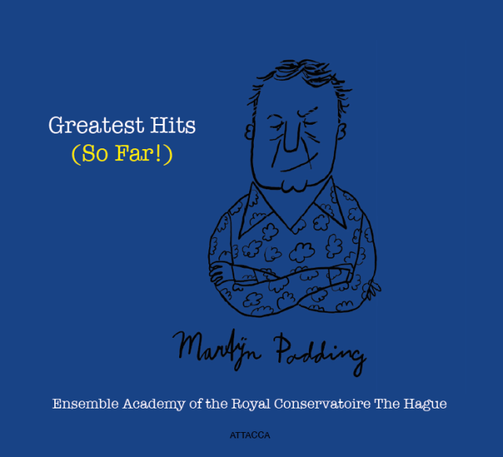
Composer Martijn Padding makes you smile

Greatest Hits (So Far!) perfectly captures the fresh, ironizing view with which composer Martijn Padding (Amsterdam, 1956) views the music world and himself. Deadpan he calls his album Greatest Hits, stretching the hyperbole even further by adding ‘so far’. In this way, he fabulously ridicules the toe-curling pomposity that so often clung to modern classical music in the past.

Padding studied with Louis Andriessen at the Royal Conservatoire in The Hague, where he later became head of the composition department himself. He recently retired and this album can be seen as a farewell gift in disguise. It was an idea of the director Henk van der Meulen, now also retired, to have top students of the institute record three of his solo concerts. The musicians, conductors and sound engineers were all but one trained there.

Padding enjoys writing solo concertos. After all, a dialogue between soloist and ensemble or orchestra in which one takes the other in tow or vice versa, offers ‘many opportunities to create a cunning trajectory, with or without obstacles and pitfalls’. The wayward composer cherishes the ‘underdog’ and has composed solo concertos for mandolin, harmonium and clavichord, among others. This once earned him the nickname ‘Head of pathetic Instruments’. Incidentally, the only unusual solo instrument on this album is a bass flute; concertos for cello and piano are legion.

Insipid samples draw longest straw

The CD opens with the cello concerto Last Words, which Padding composed in 2010 for cellist Doris Hochscheid and Asko|Schönberg. This title too is ironic: it does not refer to Christ’s seven last words on the cross, but to a keyboard that plays ‘insipid samples’ and yet ‘pulls the longest straw’ in the last movement.

This concerto is the only one to have the usual three movements. In ‘Preambulum’, the cellist plays rapidly ascending and descending runs against kitschy motifs from the ensemble, laced with crazy sounds from the keyboard and deliberately ‘false’ slides.

In the following ‘Aria’ the cellist interacts with individual woodwinds and strings and a hi-hat played by himself. The whole has a hesitant atmosphere, in which sparse pizzicati and short strokes are placed forlornly in space. In the final movement ‘Foforlalana’, the soloist posits lightning-fast runs through all registers against brisk staccato motifs from the ensemble and abrasive sounds from the keyboard. Cellist Diederik Smulders plays flawlessly, with an admirable sense of nuance.

Poetry translated into music

The one-movement concerto for bass flute and ensemble Slow Landscape (with thunder) version 2 was created in 2016, when Padding received the prestigious Dutch Johan Wagenaar Prize. He translated poetic phrases by bass flutist Felicia van den End (the only one who did not study in The Hague) into pitches and rhythms. Short motifs and exclamations from the bass flute gradually thread together to form a melodic argument. The ensemble quasi casually provides some punctuation and sometimes suggests a thunderstorm in the distance with a Balinese thunder drum. The music has a dreamy atmosphere.

The album concludes with the two-movement piano concerto Unequal Parts, in a revised version from 2016. ‘Fast’ starts with rapid, descending strings of notes from ensemble and pianist, from which a kind of hop-step-jump dance develops. An accordion briefly creates a repose with long notes in dialogue with the piano, after which piano and brass sprint noisily into the heights with virtuosic display and abrasive outbursts. The second movement. ‘Slow’, has a somewhat subdued atmosphere, the fabric is very transparent. Soloist Rutger Jansen plays wonderfully pointedly.

The three soloists are excellently accompanied by the Ensemble Academy of the Royal Conservatoire The Hague, conducted by Gregory Charette and Andreas Hanson (Unequal Parts); the recording technique is superb.

Greatest Hits (So Far!) paints a fine portrait of Martijn Padding. In passing, the album is a true flagship for the versatility of the Royal Conservatoire.

#AndreasHanson #DiederikSmulders #FeliciaVanDenEnd #GregoryCharette #LouisAndriessen #MartijnPadding #RutgerJansen