 Ongoing Now
 World History Encyclopedia
For the Greeks magic (mageia or goeteia) was a wide-ranging topic which involved spells and evil prayers (epoidai), curse tablets (katadesmoi), enhancing drugs and deadly poisons (pharmaka), amulets (periapta) and powerful love potions (philtra). https://www.worldhistory.org/article/926/magic-in-ancient-greece/ #History #GreekMedicine #GreekReligion #GreekScience
Found in 1901, Antikythera, world’s oldest analog computer, mapped eclipses with gears! #OngoingNow24 #SpaceDiscoveries #AncientTech #WorldsOldestAnalogComputer #GreekScience
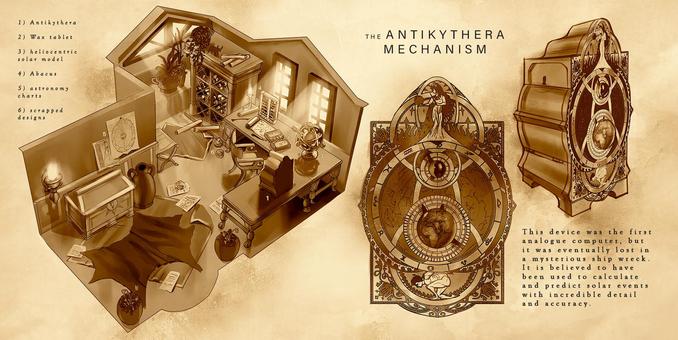

The Antikythera mechanism (also known as the Antikythera Device), dated to the late 2nd century/early 1st century BCE (roughly 205-60 BCE) is understood as the world's first analog computer, created to accurately calculate the position of the sun, moon, and planets. #History #GreekScience #GreekAstronomy #HistoryFacts https://www.worldhistory.org/Antikythera_Mechanism/

Greek mathematics, the study of numbers and their properties, patterns, structure, space, apparent change, and measurement, is said to have originated with Thales of Miletus (l. c. 585 BCE) but was clearly understood during the periods of the Minoan civilization (2000-1450 BCE) and the Mycenaean Civilization (c. 1700-1100 BCE) and was derived from older Mesopotamian and Egyptian mathematical sy... #History #Science #Pythagoras #GreekScience #HistoryFacts https://www.worldhistory.org/article/606/greek-mathematics/

The passage of time has always been a preoccupation of human beings, whether it be a question of satisfying basic needs such as when to eat and sleep, the importance of seasons for migratory and agricultural purposes or a more sophisticated measuring of time into defined periods of weeks, days and hours. https://www.worldhistory.org/Timekeeping/ #History #GreekScience #Technology #Timekeeping

The passage of time has always been a preoccupation of human beings, whether it be a question of satisfying basic needs such as when to eat and sleep, the importance of seasons for migratory and agricultural purposes or a more sophisticated measuring of time into defined periods of weeks, days and hours. https://www.worldhistory.org/Timekeeping/ #History #GreekScience #Technology #Timekeeping
The term “Athenian Calendar” (also called the “Attic Calendar”) has become somewhat of a misnomer, since Ancient Athenians never really used just one method to reckon the passage of time. https://www.worldhistory.org/article/833/the-athenian-calendar/ #History #Astronomy #Athens #GreekScience

For the Greeks magic (mageia or goeteia) was a wide-ranging topic which involved spells and evil prayers (epoidai), curse tablets (katadesmoi), enhancing drugs and deadly poisons (pharmaka), amulets (periapta) and powerful love potions (philtra). The modern separation of magic, superstition, religion, science, and astrology was not so clear in the ancient world. This mysterious, all-encompassin...https://www.worldhistory.org/article/926/magic-in-ancient-greece/ #GreekMedicine #GreekReligion #GreekScience
The Syracusia was an ancient sailing vessel designed by Archimedes in the 3rd century BCE. She was fabled as being one of the largest ships ever built in antiquity and as having a sumptuous decor of exotic woods and marble along with towers, statues, a gymnasium, a library, and even a temple.
https://www.worldhistory.org/Syracusia/ #Archimedes #GreekScience #Science
https://www.worldhistory.org/Syracusia/ #Archimedes #GreekScience #Science

The Tower of the Winds, also known as the Clock of Andronicus Cyrrhestes, is a timekeeping tower on the eastern side of the Roman agora of Athens. Built in the 2nd century BCE, it once had nine sundials and contained a large water clock. Recently cleaned and restored, visitors can now finally enter the tower as part of the visit to the agora.
https://www.worldhistory.org/article/1044/tower-of-the-winds/ #Athens #GreekArchitecture #GreekScience
https://www.worldhistory.org/article/1044/tower-of-the-winds/ #Athens #GreekArchitecture #GreekScience
