Contract Closeout In Small Business Federal Government Contracting

“SMALLTOFEDS” By Ken Larson

“Becoming informed on government contract closeout steps and putting in place processes to support them in your business system is the most important general principal to remember.

______________________________________________________________________________________________________

“If you are an off-the-shelf or purchased-finished supplier of goods to the federal government, your contact closeout is reasonably simple. You will make delivery at a firm, fixed price to the agency to which you have contracted and submit an invoice. The government will receive and inspect the delivery and approve your invoice for payment. Assuming there are no ongoing warranties, logistics support or similar contract line items involved, the government will then closeout the contract, as will you.

Contracts involving progress billing with retention, cost type contracts and those with intellectual property, government property, classified documents, provisional billing rates and similar more complex matters require astute attention to detail and considerably more administrative support and coordination between the contractor and the government for closeout. Successful contract closeout of these types of programs is an ongoing process beginning at contract award.

This article will discuss the principal features of the closeout process in small business federal government contracting and provide references for further process detail.

THE GOVERNMENT PERSPECTIVE

Below is a synopsis from the introduction to the Defense Contract Management Agency DCMA Manual 2501-07 Contract Closeout which is a free download from the  “References” File in the Box Net cube at the right margin of this site. The synopsis and the book should be read carefully by small business federal government contractors:

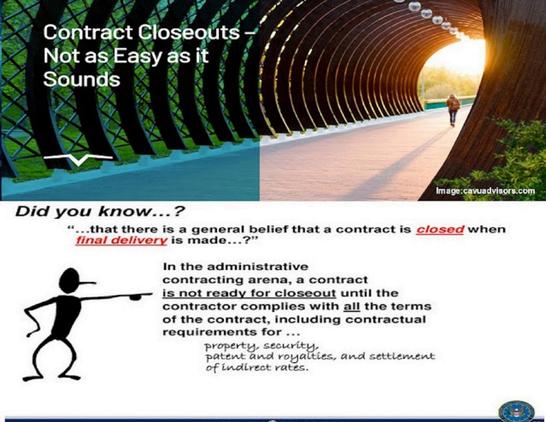
“Communication and information sharing is key to timely contract closeout. Contract Closeout occurs when all the terms of a contract/order have been met and all administrative actions are completed, all disputes settled, and final payment has been made. This includes those administrative actions that are contractually required; i.e. property, patents and royalties” 

TIPS TO INSURE SUCCESSFUL CONTRACT CLOSEOUT

  • Consider the type of contact under which you are operating and locate that type in the manual. Insure the processes specified are followed in your contract administration from the onset of your contact. Government contract types are discussed at the following link:  Contract Types

Note the manual discusses both the role of the government and the contractor in closeout and the stages in achieving closeout. 

  • Support Cost-Type Contracts With Timely Incurred Cost Proposal Rates and Submissions – Several articles at this site have addressed the development of forward pricing rates and associated DCAA audits and submissions. Here are the most important articles with respect to contract closeout:

Establishing FAR and CAS Compliant Business Systems

DCAA Audits And Small Business Job Cost Accounting Systems

Risk Analysis and Provisional Indirect Rates 

  • To close out a cost type contract that has been billed throughout its life at provisional rates, regular incurred cost submissions must be submitted by the contractor and verified by DCAA. Provisional rates must then be adjusted to audited applied actual costs and the final billing determined. This could result in net excess funding on the program that must be returned or a requirement for addition funding at closeout. In either case, the business impact could be substantial for a small enterprise.

Note the following Simplifying Techniques:

  • Verify payment accuracy and report discrepancies immediately.
  • Provide Contracting Officer with cost estimates of projected cost (usually 60 days in advance) in compliance with Limitation of Cost/Funds Clauses (FAR 52.232.20 through 21) for cost reimbursement and facilities contracts.
  • Submit patent reports on time to the Administrative Contracting Officer when required by the patent clause.
  • Submit Overhead Rate Proposals no later than 6 months after the end of the contractor’s fiscal year.
  • Prepare final voucher no later than 4 months after settlement of overhead rates.
  • Consider Quick Closeout procedure when it’s determined that normal closeout will be delayed.
  • Execute government property disposition instructions expediently.”

SUMMARY


Becoming informed on government contract closeout steps and putting in place processes to support them in your business system is the most important general principal to remember. Consider the type of contract you are releasing for incurred cost. Bear in mind how an individual contract impacts on your business system and insure your business system supports the type of contact you are putting into play. Develop a good working relationship with your contracting officers, DCMA and DCAA.  For more on the roles of these government functions, please see the following link:”

Federal Government Contracting Customer Relations

#ContractCloseout #governmentContracting #GovernmentContractors

Military Spouses Press Congress To Expand Small Business Opportunities

“FEDERAL NEWS NETWORK” By Anastasia Obis

Military spouses headed to Capitol Hill to advocate for the Military Spouse Small Business Recognition Act — a bill designed to expand access to capital and Small Business Administration resources for military spouse entrepreneurs — and to secure a commitment from lawmakers to sponsor the legislation.”

______________________________________________________________________________________________________

“More than 50 military spouse-owned businesses participated in the advocacy effort, meeting with lawmakers and congressional staff to push for legislation that seeks to designate military spouse-owned businesses as a disadvantaged category under the SBA’s 8(a) Business Development Program. 

The designation would reduce borrowing costs for military spouse entrepreneurs by waiving SBA loan guarantee fees for loans up to $1 million — fees that can add thousands of dollars to the cost of financing.

It would also reduce equity injection requirements by at least 5%. Currently, military spouses seeking to start or purchase a business are required to put down between 15% and 20% of the funding upfront.

“The 5% reduction might not sound like much, but it can be the difference between being able to afford and apply for that loan and not,” Stephanie Brown, CEO of the Military Spouse Chamber of Commerce, who is leading the effort, told a small group of reporters Thursday.

In addition, the designation would allow military spouse-owned businesses to compete for set-aside and sole-source federal contracts worth up to $4 million for goods and services, while providing greater access to mentorship, training and other business development resources. 

The legislation would also require the SBA to track and report data on military spouse participation in SBA loan programs. 

“Something our community is desperate for is more data. Right now, we don’t have that comprehensive data on how many military spouses are accessing SBA programs, whether they’re being approved or denied, and where those gaps are. This reporting requirement will allow us to measure progress and identify where additional support is needed,” Brown said.

The push comes as military spouse unemployment continues to significantly outpace the national average. Despite years of advocacy and policy efforts, the unemployment rate among military spouses has held steady at around 22% — or about five times the national average.  

Frequent relocations, deployments and the lack of affordable and reliable childcare continue to affect military spouse employment. As a result, entrepreneurship has increasingly become one of the more viable career paths for military spouses who often move every two to three years. Nearly half of military spouses — approximately 48% — are either self-employed, own small businesses or are interested in entrepreneurship. 

Patricia Barron, former deputy assistant secretary of defense for military community and family policy, said spouse unemployment remains a major factor driving service members out of the military, affecting retention and force readiness.

“If mama ain’t happy, nobody happy. When you are not happy, you make it known. And after a while, you sit down at that kitchen table and you start thinking about the future and whether or not you should leave the military or stay,” Barron said.

“It ultimately comes down to the fact that it’s hard out there to retain employment when you move 11 times in 18 years. It’s hard to reinvent yourself, and so many military spouses will then say, ‘Let me take control of this myself, and I will start my own business and control my path forward.’ It’s also very hard,” she added.

Michelle Penczak, CEO and founder of the virtual assistant company Squared Away, said she created her business after struggling to find employment as a military spouse. The company, launched in 2017, has since hired more than 1,600 military spouses into remote roles and generated more than $30 million in pay for military families without outside funding.

“Military spouses are not a risky investment. We’ve already proven the model works,” Penczak said. 

“We’re underutilized, and imagine what we can do at scale. The bill isn’t about recognition. It’s about access to capital, to resources, and ultimately to government contracts. If companies like Squared Away had access to government contracting opportunities, we could create so many more jobs for military spouses,” she added.

Brown said two members of Congress are currently reviewing the bill.

“It’s being reviewed by the folks that we can’t share at this time, but that we assume are going to be co-sponsoring, and then we’ll take another look at it based on their feedback,” Eliza Levy, founder and CEO of ELPR, said. 

Brown acknowledged the legislation could face scrutiny over both its cost and why military spouses should receive a separate designation instead of qualifying through existing categories such as women-owned small businesses. 

“We’re ready for any objection, and hopefully it will be a bipartisan effort, and everybody will recognize that it’s deserving and it will be a big game changer,” Brown said.

It is unclear what legislative strategy potential backers of the bill would pursue — standalone bills often face political hurdles, and lawmakers frequently try to attach such proposals to larger legislative packages like the annual National Defense Authorization Act to increase their chances. Brown said using the NDAA would be the goal if “that’s determined to be the best vehicle to move this forward.”

If you would like to contact this reporter about recent changes in the federal government, please email [email protected] or reach out on Signal at (301) 830-2747.

#governmentContracting #GovernmentContractors #MilitarySpouseOwnedBusiness

800 VIOLATIONS & 1,000 OPEN VULNERABILITIES found at DOD cleared contractor facilities in 2025 - contractors fail to comply with the National Industrial Security Program Operating Manual.
https://rosecoveredglasses.wordpress.com/2026/05/15/800-security-violations-and-1000-open-vulnerabilities-found-by-dcsa-at-dod-cleared-contractor-facilities-in-2025/
#GovernmentContractors #SecurityViolations

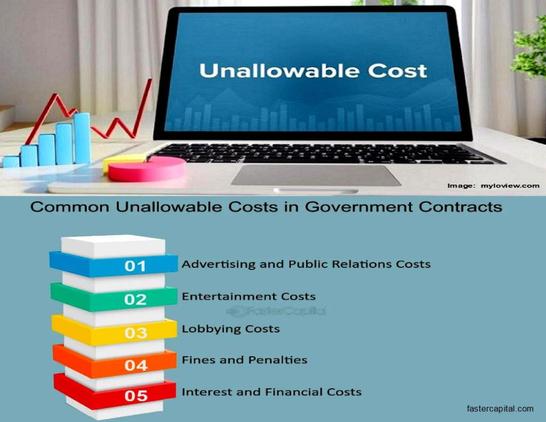
Unallowable Costs Under Federal Government Contracts

“SMALLTOFEDS” By Ken Larson

Certain costs cannot be allowed in prices, cost reimbursements or settlements under contracts with the US Government.

The government is unwilling to pay for these costs as direct charges to federal government contracts or through indirect expense pools applied to federal government contracts.”

_______________________________________________________________________________________________________

“A company is not prohibited from incurring unallowable costs, but they cannot be recovered either directly or indirectly under federal government contracts. 

 UNALLOWABLE COST CATEGORIES:

The following cost categories are generally unallowable under federal government contracts:

A. Advertising Costs are allowable only if they are necessary to meet the requirements of the contract performance.

B. Public Relations Costs are unallowable except for (1) costs specifically required by government contracts, (2) cost of communicating with the public and press pertaining to specific accomplishments which result from government contracts or (3) costs of conducting communication and liaison necessary to keep the public informed on matters of public concern such as notices of awards, financial matters, etc.

C. Alcoholic Beverage Costs are unallowable.

D. Bad Debt Costs are unallowable.

E. Automobile Costs for Personal Use are unallowable.

F. Defense and Prosecution of Criminal and Civil Proceedings, Claims Appeals and Patent Infringement are generally unallowable.

G. Donations and Contributions are unallowable.

H. Entertainment Costs are unallowable.

I. Executive Lobbying Costs Incurred in Attempting to Improperly Influence either Directly or Indirectly an Employee or Officer of the Federal Government Regarding a Contract are unallowable.

J. Fines and Penalties resulting from failure of the company to comply with federal, state, local or foreign laws and regulations are unallowable.

K. Goods and Services Cost for Personal Use are unallowable.

L. Personal Housing and Living Expenses are unallowable. (Not to be confused with direct travel costs which are allowable)

M. Insurance Costs to Protect Against Defects in Materials or Workmanship are unallowable.

N. Interest and Investment Management Costs are unallowable except for cost related to the physical custody and control of monies and securities and for interest cost paid to external parties for assets (buildings and equipment) used to support government contracts.

O. Losses on Government or Other Contracts are unallowable.

P. Membership Costs in Civic, Community Organizations, Country Clubs or Social or Dining Clubs are unallowable.

Q. Pre-Contract Costs, unless approved by the Contracting Agency are unallowable.

R. Airfare Travel Costs in Excess of the Lowest Available Commercial Discount or Standard Coach Airfare are unallowable.

Please see the following link for further details:

2 CFR Part 200 Excerpts: Unallowable Costs

To manage unallowable costs, separate accounts must be established for these type expenses and they must not be priced directly into federal government contracts during the proposal process. 

Such costs cannot be made a part of the expense pools which are applied to federal government contracts through an overhead, material handling or G&A cost allocation at accounting period close or during forward pricing rate planning.”

Managing Unallowable Costs Under Federal Government Contracts

#governmentContracting #GovernmentContractors #UnallowableCost

Contractor Convicted for Destroying Dozens of Federal Databases

A contractor's reckless actions led to the destruction of dozens of federal databases, showcasing a staggering disregard for the security and integrity of sensitive government information. After being terminated on February 18, 2025, the contractor and his twin brother intentionally caused chaos by accessing…

https://osintsights.com/contractor-convicted-for-destroying-dozens-of-federal-databases?utm_source=mastodon&utm_medium=social

#DataDestruction #FederalDatabases #InsiderThreat #GovernmentContractors #EmergingThreats

Contractor Convicted for Destroying Dozens of Federal Databases

Contractor convicted of destroying federal databases, learn how this breach occurred and take steps to protect your organization's data security now.

OSINTSights

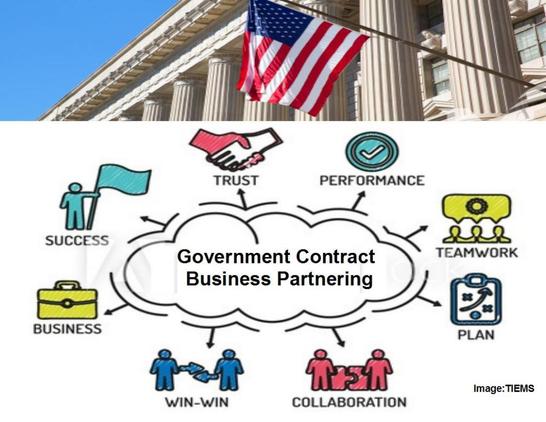
How Business Partnering Can Help You Become A Government Contractor

“FEDERAL TIMES” By Melissa Rayworth

“For entrepreneurs, it’s part of the central mythology: You launch your own business because you want to be your own boss. To thrive as a business owner, it helps to have an independent streak and be comfortable going it alone.

But when small and mid-sized companies begin pursuing government contracts, it can help — immensely — if they strategically collaborate with other businesses.”

_____________________________________________________________________________________________________

“There are several ways to make this happen:

  • Getting work as a subcontractor is one good possibility.
  • You can also seek mentoring from more experienced companies already working with the government and use that knowledge as you pursue your first contract.
  • Some companies break into the industry through a true partnership, pairing up with another applicant to submit a joint bid.

“One new entrant might complement a gap or a void that another existing business may have, and together they have a better opportunity moving forward,” says Antonio Doss, deputy associate administrator for government contracting and business development at the Small Business Administration.

What kind of matches can work?

If you’re considering working as a subcontractor, ask yourself: How might your product or service be used by a larger company to help fulfill a contract they’ve won or they’re pursuing?

Building a relationship with a prime contractor “can be a great place to start and learn,” says Lauren Weiner, co-founder of WWC Global. She has worked as a government contractor since 2006.

One key to landing a contract: really understanding the needs of a particular government department or agency, Weiner says. While working as a subcontractor, you can learn about a particular sector and really come to understand those needs – while getting paid.

Going in on a joint bid with another company can give you the same advantage. If you’re partnering with someone who has a bit of experience, it can help speed up your learning curve.

But whether you’re seeking to be an equal partner on a contract or looking to be a subcontractor, the key is building relationships.

Where does a company find potential partners?

Your local SBA office may be able to help you connect with potential partners or folks who would need you as a subcontractor.

SBA district offices do their own training and also do training in partnership with local chambers of commerce and economic development organizations “to help demystify the whole government contracting space,” says Antonio Doss, deputy associate administrator for government contracting and business development.

These training events can be opportunities for networking with other entrepreneurs who are curious about government contracting or already pursuing contracts.

The current administration is making it a priority to increase the number of American small businesses working as government contractors, Doss says, and supporting business owners in networking with others is part of their plan. “Not only can you be a part of that space,” Doss says, but “as a newer entrant into the environment, you can learn from the other people.”

Seek mentors, even among competitors

The SBA points businesses to mentorship through organizations like score.org. But Doss also recommends reaching out directly to companies that are more experienced and thriving in the government space.

You might be surprised how many people – even competitors – are willing to share their knowledge about breaking into contracting within a specific industry.

“Those persons are often a season or two or three further down the path of where you are right now,” Doss says. “Often they’re willing to share with you, because sometimes they’re also realizing that you might be a good teaming partner at some point.”

One way to avoid stepping on toes as you seek advice: Since companies usually choose a particular government agency to do business with, you might learn from a competitor and then target a different area of the government.

As you pursue subcontracting jobs, partnerships and mentorship, Weiner says, keep this in mind: There are as many ways of earning a government contract as there are businesses that do it.

“So don’t get discouraged if another business owner says, ‘it was impossible,’” she says. “It may not be impossible for you, given what you offer.”

How Business Partnering Can Help You Become A Government Contractor

For More on Federal Government Contact Teaming please see:

Small Business Teaming In Federal Government Contracting

#governmentContracting #GovernmentContractors #Teaming #TeamingAgreements

A Critical Channel For Establishing Credibility And Capturing Market Share

“In this new era, where federal agencies are seeing a massive shift in decision-makers, it’s more critical than ever for executives—CEOs, COOs, VPs, and others in the C-suite—to lead by example and establish a powerful presence on LinkedIn.”

____________________________________________________________________________________________________________

“LinkedIn is the lynchpin for engaging with the GovCon market. It’s where new influencers and decision-makers vet companies, assess areas of expertise, and gauge a leader’s commitment to the industry. As the most influential social platform for this sector, an executive’s active presence isn’t just about visibility; it’s a strategic asset for building trust and re-establishing your brand’s position.

So, what does it take to create a high-impact executive presence on LinkedIn? Here are the key tactics and content strategies that drive real results.

1. Humanize Your Brand Through Storytelling

Your LinkedIn profile is more than a digital resume; it’s a narrative of your professional journey and your company’s mission. B2B buyers and potential employees are more likely to trust a company with a human face. Use your posts to tell stories that are relatable and authentic.

  • Behind-the-Scenes Moments: Share glimpses of your team at work, a new project kickoff, or a company event. This builds a sense of connection and makes your organization feel more accessible.
  • Leadership Lessons: Go beyond the typical corporate announcement. Share a key lesson you’ve learned from a challenge, a mentor, or a success. This demonstrates vulnerability and expertise, resonating more deeply with your audience.

2. Position Yourself as a Thought Leader

The GovCon market values expertise and competence. Your content should be a constant stream of valuable insights, proving that you are a reliable source of information.

  • Industry Insights: Post your analysis on new federal regulations, emerging technology trends, or significant contract awards. This positions you as an expert who is actively shaping the industry conversation.
  • Client or Team Spotlights: Highlight a successful project or celebrate the accomplishments of your employees. This not only validates your team’s expertise but also showcases your company’s culture and commitment to its people.

3. Drive Engagement, Don’t Just Broadcast

The most effective executives on LinkedIn don’t just post content—they actively engage with their network. This two-way communication builds genuine relationships and extends your reach.

  • Thought-Provoking Questions: End your posts with a question that encourages discussion. This prompts comments and boosts your post’s visibility to a wider network.
  • Active Commenting: Engage thoughtfully on the posts of other leaders, federal decision-makers, and industry partners. Leave comments that add value, rather than generic phrases like “Great post!”

4. Leverage Content for Trust and Business Growth

The numbers don’t lie. An active executive presence directly influences purchasing decisions and talent attraction. Your LinkedIn activity should be a continuous feedback loop that reinforces your credibility.

  • Build Trust: An impressive 78% of business decision-makers are more likely to trust companies whose leadership has an authentic social media presence.
  • Influence Buyers: 64% of buyers use thought leadership content from executives to assess a company’s capabilities.
  • Attract and Retain Talent: 78% of job candidates will research a CEO’s online presence, and companies with socially engaged executives report 40% higher employee retention.

In a market defined by turnover, the power of an executive’s LinkedIn presence is undeniable. By consistently sharing strategic content and actively engaging with the community, GovCon leaders can build a professional brand that enhances their company’s reputation, attracts top talent, and drives business results. Don’t miss this critical opportunity to make your voice heard where it matters most.”

The new rules of GovCon leadership: Why your LinkedIn presence matters more than ever

ABOUT THE AUTHOR:

Mark Amtower advises government contractors on all facets of business-to-government (B2G) marketing and leveraging LinkedIn. Find Mark on LinkedIn at http://www.linkedin.com/in/markamtower.”

#Business #contentMarketing #DigitalMarketing #governmentContracting #GovernmentContractors #LinkedIn #Marketing #socialMedia

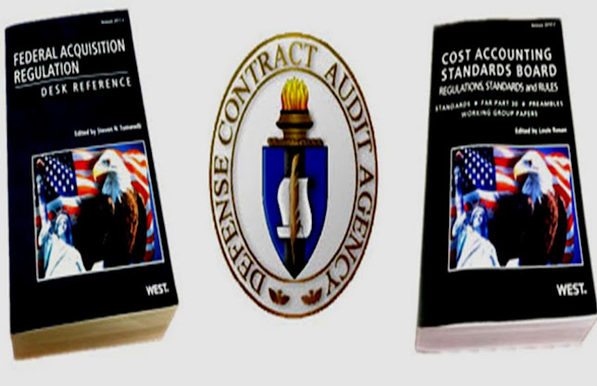
What Small Business Should Know About FAR and CAS

“SMALLTOFEDS” BY Ken Larson

“Federal Acquisition Regulation (FAR) and Cost Accounting Standards (CAS) – Rules of the Game and Developing Your Game Plan”

_____________________________________________________________________________________________________

“Small businesses consistently encounter FAR and CAS requirements upon entering or growing into federal government contracting.   The purpose of these standards is to supply uniform regulatory guidance to all companies doing business with the government and to the agencies that buy from them.

“This article will discuss a basic understanding of FAR and CAS as well as the methods to design approaches to meeting them.

OVERVIEW

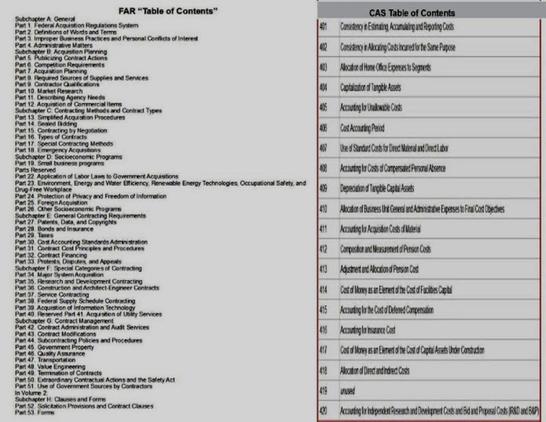
The below table contains the principle FAR chapter titles and each of the 19 CAS clause titles (CAS 419 was never written).  Linked below the table are the web sites that can be utilized to explore these documents.

 (Please Click Image To Enlarge)  

Federal Acquisition Regulation

Determine the regulation basics that apply to any given job considered for bidding.  Examine a few solicitations in your area of expertise at the SAM web site:

SAM Contract Opportunities

Glance through the terms and conditions of a given solicitation and note the FAR and CAS requirements sited.  Use the links to the FAR and CAS web sites as source documents to read in detail the clauses you must understand to effectively bid the job .  

Cost Accounting Standards

Small businesses are generally required to meet modified CAS coverage.  The business system requirements for Modified Cost Accounting Standards (CAS) Coverage are defined by the government as follows: 

Standard 9904.401, Consistency in Estimating, Accumulating, and Reporting Costs

Standard 9904.402, Consistency in Allocating Costs Incurred for the Same Purpose

Standard 9904.405, Accounting for Unallowable Costs

Unallowable Cost Guidance

Standard 9904.406, Cost Accounting Standard―Cost Accounting Period

Modified, rather, than full, CAS coverage may be applied to a covered contract of less than $50 million awarded to a business unit that received less than $50 million in net CAS-covered awards in the immediately preceding cost accounting period.

The following article contains practical business system guidance regarding building a Modified CAS Coverage Small Business System for federal government contracting:

Managing Risk In Small Business Federal Government Contracting Business System Development

If you have confusion regarding interpreting a requirement, seek assistance in the table of contents to the free book at this site offering guidance under the topic in question

SUMMARY

While assessing the impact of FAR and CAS on your company educate yourself on that what directly affects your company first in making the transition to federal government contracting and growing into the field.

Carefully  maximize your existing business processes and systems first before making changes and do not jump to instant fixes with exotic software tools a supplier or consultant has told you will make you compliant or competitive overnight in government contracting. 

FAR and CAS are generally logical bodies of regulation that have come about due to the need to control and make consistent the government and industry approaches to meeting prudent and sound contracting objectives with the necessary  transparency to govern. 

FAR and CAS do not impose business systems.  They do require that you disclose the way you meet regulatory requirements in the way you operate with your processes and tools. Plan the approach and learn to convey it to auditors, contracting officers and industry partners.

Grow into the business by exploring the venue and having it grow into you.”  

What Small Business Should Know About FAR and CAS

#CAS #FAR #governmentContracting #GovernmentContractors

Tips For Small Business In Teaming With Prime Contractors

“WASHINGTON TECHNOLOGY” – By Mike Lisagor

Adapted from the book: How to Win in the Government Market (co-authored with Mark Amtower)

There are plenty of pitfalls and possible mistakes when you form partnerships.There is no such thing as a risk-free proposition as a subcontractor. But here are eleven guidelines that can increase your chances of picking the winning prime contractor.

_______________________________________________________________________________________________

  • While established relationships often influence teaming decisions, business associates can be re-assigned or leave their company. Having a definitive teaming agreement is one of the few ways you can mitigate this risk.
  • Your company’s technical role and work percentage should be clearly defined in a written teaming agreement (usually Attachment A). Avoid terms like “best efforts” or “goals.” These rarely pan out. On IDIQ and GWAC bids where work content is guaranteed, get an agreement on which technical areas you will lead…something like “all the work in our core competency.”
  • It is a good practice to request a Dun & Bradstreet credit report on a potential small business prime contractor to assess whether they will be deemed financially credible in the eyes of the client. I’ve seen the government throw out bids because the small business prime couldn’t pay their bills. This was incredibly frustrating for subs.
  • Ask the client what they think of potential teammates – the worst that can happen is they’ll decline to comment.
  • Most acquisitions require either the prime contractor or the entire team to provide a certain number of project citations. Confirm that the prime has the necessary past performance and relevant projects to cite in the proposal.
  • Look for a prime that has subject matter experts who meet the key personnel requirements. Negotiate having some of these be from your company.
  • Many government acquisition re-competes assume the winning team will hire some or all the incumbent contractor’s staff. This will need to be considered as part of your teaming and win strategy.
  • Make sure the potential prime contractor has the resources and ability to develop a professional winning proposal. Find out up front how much effort you will be expected to expend.
  • Discuss pricing strategy up front so you know whether the rates you will have to bid will fit within your company’s pricing model. This means you need to know whether the target agency has a history of best value or lowest price ‘barely’ technically capable awards. And the prime’s ability to be competitive.
  • Avoid companies that have a reputation for treating their subcontractors unfairly especially when negotiating a subcontract after the award and sharing the resulting work. Query your industry partners for their experience teaming with the prime. And, just as you should when hiring someone, trust your instincts. It won’t get better after the award.
  • One final suggestion — use a decision matrix to evaluate the teaming landscape for each specific new business opportunity. This will take some of the emotion out of the selection process. First, develop the important win strategy criteria (column 1). These should be based on both stated and perceived procurement needs as a result of client discussions and reading procurement documentation. Next assess your own company’s ability to meet these criteria and any gaps you can’t fill (column 2). Then, evaluate each candidate prime against the same criteria using colors; high, medium, low; or a numerical score to determine the best fit (one column for each company).
  • And, above all, avoid teaming just because it’s someone you already know…team to win!

    Tips On Teaming With Prime Contractors

    ABOUT THE AUTHOR:

    Mike Lisagor

    A (usually) retired writer, gov’t contractor BD & PM expert, and blues musician, Mike Lisagor is the founder of Celerity Works and a co-founder of GovFlex.com. His books include the just released, How to Win in the Government Market (with Mark Amtower), The Essential Guide to Managing a Government Project, and How to Develop a Winning SBIR Proposal (with Eric Adolphe). He can be reached at LinkedIn.com/in/mikelisagor and [email protected]

    #books #governmentContractTeaming #governmentContracting #GovernmentContractors #news #Teaming #technology

    Small Business Research Programs Prove Their Worth

    “NATIONAL DEFENSE MAGAZINE” By  Michael Seeds

    “Congressional small business leaders came to an agreement in March with the passage of S.3971, the “Small Business Innovation and Economic Security Act.” The bill reauthorizes the two programs through Sept. 30, 2031, and includes several proposals to build on previous reauthorizations.”

    ___________________________________________________________________________________________________

    “When the federal government shut down on Oct. 1, contractors across the U.S. defense industrial base were facing severe challenges. However, many small businesses were also facing a second headwind as the authorization lapsed on the same day for the Small Business Innovation Research and Small Business Technology Transfer programs.

    In February, defense programs received funding for the rest of the fiscal year, but small businesses and their government partners were still facing a “small business shutdown,” since the two programs were still not authorized. However, congressional small business leaders were able to come to an agreement in March with the passage of S.3971, the “Small Business Innovation and Economic Security Act.”

    The bill reauthorizes the two programs through Sept. 30, 2031, and includes several proposals to build on previous reauthorizations.

    This includes creating a clear, consistent baseline for the foreign ties due diligence programs with minimum standards for denial and establishing a process to communicate the reason for a foreign risk denial to small businesses.

    The legislation establishes the new Phase II Strategic Breakthrough Awards process, which allows agencies with the largest SBIR programs to utilize existing funds to award sequential Phase II awards of up to $30 million with required matching funds from private capital or non-SBIR government contracts.

    The agreement also implements Phase III improvements that align with the National Defense Industrial Association’s recommendations in “Vital Signs 2025,” the annual snapshot of the health of the U.S. defense industrial base.

    This includes establishing training activities to ensure federal agency acquisition and contracting officers are fully aware of the processes and intent of awarding follow-on contracts for SBIR awarded technologies. The bill also instructs agencies to develop simplified and standardized procedures and model contracts for Phase III awards that mirror previous protections for agencies to establish standardized data rights frameworks for its awardees.

    Overall, the two programs are effective tools for bringing cost-effective and valuable innovations to the Defense Department and, ultimately, to warfighters. They are also essential programs in attracting and retaining small business innovators in the defense ecosystem.

    Both the programs have three phases. Phase I funds feasibility-related research and development corresponding to the participating federal departments’ and agencies’ requirements.

    Phase II supports additional research-and-development efforts initiated under Phase I, with a focus on prototyping specific program requirements and exhibiting potential for commercial application.

    Finally, Phase III focuses on the commercialization of the results of Phase I and Phase II grants. It is important to note that neither program provides funding under Phase III, and that not every Phase II results in a prototype that is ready for Phase III commercialization.

    The two programs have a proven track record as a pipeline for ingenuity and advancements in the defense sector. Their goals are to encourage competitive small businesses to work in coordination with the federal government on agency research-and-development needs, and to expand private sector commercialization of the innovations stemming from this research.

    By supporting small business competition for these contracts, the programs inspire technical innovation and inject an important sense of entrepreneurship into the defense enterprise. Speeding innovations and advanced capabilities to our warfighters is critical to the department’s efforts to outpace the People’s Republic of China and other potential competitors in this era of great power competition. The two programs have also had a significant impact on the U.S. economy.

    According to the Small Business Administration, through fiscal year 2019, the SBIR program has provided over 179,000 awards totaling over $54.3 billion to small businesses.

    According to the Pentagon’s latest economic impact report released in 2019, the two programs have generated a 22:1 return on investment within the Defense Department. They have also had a significant economic impact with the creation or sustainment of 1,508,295 jobs, a total labor income of $111 billion and over $39 billion in combined federal, state and local tax revenues.

    The National Science Foundation has also done extensive work tracking the trends in research-and-development expenditures. Over the last 60 years, there has been a significant shift in such investments made by the federal government and the private sector. In 1964, federal R&D expenditures accounted for 67 percent of all domestic R&D investment, and private sector business accounted for 31 percent of the investments.

    By 2020, the roles had reversed, with private sector business accounting for 73 percent of domestic research and development and federal government investment accounting for 21 percent. This change further highlights the importance of the two programs as an established pathway to enable small business innovators to meet federal R&D requirements.

    Overall, the Small Business Innovation Research and Small Business Technology Transfer programs provide a purposeful focus on strengthening high-tech innovators’ abilities to effectively engage with the Defense Department with cutting-edge technologies.

    NDIA and its member companies appreciate the effort of congressional leaders and other stakeholders to reauthorize the programs, which bridge a key gap in the national innovation ecosystem by enabling small businesses to deliver innovation critical to the wide-ranging needs of national security.”

    GOVERNMENT POLICY Small Business Research Programs Prove Their Worth

    Michael Seeds is NDIA’s senior director of strategy and policy.

    #governmentContracting #GovernmentContractors #SBIRRenewal #SmallBusinessInnovativeResearchPrograms