ATP Geopolitics
🔴 LIVE STREAM: Iran Conflict Live UPdate - Gas Prices Sky High, Jets Lost - What Could Possbly Go Wrong?
📅 2026-03-02 14:30 UTC (Starts in 18m)
https://www.youtube.com/watch?v=Q9nwR1wFIUs
#Geopolitics #IranWar #TrumpStrikes #Geopolitics #MiddleEast #GlobalConsequences #livestream
 Paulo Fernando de Barros
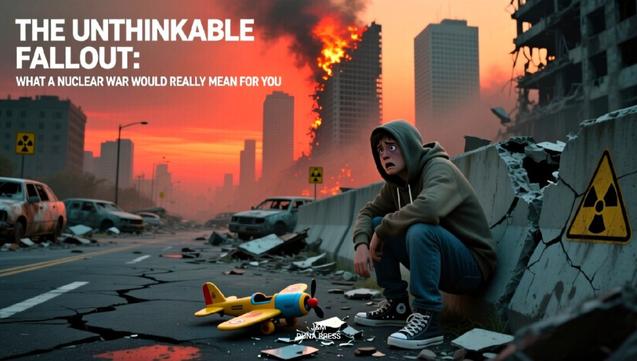
The Unthinkable Fallout: What a Nuclear War Would Really Mean for You
The Devastating Real-World Impacts of a Nuclear War
Imagine this: you’re scrolling through your phone, vibing to your favorite playlist, when suddenly the sky lights up brighter than a thousand suns. Your phone goes dark. The air feels like it’s burning. In seconds, everything you know—your city, your friends, your life—is gone. This isn’t a scene from a dystopian movie or a video game. This is what a nuclear explosion does, and it’s a reality we need to face, especially if you’re young and think history or global politics don’t matter. Spoiler alert: they do. A nuclear war isn’t just a far-off “what if.” It’s a ticking possibility, and its consequences are so brutal they’d make your worst nightmare look like a sunny day at the beach.
You might not read much. Maybe history class bored you to death, and geopolitics sounds like something old people argue about on TV. But if you don’t know what a nuclear war could do, you’re not just clueless—you’re vulnerable. This article is for you: the young, the distracted, the ones who think the world’s problems won’t touch them. Let’s break it down, raw and real, so you can understand why a nuclear conflict isn’t just a problem for world leaders but a catastrophe that could rewrite your future.
The Blast: Instant Annihilation
A nuclear bomb isn’t just a big explosion. It’s a force of nature on steroids. Let’s say a 1-megaton bomb—roughly 80 times more powerful than the one dropped on Hiroshima in 1945—hits a major city like New York, London, or São Paulo. Within a millisecond, a fireball hotter than the sun’s surface (about 100 million degrees Celsius) vaporizes everything in a 1-kilometer radius. Buildings, cars, people—gone. No chance to run, no time to scream. If you’re within 5 kilometers, the blast wave hits like a tsunami of fire and pressure, flattening skyscrapers and crushing your body. Even 10 kilometers away, you’re not safe. Flying debris, shattered glass, and intense heat can burn you to a crisp or bury you under rubble.
Hiroshima and Nagasaki, the only cities ever hit by nuclear bombs, give us a glimpse of this horror. In Hiroshima, 70,000 people died instantly when the U.S. dropped “Little Boy” in August 1945. By the end of the year, radiation and injuries pushed the death toll to around 140,000. That bomb was tiny—15 kilotons—compared to modern nukes, which can exceed 1 megaton. Today, a single warhead could kill millions in minutes. If you’re thinking, “I’d just hide in a basement,” think again. The heat can ignite fires miles away, and the blast wave doesn’t care about your hiding spot.
The Fallout: A Slow-Motion Apocalypse
Survive the blast? Congrats, but the nightmare’s just starting. Nuclear explosions release radioactive fallout—tiny particles of irradiated material that rain down for days or weeks. This isn’t the cool, glowing stuff from video games. It’s invisible, deadly, and sticks to everything: your clothes, your food, your water. Inhaling or ingesting even a speck can lead to acute radiation syndrome (ARS). Symptoms? Nausea, vomiting, hair loss, and internal bleeding. Within weeks, your organs shut down. No hospital, no cure.
Fallout doesn’t stay local. Winds can carry it hundreds of miles, contaminating entire regions. In a 1980s study, scientists estimated that a nuclear war between the U.S. and Soviet Union could spread fallout across the Northern Hemisphere, making farmland unusable and poisoning water supplies. Imagine trying to grow food or find clean water when everything’s tainted. Grocery stores? Empty. Supply chains? Collapsed. Your TikTok feed won’t help you when you’re starving.
Nuclear Winter: The World Goes Dark
Here’s where it gets even uglier. A large-scale nuclear war—say, between major powers like the U.S., Russia, or China—could trigger a “nuclear winter.” The explosions would send massive amounts of soot and ash into the atmosphere, blocking sunlight for years. Global temperatures could drop by 5-10°C, turning summers into winters and killing crops worldwide. A 2019 study in Science Advances modeled a U.S.-Russia nuclear war and predicted a 90% drop in global food production. Famine would hit hard, and not just in war zones. Even countries far from the conflict—like Brazil or Australia—would face starvation as food supplies dwindled.
No food means no society. Cities would turn into chaos zones as people fought over scraps. Governments would struggle to maintain order. Your phone, your internet, your entire way of life—gone. Picture a world where your biggest worry isn’t Wi-Fi speed but whether you’ll eat tomorrow. And don’t think you can just “adapt.” A nuclear winter could last a decade, and rebuilding would take generations.
The Human Cost: Beyond the Numbers
Numbers are numbing, so let’s make this personal. Imagine your best friend, your family, your crush—gone in a flash or dying slowly from radiation. Schools, hospitals, and malls? Reduced to rubble. The internet? Offline forever. Your dreams of starting a business, traveling, or just chilling with friends? Crushed under the weight of a world thrown into chaos. Survivors wouldn’t just be fighting for food or shelter; they’d be battling despair, trauma, and a future that looks nothing like the one you planned.
History shows us glimpses of this. After Hiroshima, survivors (called hibakusha) faced not just physical scars but social stigma and lifelong health issues, like cancer and infertility. A modern nuclear war would multiply this suffering by millions. Mental health would collapse as survivors grappled with loss and a world without hope. You might think you’re tough, but could you handle watching everything you love disappear?
Why It Could Happen
You might be thinking, “Okay, this sounds bad, but why worry? Nobody’s dumb enough to start a nuclear war.” Wrong. Tensions between nuclear-armed nations like the U.S., Russia, China, India, Pakistan, and North Korea are higher than they’ve been in decades. In 2023, Russia suspended its participation in the New START treaty, which limits nuclear arsenals. North Korea keeps testing missiles. The U.S. and China are locked in a tech and trade war that could escalate. Miscommunication, accidents, or a single rogue leader could spark disaster. The Doomsday Clock, a measure of global catastrophe risk, was set to 90 seconds to midnight in 2023—closer than ever.
And don’t forget: humans have messed up before. In 1983, a Soviet early-warning system falsely detected U.S. missiles. Only one officer’s gut instinct stopped a retaliatory strike. That’s how close we’ve come. With over 12,000 nuclear warheads worldwide (as of 2023 estimates by the Federation of American Scientists), the risk isn’t theoretical—it’s real.
What Can You Do?
Feeling helpless? You’re not. The first step is waking up. Understand the stakes. A nuclear war isn’t someone else’s problem—it’s yours. It’s your future, your world, your life on the line. Start by talking about it. Share this article. Bug your friends to care. Push for leaders who prioritize diplomacy over brinkmanship. Support organizations working for nuclear disarmament, like the International Campaign to Abolish Nuclear Weapons (ICAN), which won the Nobel Peace Prize in 2017.
You don’t need to be a history buff or a policy nerd to make a difference. Use your voice—on X, TikTok, wherever. Amplify the truth. Demand accountability. The more people know, the harder it is for leaders to gamble with our lives. You’re young, you’re loud, and you’ve got power. Use it.
The Bigger Picture
A nuclear war isn’t just about bombs. It’s about what we lose as a species. Art, music, science, memes—all the things that make life worth living—could be erased. The world you’re building, the dreams you’re chasing, the love you’re seeking? They’re all at stake. This isn’t about fearmongering; it’s about facing reality so we can change it. History isn’t just a boring textbook—it’s a warning. Ignore it, and we’re screwed. Learn from it, and we might just save ourselves.
The choice is yours. Stay distracted, or wake up and fight for a future where you don’t have to worry about the sky turning to fire. Because if we don’t act, the next notification on your phone might not be a like or a follow—it might be the end of everything.
Share your thoughts in the comments, and explore more insights on our Journal and Magazine. Please consider becoming a subscriber, thank you: https://dunapress.org/subscriptions – Follow J&M Duna Press on social media. Join the Oslo Meet by connecting experiences and uniting solutions: https://oslomeet.org
References:
#globalConsequences #GlobalImpact #NuclearWar #NuclearWar #societalCollapse #WakeUp