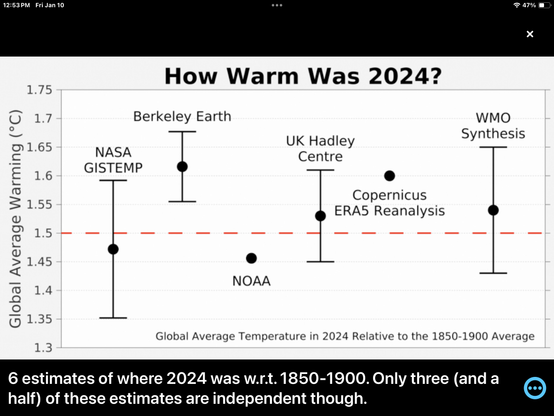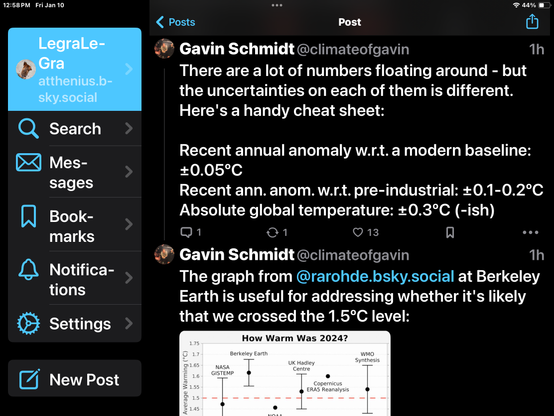
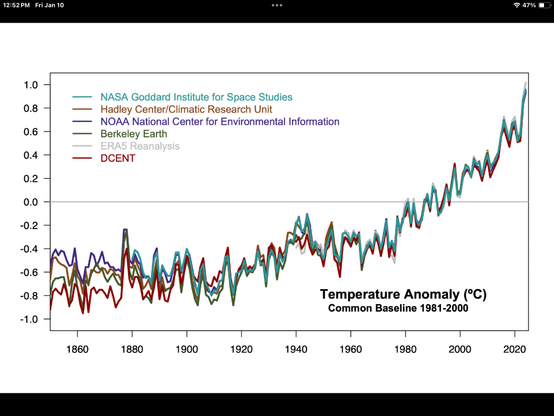
#ClimateChange caused the #temperature of 2024 to be 0.1degC warmer than 2023 and 0.25degC warmer than any year prior to that.

See my boss' explanation of the latest #gistemp findings on BlueSky (or see the pics below).

https://bsky.app/profile/climateofgavin.bsky.social/post/3lfflezr6q22h
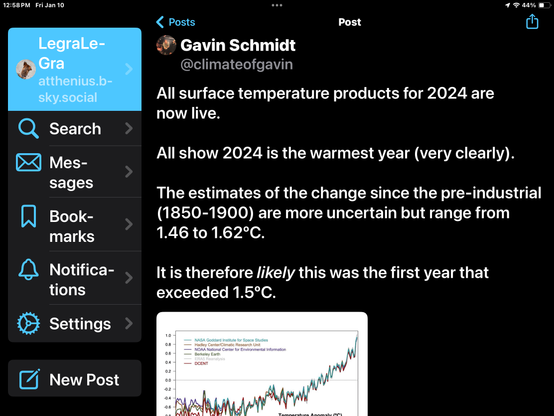
Gavin Schmidt (@climateofgavin.bsky.social)

All surface temperature products for 2024 are now live. All show 2024 is the warmest year (very clearly). The estimates of the change since the pre-industrial (1850-1900) are more uncertain but range from 1.46 to 1.62ºC. It is therefore *likely* this was the first year that exceeded 1.5ºC.

Bluesky Social

#gistemp is one of the signature products to come out of #nasa #giss , my lab.

#helene took down #noaa ‘s ncei data center

Gistemp monthly updates depend on this data center. So they’ll be on hold for a bit

https://data.giss.nasa.gov/gistemp/

Each day the sadness and resilience in the face of incredible devastation in North Carolina étal become more apparent

Surprisingly: not even the most knowledgeable of #climate experts were prepared for the devastating impact of #climatechange fueled #ExtremeRain

NASA

NASA.gov brings you the latest news, images and videos from America's space agency, pioneering the future in space exploration, scientific discovery and aeronautics research.

NASA

And now my friends down at #nasa #gsfc #merra2 plus #giss #gistemp weigh in::

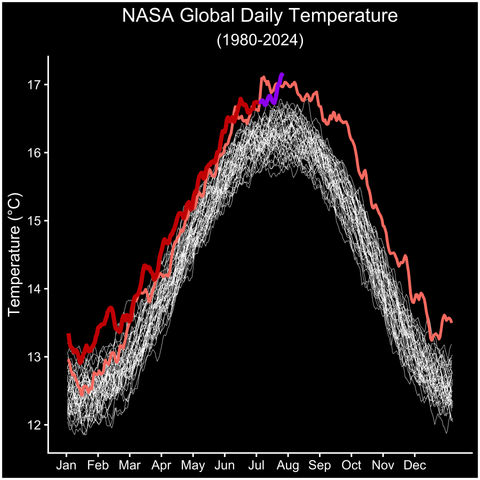
July 22 2024 was the hottest day in recorded history… likely the hottest day since the Eemian.

#climate #climateChange #temperature

#hot

https://www.nasa.gov/earth/nasa-data-shows-july-22-was-earths-hottest-day-on-record/

See my thread from last year for my opinion on why these days were the hottest in 120,000 years

https://fediscience.org/@atthenius/110668739230530095

NASA Data Shows July 22 Was Earth’s Hottest Day on Record - NASA

July 22, 2024, was the hottest day on record, according to a NASA analysis of global daily temperature data. July 21 and 23 of this year also exceeded the

NASA

#gistemp

Your favorite #nasa lab in #nyc #nasagiss came out with its May temperature analysis.

Giss measures its baseline climate to the 1950-1980 average.

This past year, we are 1.3 ℃ (2.34degF) above that.

🔥 #ClimateChange #Climate

https://www.nasa.gov/earth/nasa-analysis-confirms-a-year-of-monthly-temperature-records/

NASA Analysis Confirms a Year of Monthly Temperature Records - NASA

May 2024 was the warmest May on the books, marking a full year of record-high monthly temperatures, NASA scientists found. Average global temperatures for the

NASA

#ClimateChange this past year did something odd.

2023 wasn’t supposed to be so hot. #enso El Niño didn’t start until mid year. And yet it was a scorcher.

Gavin Schmidt (my boss) explains why we were all caught +0.2degC off guard.

wasnt hunga tonga ‘22 volcano water vapor

mightve been cleaner shipping fuels… but not all

and so we really dont know what DID happen

YIKES

#GlobalWarming #2023wasSOweird

#nasa #nasagiss #climate #gistemp

https://www.nature.com/articles/d41586-024-00816-z

Climate models can’t explain 2023’s huge heat anomaly — we could be in uncharted territory

Taking into account all known factors, the planet warmed 0.2 °C more last year than climate scientists expected. More and better data are urgently needed.

Organización Meteorológica Mundial

Visualización de datos por @antilip en el Instituto Meteorológico Finlandés de anomalías de temperatura 1880-2017

@wmo
@nasa
GISS #GISTEMP #climatechange.

Also updated my zone stripes that show the arctic amplification.

#nasa #2023 #gistemp #climate #arctic

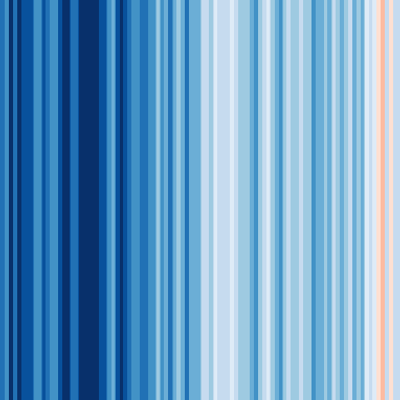
Updated the climate stripes to include the 2023 data released today at data.giss.nasa.gov/gistemp/

It is getting hot 🥵

#nasa #2023 #gistemp #climate

#nasa #Gistemp #temperature map of 2023 v 1951-80.

#Arctic #temperatures are warming at 3.5 times the rate of global temperature (!!)

Make your own graphic or grab the data here:

https://data.giss.nasa.gov/gistemp/

Data.GISS: GISS Surface Temperature Analysis (GISTEMP v4)

#NOAA says 2023 #temperatures : 1.14C (2.05F) above 1951-80 average

#nasa #gistemp says 2023 1.17C (2.11F) above the 1950-1980 average
#Climate
(Why so hot?
Russ misspoke when he attributes some of the heat to Hunga Tonga- scientists have now figured out that isn’t so— it’s our GHG plus ENSO plus ??? Unknown but perhaps aerosol changes/decreases over ocean)