 WE AND THE COLOR
The Interior Design Handbook by Frida Ramstedt Teaches You Why Good Design Works
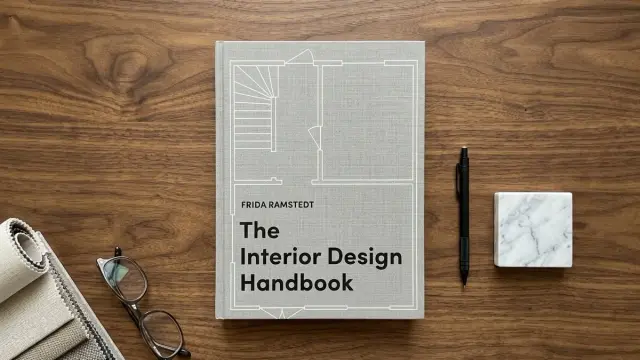
Most people approach decorating backwards. They chase a trending sofa, fall for a paint color on Instagram, and then wonder why the room still feels off. The Interior Design Handbook by Frida Ramstedt flips that logic entirely. Published in 2020 by Clarkson Potter, this 240-page illustrated guide argues that the problem was never your furniture — it was that nobody taught you the principles behind it. Ramstedt, one of Scandinavia’s most recognized home styling voices, has spent her career asking a deceptively simple question: not what looks good, but why it looks good. This book is her answer.
That shift in framing matters more than it sounds. Interior design advice tends to be trend-dependent, culturally narrow, or hopelessly vague. Ramstedt’s approach, by contrast, is principle-based. She treats your home like a visual problem to be solved, not a mood board to be assembled. The result is a book that reads less like a style guide and more like a quiet education in spatial reasoning.
The book is available on AmazonSo why is this book still relevant years after its release? Because the hunger for lasting principles never fades. Trends rotate every eighteen months. Good proportion lasts forever.
The Interior Design Handbook: Furnish, Decorate, and Style Your Space, a book by Frida Ramstedt. The book is available on AmazonWhat Makes The Interior Design Handbook Different from Every Other Decorating Book?
Walk into any bookstore’s design section, and you’ll find two kinds of books. The first is essentially a catalog — beautiful rooms, aspirational photography, and almost no transferable knowledge. The second is an academic textbook you’ll never actually read. The Interior Design Handbook occupies a third category that rarely gets filled: the principled practical guide.
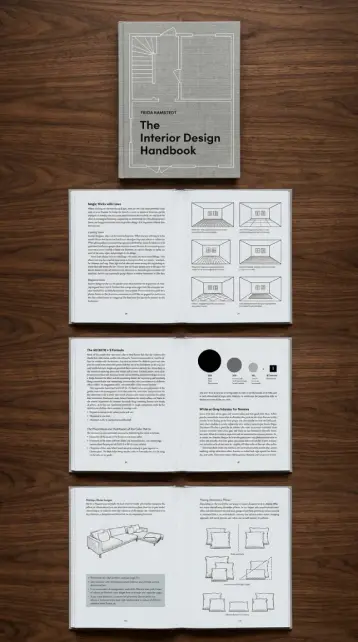
Ramstedt introduces the reader to foundational concepts — the golden ratio, the golden spiral, furniture scale relationships, lighting height, and mood boarding — without making any of it feel like homework. Her writing style is direct. Her explanations are built around helpful illustrations. And crucially, she consistently connects the rule to the reason. You don’t just learn that a coffee table should be a certain size relative to a sofa. You understand why that proportion creates visual balance.
This matters because understanding the “why” makes you an independent thinker. You stop needing a designer to validate every purchase. You start trusting your own eye, because your eye is finally working from a framework.
That’s the real value proposition of this book, and it’s one that almost no competitor delivers at this level of clarity.
The Ramstedt Principle: Thinking Over Acquiring
If I had to name the single defining argument of The Interior Design Handbook, it would be this: we have too much information about what to buy and almost no understanding of how to think about space. Ramstedt builds her entire methodology on closing that gap.
She calls attention to a cultural irony. Access to design content has never been higher. Pinterest, Instagram, and an endless stream of home renovation media have made everyone fluent in design vocabulary. Yet most people still struggle to make their homes feel cohesive. Why? Because trend literacy is not the same as design literacy.
Ramstedt distinguishes between these two modes of engaging with your space. Trend literacy tells you what’s popular. Design literacy tells you what works. The first is about acquisition. The second is about understanding. Her book trains the second skill systematically.
What Is the “Spatial Grammar” Framework?
I use the term Spatial Grammar to describe what Ramstedt is actually building throughout the book. Just as grammar gives structure to language, a spatial grammar gives structure to a room. It’s a system of rules — proportion, scale, rhythm, light — that determines whether a space feels resolved or restless.
Ramstedt doesn’t use this exact term, but her methodology maps onto it precisely. She teaches you the rules of that grammar: where objects should sit relative to one another, how the eye moves through a space, when symmetry serves you and when it stiffens a room. Once you internalize that grammar, you can make any room work — regardless of budget, size, or style.
This is why the book has such a broad appeal. It’s not about Scandinavian minimalism, even though Ramstedt is Swedish. It’s about structure. And structure applies everywhere.
The Golden Ratio, the Coffee Table Rule, and Other Frameworks That Actually Stick
One of the practical strengths of The Interior Design Handbook is its willingness to give you numbers. Not vague suggestions — actual proportional guidelines you can use immediately.
The golden ratio (approximately 1:1.618) appears throughout the book as a lens for evaluating spatial relationships. Ramstedt applies it not as a mathematical exercise but as a perceptual calibration tool. When proportions approach the golden ratio, the human eye tends to register them as balanced. That’s not an opinion — it’s a well-established principle in visual perception, and Ramstedt makes it actionable.
Similarly, her guidance on coffee table sizing — typically around two-thirds the length of the sofa it accompanies — sounds almost too simple. But it resolves one of the most common mistakes in residential living rooms. Most people undersize their coffee tables. The room then reads as incomplete, even if every individual piece is beautiful.
Lighting Height: The Most Overlooked Variable in Home Styling
Ramstedt devotes serious attention to lighting, and rightly so. Lighting is the variable that most DIY decorators get wrong, and the consequences are hard to diagnose because most people don’t think of lighting as a spatial element. They think of it as a functional one.
But the height at which you hang a pendant light directly affects how a room feels. Too high, and the light floats disconnected from the space below it. Too low, and it becomes an obstacle. Ramstedt provides clear guidelines — pendant lights over a dining table, for instance, are typically hung between 28 and 34 inches above the table surface — with the reasoning explained clearly behind each recommendation.
This kind of specificity is rare in decorating books. And it’s the specificity that makes advice useful rather than decorative.
How Frida Ramstedt Uses Mood Boards as a Thinking Tool, Not a Pinterest Fantasy
Mood boards have a reputation problem. For most home decorators, they function as a collage of things they wish they could buy. Ramstedt rehabilitates the mood board as something more rigorous: a decision-making tool that forces clarity before you spend a single dollar.
Her approach to mood boarding is methodical. She guides readers through building boards that test proportion, color balance, material contrast, and tonal range — before any physical item enters the room. The board becomes a low-stakes simulation of the space. Mistakes happen on paper instead of in your living room.
This reframing of the mood board as a spatial hypothesis rather than a wish list is one of the book’s most original contributions. It transforms a familiar tool into something with genuine analytical value.
The “Material Contrast Test” — A Personal Framework Inspired by Ramstedt
Building on Ramstedt’s mood boarding methodology, I’d suggest adding what I call the Material Contrast Test to any board-making process. Before finalizing a board, ask three questions: Does the room have at least three distinct material types? Is there at least one matte and one reflective surface? Does the palette include both warm and cool tones?
If the answer to all three is yes, the room has a reasonable chance of feeling layered and considered rather than flat and one-dimensional. Ramstedt doesn’t phrase it exactly this way, but her principles support this test entirely. Her book gives you the foundation. Frameworks like this help you apply it faster.
The Interior Design Handbook and the Scandinavian Design Philosophy Behind It
It’s impossible to read The Interior Design Handbook without sensing its Scandinavian roots. But Ramstedt is careful not to confuse Scandinavian design with minimalism, which is a common and reductive equation. Scandinavian design is not about having less. It’s about having what works.
The underlying philosophy is one of intentionality. Each element in a space should earn its place. Not because of a rule against clutter, but because unnecessary elements create visual noise that the brain has to process. That cognitive load accumulates. Rooms that feel exhausting often feel that way, not because they’re messy but because too many competing objects demand attention simultaneously.
Ramstedt’s Scandinavian background gives her book a particular clarity of argument. She writes with the confidence of someone who has thought deeply about visual harmony, and that confidence translates into prose that is precise without being cold.
Is This Book Only for Scandinavian-Style Homes?
Absolutely not. And this is worth stating directly, because the misconception is widespread. The principles Ramstedt teaches — proportion, scale, light management, material balance — apply equally to a maximalist New York apartment, a colonial-style home in the American South, or a brutalist-inspired loft in Berlin. The style of the furniture is irrelevant. The grammar of how you arrange it is universal.
A reader who prefers heavily patterned textiles and layered Victorian styling will get as much from this book as a reader who leans toward spare Nordic interiors. The specific aesthetic changes. The underlying logic doesn’t.
What The Interior Design Handbook Gets Right That Design Schools Often Miss
Formal interior design education tends to front-load theory. Students spend significant time on architectural history, color theory, abstractions, and academic vocabulary before they ever have to make a room work. Ramstedt’s book inverts this sequence. She starts with the practical problem — how do you make this specific kind of room feel resolved? — and introduces theory only where it illuminates the answer.
That pedagogical reversal is quietly radical. It mirrors how skilled professionals actually think. Experienced designers don’t start from theory and work toward the room. They start from the room and reach for theory when they need it. Ramstedt trains that habit from page one.
Furthermore, the book’s 240 pages cover more ground than many semester-long courses without ever feeling rushed. The illustrated format helps enormously. Visual learners — who make up the majority of people drawn to interior design — will retain far more from a well-drawn diagram than from three paragraphs of descriptive text.
Interior Design Handbook for Beginners: Is It Accessible Without Prior Knowledge?
Yes, and deliberately so. Ramstedt writes with the assumption that her reader has no formal design training. She builds from first principles. She explains the golden ratio before applying it. She defines terms like “visual weight” and “focal point” before relying on them. By the time she reaches more complex compositional ideas, the reader has already absorbed the vocabulary needed to follow along.
This makes the book unusually effective as a starting point for anyone who has felt intimidated by interior design. It removes the gatekeeping that so much design media imposes, intentionally or not, and replaces it with a clear, progressive structure of understanding.
The Concept of “Resolved Space” — Why Some Rooms Just Feel Right
There’s a phrase I want to introduce here: resolved space. I use it to describe a room where every element appears to have been placed with intention, where the visual relationships between objects feel considered, and where the overall effect is a sense of calm legibility. You know it when you walk into one. The room doesn’t demand explanation. It simply works.
Ramstedt’s entire book is, in a sense, a manual for creating resolved spaces. Every principle she teaches — from the proper height of a pendant to the correct ratio of decorative objects to functional ones — contributes to this quality of resolution. The book gives you the tools to move from a room that feels “almost right but something’s off” to one that feels genuinely complete.
That transition is often smaller than people expect. Resolved space rarely requires more furniture. It usually requires better placement of what’s already there.
The “Off-Feeling Room” Diagnostic
If your room consistently feels wrong but you can’t identify why, I’d suggest applying what I call the Off-Feeling Room Diagnostic — a checklist drawn from Ramstedt’s principles. Ask yourself: Is your largest piece of furniture scaled correctly to the room? Is your lighting too high, too low, or too uniform? Are your decorative objects grouped or scattered at random? Is there a clear focal point, or does the eye have nowhere to land?
In most cases, one or two of these questions will expose the problem immediately. Ramstedt’s book gives you the knowledge to diagnose those issues rather than just rearranging things and hoping for improvement.
Insights: Interior Design Handbook for Small Spaces, Rentals, and Budget Decorating
One of the most practically valuable aspects of The Interior Design Handbook is its applicability across constraint scenarios. Ramstedt’s principles are budget-neutral and scale-neutral. The golden ratio works in a 90-square-foot studio apartment just as well as in a 3,000-square-foot house.
For renters, the book’s emphasis on furniture proportion and decorative arrangement is especially relevant. Renters rarely control their walls, their floors, or their fixed lighting. But they do control what they bring in, how they arrange it, and how they layer it. Ramstedt’s framework gives renters a surprisingly powerful tool set for working within those constraints.
For budget decorators, the principle-based approach is similarly liberating. When you understand what makes a space feel balanced, you stop spending money on additional items to fill a gap. Instead, you rearrange what you have. Or you invest precisely and selectively in the one element that actually solves the problem.
Using the Interior Design Handbook for Apartment Styling
Apartment styling presents specific challenges: odd proportions, low ceilings, limited natural light, and furniture that has to serve multiple functions simultaneously. Ramstedt addresses most of these scenarios directly or gives you the principles to extrapolate. Her sections on lighting placement, for instance, become especially valuable in apartment contexts where overhead lighting is often both insufficient and unflattering.
Her discussion of scale is similarly applicable. In small apartments, the instinct is often to buy small furniture to avoid overwhelming the space. Ramstedt pushes back on this reflex. Under-scaled furniture in a small room doesn’t make it feel larger — it makes it feel underfurnished and provisional. Sometimes the right large sofa is the thing that finally makes a small room feel intentional.
A Personal Take: Why Every Designer Should Own This Book
I’ll be direct about this. The Interior Design Handbook is one of the few books in the genre that I’d recommend without qualification across skill levels. It works for the first-time renter trying to make sense of a blank apartment. It works for the experienced designer who wants a clean reference for principles they already know intuitively but have never articulated. It works for the design-curious reader who doesn’t necessarily want to become a professional but wants to understand why some spaces feel extraordinary and others don’t.
Ramstedt’s writing has a quality that’s genuinely rare in this category: it respects the reader’s intelligence without overcomplicating the material. She doesn’t condescend, and she doesn’t over-explain. She trusts you to follow the logic. That trust makes the book feel collaborative rather than instructional.
And the illustrations — this deserves emphasis — are genuinely good. They do real explanatory work. They’re not decorative. In a genre where images often substitute for ideas, Ramstedt’s illustrations consistently extend them.
The Interior Design Handbook in the Context of Modern Design Education
We’re at a moment where design education is fragmenting rapidly. YouTube tutorials, online courses, Instagram accounts run by professional designers, and AI-generated interior renderings are all competing for the attention of people who want to learn how to make their spaces better. Most of that content is useful at the surface level. Very little of it builds lasting capacity.
Books like The Interior Design Handbook become more valuable in this environment, not less. Precisely because the internet optimizes for novelty and immediacy, a book that teaches durable principles offers something the feed cannot: a complete argument, developed at the pace the complexity requires.
Ramstedt’s book is a document that repays rereading. The first time through, you absorb the principles. The second time, you apply them consciously. By the third reading — ideally after you’ve lived with a redesigned space for a few months — you start to see the principles operating everywhere, not just in your own home but in every space you inhabit.
That’s the mark of a book that actually changes how you see. And that’s a rare thing.
What’s Next: The Future of Principle-Based Interior Design Resources
The trajectory of home design media is moving toward personalization and interactivity. AI tools can now generate room visualizations in seconds. AR applications let you place virtual furniture in your actual space before buying. The technology is genuinely impressive.
But none of it teaches you to see. None of it gives you the framework to evaluate what you’re looking at. A tool that places a rendered sofa in your living room doesn’t tell you whether that sofa is the right scale for the room, whether it creates the right visual weight relative to the other elements, or whether the room needs a sofa at all rather than something else entirely.
Books like The Interior Design Handbook will remain indispensable as long as that gap exists. And the gap is structural, not technological. Seeing well is a trained skill. Ramstedt’s book trains it.
My prediction: as AI-generated design tools proliferate, demand for principle-based design literacy will increase rather than decrease. People will have more visual options than ever. They’ll need more sophisticated judgment to choose between them. Ramstedt built exactly the right book for that future.
The book is available on AmazonFrequently Asked Questions About The Interior Design Handbook
What is The Interior Design Handbook by Frida Ramstedt about?
The Interior Design Handbook is a 240-page illustrated guide published in 2020 by Clarkson Potter. It teaches the foundational principles of interior design — including proportion, scale, lighting height, the golden ratio, and mood boarding — with the goal of helping readers understand not just what looks good, but why it looks good.
Who is Frida Ramstedt?
Frida Ramstedt is a Swedish home styling expert and one of Scandinavia’s most influential voices in residential interior design. She built her reputation helping a generation of readers develop a more principled, intentional approach to decorating their homes.
Is The Interior Design Handbook suitable for beginners?
Yes. Ramstedt writes from first principles and assumes no prior knowledge of design. She introduces key terms and concepts before applying them, making the book accessible to complete beginners while remaining useful to more experienced readers.
What specific topics does The Interior Design Handbook cover?
The book covers the golden ratio and golden spiral, furniture scaling (including the coffee table-to-sofa ratio), optimal lighting fixture heights, mood board construction, visual weight and focal points, and the underlying principles of creating balanced, harmonious spaces.
Can I use The Interior Design Handbook for a small apartment?
Absolutely. Ramstedt’s principles are scale-neutral and work equally well in compact apartments as in larger homes. Her guidance on furniture proportion is particularly valuable for small spaces, where the common instinct to under-scale furniture often creates the opposite of the intended effect.
How does The Interior Design Handbook differ from other interior design books?
Unlike most decorating books, which either showcase aspirational photography without transferable knowledge or present academic theory without practical application, Ramstedt’s book consistently explains the reasoning behind each principle. The result is a guide that builds genuine design literacy rather than just trend awareness.
Is The Interior Design Handbook specific to Scandinavian design styles?
No. While Ramstedt’s background is Scandinavian, the principles she teaches are universal. The book’s frameworks apply to any aesthetic — from maximalist eclecticism to spare modernism — because they address spatial logic, not stylistic preference.
What is the golden ratio, and how does Frida Ramstedt use it?
The golden ratio (approximately 1:1.618) is a mathematical proportion that the human eye tends to perceive as balanced and harmonious. Ramstedt uses it as a practical calibration tool for evaluating spatial relationships in a room — not as a rigid formula, but as a perceptual guide for making better proportional decisions.
Where can I buy The Interior Design Handbook?
The book (ISBN-13: 978-0593139318) is available through major online retailers, including Amazon, as well as in independent bookstores. It is published by Clarkson Potter and available in an illustrated hardcover edition.
Is The Interior Design Handbook worth buying in 2025?
Yes. Because the book is principle-based rather than trend-based, it hasn’t dated. The golden ratio hasn’t changed. The relationship between furniture scale and spatial perception is the same as it was in 2020. If anything, the book is more valuable now as design media proliferates and the need for durable frameworks increases.
Check out WE AND THE COLOR’s Interior Design and Books categories for more.
#book #FridaRamstedt #handbook #interiorDesign #interiorDesignBook #TheInteriorDesignHandbook