 WIRED - The Latest in Technology, Science, Culture and Business [Unofficial]
Drive Slower, Save Money on Gas. Thanks, Physics!
https://fed.brid.gy/r/https://www.wired.com/story/drive-slower-save-money-on-gas-because-physics/

Drive Slower, Save Money on Gas. Thanks, Physics!
https://fed.brid.gy/r/https://www.wired.com/story/drive-slower-save-money-on-gas-because-physics/

Fungal infections are an escalating global health concern, with rare Candida species posing an urgent threat due to emerging multidrug resistance. Clavispora ( Candida ) lusitaniae is an uncommon pathogen in which multidrug resistance has been documented during antifungal therapy, yet the selective forces driving this phenotype remain unclear. Here, we show that exposure to the echinocandin micafungin (MCF) alone can select for multidrug resistance in C. lusitaniae . Through controlled evolution experiments we identified individual point mutations in genes encoding ergosterol biosynthesis enzymes ( ERG s), sterol trafficking proteins ( OSH2 ), and the echinocandin drug target ( FKS1 ) that confer a significant fitness benefit to one or more classes of antifungals. We find that ERG loss-of-function is the primary and independent driver of pan-antifungal resistance to echinocandins, azoles and polyenes. The ERG mutants have <1% ergosterol, increased levels of non-toxic sterol intermediates, and increased chitin content, consistent with both cell membrane and cell wall remodeling that enables the fungal pathogen to evade all three drug classes. The convergence of sterol reprogramming and compensatory cell wall remodeling that occurs during adaptation to echinocandin monotherapy can evolve through a single point mutation and parallels our recent case study of acquired multidrug resistance.
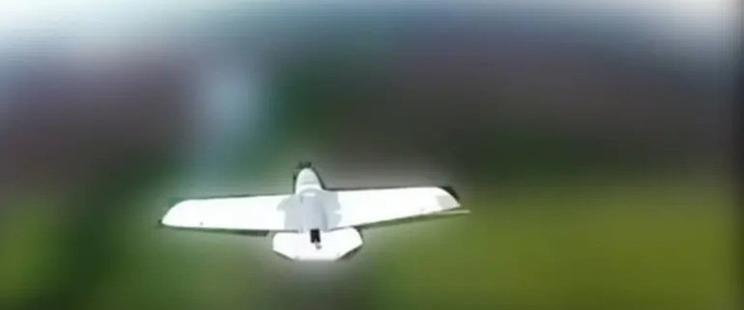
L’armée ukrainienne a neutralisé un Sokol-I à l’aide d’un intercepteur "General Cherry Air". Un mois seulement s’était écoulé depuis la présentation du prototype russe.
L'Indépendant: #Guerre en #Ukraine : Les #forces #armées #ukrainiennes détruisent pour la première fois un #drone #russe Sokol-I fabriqué en #mousse #plastique composite et quasi indétectable
L’armée ukrainienne a neutralisé un Sokol-I à l’aide d’un intercepteur "General Cherry Air". Un mois seulement s’était écoulé depuis la présentation du prototype russe.

The cytoskeleton organizes the cellular interior using cytoskeletal filaments that rely on bundling, usually executed by stable and ordered crosslinking proteins. Bundling often requires protein complexes with at least two defined microtubule binding regions, as present in many molecular motors. Here, we establish a mechanism of microtubule bundling based on capillary forces, analogous to how wet hair sticks together. We show using in vitro experiments and theory that condensates can bundle microtubules through capillary forces, wherein liquid-like capillary bridges form between microtubules and adhere them together through interfacial and wetting forces. We quantify the structure and dynamics of these capillary bundles using total internal reflection fluorescence microscopy, and directly measure the charge-dependent interfacial tensions of condensates on microtubules using atomic force microscopy. Lastly, we show that these capillary bridges provide viscous resistance to motor-driven microtubule sliding that is insensitive to the bulk protein concentration. Taken together, we provide a novel mechanism for how cytoskeletal filaments bundle: through condensate-mediated capillary forces. ### Competing Interest Statement The authors have declared no competing interest.
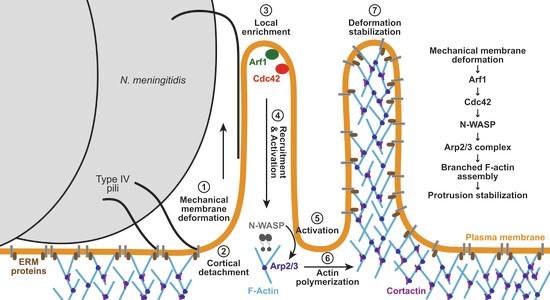
Cells experience external forces that deform the plasma membrane to which they adapt by reorganizing their actin cytoskeleton. Here, using the extracellular bacterium Neisseria meningitidis as a model system, we explore how this bacterium reorganizes the cortical actin cytoskeleton subsequently to mechanical membrane deformations. Meningococci trigger the formation of tubular cellular plasma membrane protrusions by a previously described adhesion-driven process known as one-dimensional wetting. Cryo-electron tomography reveals that in epithelial cells such a deformation of the plasma membrane leads to the formation of F-actin bundles. In contrast, in endothelial cells a branched F-actin network is formed. By combining high resolution photonic microscopy approaches with genetic and drug perturbations in endothelial cells, we demonstrate that Arp2/3 activity is necessary for forming this branched network. We demonstrate the role of the nucleating-promoting factor N-WASP downstream of Cdc42. Proteomic analyses reveal the contribution of the small GTPase Arf1. Taken together, our results delineate an Arf1-Cdc42-N-WASP-Arp2/3 pathway that links mechanical plasma membrane deformation to the subsequent reorganization of a cortical branched F-actin network in endothelial cells.
 Rxiv mechanobio
 Rod2ik 🇪🇺 🇨🇵 🇪🇸 🇨🇱 🇺🇦 🇨🇦 🇬🇱 ☮🕊️
 Rod2ik 🇪🇺 🇨🇵 🇪🇸 🇨🇱 🇺🇦 🇨🇦 🇬🇱☮🕊️
 kipriyanovich
 Osna.FM