 Central & Western Archive/GLAM
Do you remember Kilkelly's Mills or might you have more photos or information on them? In this image, the Kilkelly's Motu Mote Mill can be seen in full swing. But in February of 1942, the mill was lost to fire, which was a great blow to the men working there and their families. It was not rebuilt, but Kilkelly's did reopen their old Tūātapere mill.
More information on this can be accessed by clicking or visiting via the link showing below.
https://ehive.com/collections/202139/objects/1564901
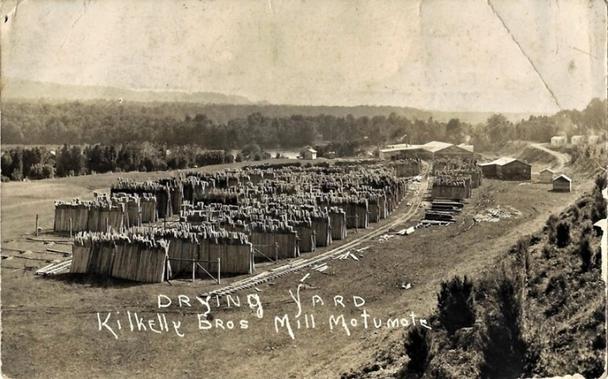

Motu - Kilkelly's Mill & Settlement ; Unknown; 1925-1935; CWA.028.120.5 on eHive
Postcard of Kilkelly's Drying Yards at the Motu: The Kilkelly’s had a number of mills over the years across the Murihiku Southland region. It appears in later years their venture was run out of Waihōpai Invercargill, which is borne out by the postcard pictured here: "WITH COMPLIMENTS, KILKELLY BROS LTD, BOX 6, INVERCARGILL" is typed across the back of the card, which contains the above photo. In a news article earlier this year, Isabelle Burgess-Matthews, who just turned 106, recalls her childhood at Spar Bush, where the town was sustained by the local Kilkelly Sawmill there. But when the mill was moved to Tūātapere, the school closed, and she had to go to Lochiel. According to John Fraser’s article on the history of the area, the Waiau Kilkelly Bros. mill was on the Pearce’s Otahu property and it was very large. As you can see by the photo attached to this entry, their drying yard alone was huge, so the mill itself must have been impressive. We hear from John about how logs would be dragged through the river up to the mill site, and that had two breast benches operating. The history continues to tell us about a dangerous ford that was somewhere about the Motu, with photos (I would love to see these), showing “haulers and engines being dragged through the river, via a team of horses on an endless rope.” What a sight that would have been, back in the day. As John rightly says, we now wonder at the ability of those men who were able to transport two half ton flywheels into the Motu back in the day. Another interesting account he relates is about a horse who was in front of a ten ton load while it was winched down a steep incline and when the rope broke, the clever draught horse managed to “magnificently” skid and steer the huge heavy load to safety, without it tipping over. Those men and horses really worked hard. In the “Southwest Sawmill’s” history of Allen Templeton’s, we hear how a smithy and stable for the horses working at the timberyard as well as the two shoe horses, was near the mill. The milling area which was about a mile from Lonnekers Bush, held stands of white, black and red pine and totara. These were bought out of the bush with a solid-tyred international truck. However the majority of the wood was taken out via the typical type of bush tramway system and rail tractor from the Deanburn Flat, which is on the western side of the Waiau River. This was a 75/25 mix of white pine and beech forest, according to Allen’s account. Immense gratitude to Larry Mouat, a descendant of local landowners in the district, for pointing out how the white pine milled here was in fact Kahikatea, which was virtually slaughtered out of existence for the production of food packaging for Aotearoa New Zealand industries. The family have donated more material on the Kilkelly's mill shown here to the archive and in time we will put these up in new entries. In Te Aka, the Māori Dictionary, it is described thus: "kahikatea, white pine, Dacrycarpus dacrydioides - a tall coniferous tree of mainly swampy ground, the leaves are scale-like and soft to touch." In a blog on EnviroHistory (link included in place notes below), this notes that while earlier findings revealed the soft wood of this tree made it unsuitable for marine applications and therefore initially spared its life for some time, the reason much of it was initially cleared was to make way for farmland, in a colonial crash course of clearing the land to make it 'profitable', after it was discovered that the land underneath the stands of these trees was most suitable to farming and in particular, dairy farming. Dairying was to have even more of an impact in the near total extinction of this species however, as the flow-on from the dairy industry led to the Kahikatea's wholesale destruction, and this was in 1882, when refrigerated shipping was developed. Not only did this allow frozen meat to be exported, particularly from Murihiku Southland as one of the early experiments, it also created massive demand for literally millions of boxes for all of the butter and cheese products now being produced by a new industry, dairy farms. It was sadly the kahikatea’s soft, pale, odourless wood which made it perfect for these product packaging boxes, at it was not able to taint the products taste during it's long sea journey to Britain. Across Aotearoa New Zealand and also here in Murihiku Southland, loggers were frantic to fell and mill these now known to be giant Jurassic period survivors. Kahikatea forests across the country were therefore doomed to destruction; astonishingly, between 1909 - 1917 in just 8 years, remains of kahikatea stands were reduced by 63 per cent! It is interesting also to note that it appears some of the descendants of those who cleared entire forests of these towering giants, had the most sincere regrets after the fact, of course too long later to do any good. It is therefore a good reminder of how necessary it is for us to ensure that the species we still have on our earth and in our relatively young country, survive for all to enjoy today, into the future and beyond. It is amazing how much history there is in one small settlement. It would be wonderful for more people to contribute memories, photos and other memorabilia to add to the story. If you can help with this, please comment in the section under this image page, or contact us.