🚨 NEW ARTICLE: How “essential” are hazardous substances?

⚠️ Find out how #Toxicsindustry is fighting to weaken EU Commission’s upcoming new tool aimed at protecting people and the planet.

#EssentialUse

👉 https://corporateeurope.org/en/2024/01/how-essential-are-hazardous-substances

How “essential” are hazardous substances? | Corporate Europe Observatory

New evidence reveals how Big Toxics and its allies have used misleading narratives to try to weaken the concept of ‘essential use’, to create regulatory loopholes for their hazardous products, and ultimately derailing the Commission’s flagship chemicals reform.
Breaking down diverse perspectives on the Essential-Use concept with Sabine Pahl and Ellise Suffill

YouTube
Lots of great resources from our @ZeroPM project can be found on the dedicated YouTube channel, for example here are the students and postdocs talking about their work on #Pmsubstances #pfas #EssentialUse including #RiskPerception and #environmentalpsychology #chemicals #regulation #zeropollution #EU #h2020 https://youtu.be/iQjTZ45Vhtc
ZeroPM's Postdocs and PhD Candidates present their research at the ZeroPM Prevention Workshop

YouTube

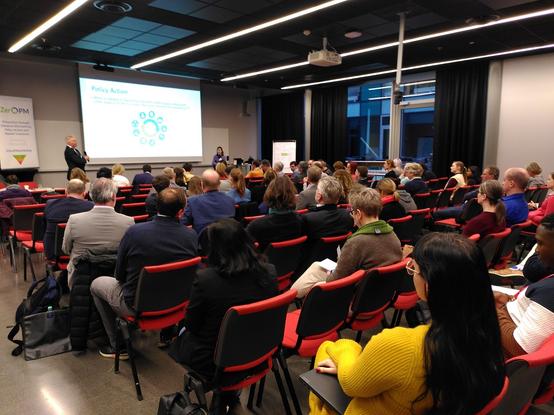
Great final Discussion Café on the last day of our #ZeroPMworkshop bringing together researchers, regulators, industry and more!

There is urgency to protect natural environments and human health from #PFAS, #PMT etc. Possible ways forward include regulation, applying the #EssentialUse concept, harmonisation, awareness raising and training in the industry

Check out https://zeropm.eu/

& thank you Sarah Hale and @hanspeterarp for organising a great workshop!

#Reach

Welcome to ZeroPM - ZeroPM

ZeroPM is a research project funded by H2020. ZeroPM will enable the EU Green Deal‘s ambition towards Zero Pollution of Persistent, Mobile Substances. ZeroPM will target groups of PFAS, and PMT/vPvM substances. ZeroPM will do so by interlinking three key strategies: Prevent, Prioritize and Remove

ZeroPM

Essential reading on #essentialuse!
---
RT @beckysuttonphd
The #essentialuseapproach is simple: restrict harmful chemicals to uses that are essential, develop safer alternatives https://doi.org/10.1021/acs.est.2c05932

Learned tons from @dqasci @ZhanyunWang @Green_Science @TalkingToxics @NRDC @UofT @ReducingToxics @CaliforniaDTSC
great collaborators!
https://twitter.com/beckysuttonphd/status/1617567404216963072

#EnvironmentScienceNews
Scientists in Canada 🇨🇦 and the US 🇺🇸 propose a simple and safer #EssentialUse method to approve chemicals for commercial use.

https://phys.org/news/2023-01-scientists-major-shift-chemicals-canada.html

Scientists propose a major shift in chemicals management in the US and Canada

A new approach can help governments and businesses eliminate harmful chemicals from daily use and exposure, according to a paper published today in Environmental Science & Technology.

Phys.org

New #ZeroPM policy analysis paper on #essentialuse!

No fundamental changes to #REACH needed to accommodate essential use if registrants provide information demonstrating uses are essential!

by: @R_Figuiere @FloraBorchert @IanTCousins @m_agerstrand 👏

https://enveurope.springeropen.com/articles/10.1186/s12302-022-00708-x

The essential-use concept: a valuable tool to guide decision-making on applications for authorisation under REACH? - Environmental Sciences Europe

Background In 2020, the European Commission published the Chemical Strategy for Sustainability (CSS) in which it aims to increase the level of protection for human health and the environment from hazardous chemicals. Part of the implementation of the CSS will involve a reform of the REACH authorisation and restriction processes. One option for the reform of the authorisation process is to implement the essential-use concept as a tool to guide decision-making on applications for authorisation to make the process more efficient and to align it with societal needs. The purpose of this study is to investigate whether changes in the legal text that defines the authorisation process, and of the amount and type of information that applicants should provide in an application for authorisation, are needed to enable an implementation of the essential-use concept. Results The results suggest that no fundamental changes in the regulatory requirements are needed and that applicants should already provide sufficient and relevant information to the authorities to determine if the use(s) applied for is (are) essential. Conclusions Although the REACH authorisation already provides a legal and practical basis for an implementation of the essential-use concept, the feasibility of the essentiality assessment and its potential to make the decision-making on applications more efficient are highly dependent on the quality of the information provided and the clearness of decision criteria. However, if an applicant successfully demonstrates that the risk related to the use(s) applied for is adequately controlled, it could not be legally justified for the European Commission to refuse an authorisation by arguing that the use(s) applied for is (are) non-essential.

SpringerOpen

Check out our ZeroPM #Prevention workshop Feb 7 - 8th in Gothenburg Sweden. We feature central figures from #policy, #industry, #NGOs & #academia on:

- #PMT/ #vPvM criteria
- #essentialuse
- #alternatives
- #PFAS restriction
- #SINlist
- #Venturecapital

https://zeropm.eu/events/

Events - ZeroPM

The first ZeroPM workshop to the 7-8'th of February, with the new location in Gothenburg. Here you will find a teaser trailer, the program, registration information, as well as practical information about the location and venue.

ZeroPM

Members of #ZeroPM submitted a statement to the @EU_Commission #CARACAL meeting on how the #EssentialUse concept should be developed as part of the #EUGreenDeal.

🟢Enforcable
🟢Effective
🟢Understandable

Read the full statement below!

💙💧💙

https://zeropm.eu/wp-content/uploads/2022/11/ZeroPM_essential_use_final.pdf