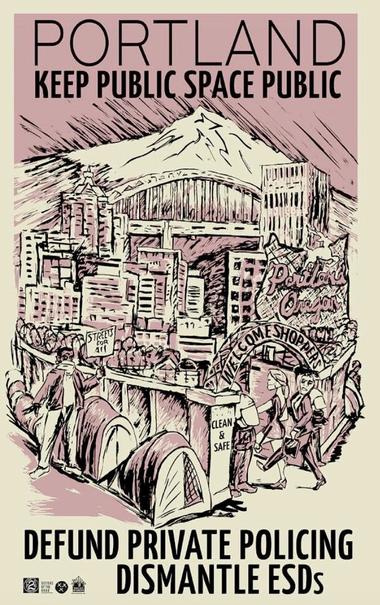
If you live in Portland, OR, this issue concerns you.
Your tax dollars are being used to subsidize corporate lobbying against progressive, community-supported issues like charter reform, Portland Street Response, universal preschool, and the Portland Clean Energy Fund. You have the right to demand transparency and accountability from the City.
What you can do
Through January 15, 2024, the City is collecting public comment on the recommendations for Portland’s ESD program. To submit public comment:
1. Read the talking points below.
2. Email the City ESD coordinator, Devin Reynolds: [email protected].
In February, the City Council will hear the report from the private consultant firm they have hired. See https://www.endcleanandsafe.org/ or https://www.sistersoftheroad.org/current-campaigns/end-esds for updates.
Keep reading to learn more about this problem and how you can help by submitting public comment and attending public meetings.
Context: Portland, ESDs, and Business Lobbyists
In August 2020, the Portland City Auditor conducted an audit (https://www.portlandoregon.gov/auditservices/article/764910) of the city’s enhanced services districts, or ESDs.
● ESDs (which some cities call “business improvement districts” or BIDs) are a public-private partnership: The city authorizes a private entity to, essentially, tax (https://www.mcda.us/wp-content/files_mf/Order_23-02.pdf ) every property within a specific zone to fund services beyond what the city offers, such as extra policing or cleaning.
● Portland currently has three ESDs: Downtown Clean & Safe ESD, Lloyd ESD, and Central Eastside Industrial District.
The largest of the three ESDs, Clean & Safe, operates on a $5 million annual budget and is run by Portland Business Alliance (PBA, AKA Portland Metro Chamber).
● PBA claims to be the voice of local business, but their board mostly represents multinational corporations, commercial real estate companies, banks, and corporate law firms.
● PBA is the city’s most prolific lobbyist (https://bigblinkpdx.org/ ) and has spent significant time and money fighting charter reform (https://www.opb.org/article/2022/07/15/portland-business-alliance-sues-to-block-city-charter-reform-package/) , universal preschool (https://kboo.fm/media/118950-how-portland-metro-chamber-and-business-lobbyists-undermine-education-funding), tenant protections (https://www.wweek.com/news/2022/03/28/the-portland-business-alliance-files-ballot-title-challenge-on-proposed-multnomah-county-capital-gains-tax/) , and Portland Clean Energy Fund (https://www.wweek.com/news/2023/03/01/as-difficult-city-budget-approaches-portland-clean-energy-fund-is-flush/) while pushing pro-business policies.
● The Clean & Safe contract subsidizes PBA lobbying by paying for significant portions of 7 PBA staff salaries (https://www.portland.gov/omf/documents/2021-clean-and-safe-contract-1/download), including:
○ 45% of salary for President & CEO Andrew Hoan
○ 50% of salary for VP of Government Affairs Jon Isaacs
○ 30% of salary for Senior Director of Strategic Communications
○ 45% of salary for Senior Director of Finance and Operations Ariana Alejandres
● Furthermore, Clean & Safe pays $26,000 per year to sit on the PBA board.
But what about the audit?
The 2020 audit found that Portland had limited oversight of its ESDs and zero guidelines for ESD formation or governance, which results in overpolicing and prevents community members from monitoring or having a say in ESD activities. Essentially, the lack of City oversight enables PBA to shield its budget and activities from public scrutiny.
To address these problems, the auditor made three recommendations.
1. Review the status of ESDs, their purposes, and the City’s responsibility for them, then potentially propose City Code to manage ESD formation, allowed scope of activities in public spaces, governance, and reporting
2. Revise agreements with each ESD to align with code changes
3. Develop a process for City oversight of ESD contracts, including a dedicated liaison and public reporting of ESD activities, including law enforcement and security activities to City Council and the public.
The City followed all the audit recommendations, right?
The City did hire an ESD coordinator in 2021. Shawn Campbell hosted several public listening sessions where many voiced opposition to ESDs. However, after one year Campbell was abruptly let go from his position (https://wraphome.org/2023/02/17/portland-or-the-curious-case-of-the-missing-audit-response/) and many of his documents removed from the City website.
A year later, in summer 2023, Portland hired Seattle firm BDS Planning to complete the first audit recommendation. With very little public notice, in December 2023 BDS Planning released a draft program assessment and recommendations (https://www.portland.gov/omf/documents/enhanced-service-district-audit-response-initial-assessment-and-recommendations/download) and held a public listening session (https://www.portland.gov/omf/events/2023/12/12/enhanced-service-district-audit-response-information-session). The City opened public comment on the draft recommendations — but only accepted public comment for one month over the winter holiday season.
After public comment closes, BDS Planning will present its final recommendations to City Council in February 2024. It is unclear if the City intends to follow through with auditor recommendations 2 and 3.
Through January 15, 2024, the City is collecting public comment on the recommendations for Portland’s ESD program.
To submit public comment:
Email the City ESD coordinator, Devin Reynolds: [email protected].
The City has ignored significant public testimony against ESDs. During the Downtown Clean & Safe ESD contract renewal process in 2021, hundreds of community members wrote letters to City Council and dozens more spoke in public meetings (https://www.youtube.com/watch?v=h7Yeda7ULI8) asking the city not to renew its contract with Portland Metro Chamber. The voices of these community members do not appear in the draft report or recommendations. Further, the public comment process for this report occurred over the holiday season, had little publicity, and was very rushed—all factors that will minimize public engagement.
The BDS Planning draft report is biased in favor of ESDs. BDS Planning makes money from consulting on “establishing, managing, and renewing Place Management Districts,” (https://www.bdsplanning.com/key-practice-areas) another term for ESDs. In other words, the firm has a clear interest in recommending that Portland “sustain and expand its ESD program.” Further, BDS Planning founder Brian Douglas Scott was involved in 1985 Oregon legislation that enabled ESDs like Clean & Safe to form, and several members of the BDS Planning team have worked at ESDs across the country. This bias in favor of ESDs shows in their report, which cites “concerns from the ESDs themselves about the accuracy and balance of the audit’s findings” without mentioning the significant public pushback against ESDs in Portland.
The draft recommendations do not meaningfully address concerns about transparency and accountability. While the report mentions the need for transparency with ratepayers, it ignores the need for transparency or accountability to the public. This is problematic for multiple reasons. One, ESD services directly impact the public as many services occur on public streets and sidewalks. Two, many ESD zones include publicly owned buildings, meaning public institutions are ESD ratepayers, and taxpayer money subsidizes some ESD services.
Under PBA, Clean & Safe has consistently failed to deliver results in line with its established mission and commensurate with the level of funding they request. Complaints about the dirtiness of Clean & Safe’s service area abound in the official record as well as in online and in-person chatter. Clean & Safe has not delivered on the promise of “enhanced” sanitation services via privatization. It’s against common sense for City Council to continue to throw money at a bad program.
If ESDs should exist at all, they should deliver effective public services — not subsidize corporate lobbying.
Another vision
1. All ratepayers, including the public as taxpayers, have a right to transparent information about ESDs, particularly their budgets and governance. Public resources are used to collect ESD fees, and public institutions are ratepayers in ESDs. The public should have clear insight into how ESDs operate, who governs them, and what services they offer in addition to detailed budget information.
2. The people of Portland deserve fair, transparent, and public processes when the City contracts with external organizations.
3. Portland needs leaders who do not bend to the will of corporate lobbyists. Portland Metro Chamber lobbies City Council over 7 times more often than the next most prolific lobbyist (https://bigblinkpdx.org/), even though they have also been fined for failing to disclose lobbying meetings (https://www.opb.org/article/2021/04/27/portland-business-alliance-lobbying-rules-violations/) with City officials.
4. The City must invest in public institutions — not private organizations — to carry out essential public services, including sanitation and behavioral and mental health services. PBA has failed to deliver a clean or safe downtown, despite receiving millions of dollars each year to do just that. Time and again, the public has demanded the City invest in functional programs like Portland Street Response.
Some of the problems with BDS Planning’s Recommendations
● BDSP claims that districts like Portland’s ESD’s add proven value to urban environments. They have not demonstrated that this is the case.
● BDSP argues that Portland should sustain and expand its ESD program, even though there has been ample public testimony against them.
● BDSP proposes that the City should modify its guidelines on ESD subcontracting practices to give the ESDs more flexibility to work with small local firms. That is, they propose the City undermine its support for the the rights of subcontracted workers.
#PortlandOregon #PDX
#EndESDs
 emeritrix