In 2021, I was involved in a study of the #chromatin remodeler ALC1, a protein involved in the early events of the DNA damage response. This led to a paper summarized in a previous thread: https://fediscience.org/@Guillawme/111534984107819771

We had deposited the raw #cryoEM data to #EMPIAR (dataset EMPIAR-10739), which is the primary reason this new preprint could come to exist at all.

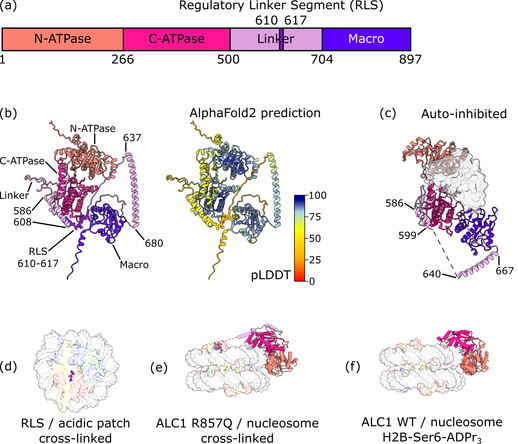
This figure shows the structural knowledge available on ALC1 up to the point of the new structure we report in the preprint. An AlphaFold2 prediction, a structure of the auto-inhibited conformation, and a few structures of ALC1-nucleosome complexes. Notably, none of the structures of nucleosome complexes resolved the macro domain. This is a significant gap, because the macro domain is key in regulating ALC1: it is responsible for auto-inhibition and recruitment to PARylated nucleosomes, and these two things are exclusive, which is why recruitment also causes release of the auto-inhibition. So at this point we know what the protein looks like when auto-inhibited and when active, but how it transitions from the former to the latter is unclear.

2/5

When depositing #cryoEM data to #EMPIAR, I can never remember how to determine the "voxel type" requested in the metadata entry form.

Over the years, I have asked about it on CCPEM, bookmarked the permalink to the answer I received back then (probably in multiple browser profiles) and written similar notes at different places in my system.

Here is one more note about it, this time public: https://www.gaullier.org/en/blog/2025/06/01/voxel-type-empiar-deposition/

Determine the voxel type for an EMPIAR deposition • Guillaume

While finalizing a deposition to EMPIAR, I found myself once again stumbling on the “voxel type” field in the metadata entry form. I looked up how to determine this type from the raw images in the past, and even have notes about it at different places. Here is one more note, hopefully easier to find.

Guillaume

@jeremyforest @jonny

Hosting scientific data in the corporate cloud is a bad idea, given current costs and the volatility of the digital storage industry.

Projects like #EMPIAR https://www.ebi.ac.uk/empiar/ seems more capable and likely to survive into the future.

EMPIAR - Electron Microscopy Public Image Archive

EMPIAR, the Electron Microscopy Public Image Archive centered at EMBL-EBI, is a public resource for raw electron microscopy images related to EMDB, contains micrographs, particle sets and tilt-series.

#OpenSoftwareAcceleratesScience! 😍
---
RT @ribo_rob
Happy to share @cryocloud_io's first blog article & benchmark! Huge thanks to @SjorsScheres for making #Relion #opensource, & @RadoDanev for uploading the data to #Empiar - this would not have been possible otherwise!
#cryoEM #cloudcomputing https://twitter.com/cryocloud_io/status/1621094105492369408
https://twitter.com/ribo_rob/status/1621094951596564480
CryoCloud on Twitter

“Check out our first blog article & benchmark, where we determine a 3.5Å #GPCR structure in less than 3.5h! #cryoEM #CloudComputing #biotech #SBDD link: https://t.co/at1F8VeXqI”

Twitter