‘The Shell Trial’ drowns in too many characters and pamfleteering texts
Engagement in the arts is back. In 2017, Kate Honey composed her Shell Symphony in protest against the Amsterdam Concertgebouw, which was sponsored by the polluting oil giant. Seven years later, Ellen Reid, composer in residence of the Concertgebouw Orchestra, wrote The Shell Trial. This opera was inspired by a play about the lawsuit against Shell in 2021, in which the court ruled that Shell must drastically reduce its CO2 emissions by 2030.
Unfortunately, Reid and her librettist Roxie Perkins chose to radically expand the number of characters, add a children’s choir and a group of elders, and pretty much double the length to almost two hours. This overload causes the basically poignant message to lose force. Somewhat lambasted, you leave the Amsterdam Music Theatre. Has this opera woken me up? Ignited a sense of guilt? Made me think? Nope.
The Shell Trial, Dutch National Opera (c) Marco Borggreve
Brechtian intervention
The Shell Trial begins excitingly enough. As the audience flocks in, the musicians recruited partly from the Royal Concertgebouw Orchestra are already on stage. They practice their tunes, while left and right a dozen people of advanced age look on, coloured white to black and all shades in between. All have roots in the Dutch former colonies, where much damage has been done partly at the hands of Shell. Gradually, they will mingle among the singers, dancing endearingly amateurish.
The equally twelve soloists come up through the side paths and take their places behind the orchestra. Then soprano Lauren Michelle steps forward, says her name and declares what we are about to see and hear. A Brechtian intervention by directors Gable and Romy Roelofsen of Het Geluid Maastricht that works out well.
Shell was not in the least put out by the court’s verdict explains Michelle, but was well prepared for this. After all, the oil company has known for decades how immensely it contributes to climate change, and has prepared scenarios to neutralise a potentially negative ruling.
The appeal filed by Shell will take place in a few weeks. Until we know the outcome, she – and we with her – can only wonder how she can answer to her children later. Is it her/our job to save the world, or should we leave that to the institutions? The performance will take place in Shell’s ‘Scenario Department’. She plays the roles of The Law and The Artist.
Then, Manoj Kamps, dressed in a wrap-around skirt, takes up the baton and a spectacle unfolds in which the singers come up one after the other and sing their lines frontally towards the audience; the hall lights are only slightly dimmed. To nimble music à la Kurt Weill, Lauren Michelle sings to us as The Law: she can pass verdicts, but cannot save us from ourselves. With admirable ease, she tackles Reid’s dizzying melismas, retaining perfect pitch even in extremely high pianissimo passages.
Hypocricy all around
After Michelle, the CEO steps forward, an equally terrific role by Norwegian baritone Audun Iversen. He holds up a mirror to us with sardonic pleasure. We use our gas oven to roast chicken we bought from an organic farm and collected by a car we fuel up twice a month. Of course, we can shift all sins on Shell/him, but is it his job to save the world? He abides by the law and does not set quotas, the shareholders do. ‘I just make a profit for the business that fuels your needs, consumer!’
Thereupon we are then presented with a parade of characters, each with their own reason for doing nothing. The Government calls for slow action because ‘slowness creates understanding’, The Consumer holds the government responsible, The Pilot and The Worker fear losing their jobs, and so on and so forth. Their somewhat pamphleteering lyrics, one-dimensional characters and lack of interaction get in the way of identification, and soon you think: hell, I got the message!
Conveniently, the names of the protagonists are projected on the backdrop. This also shows projections of trial transcripts, bubbling oil, black clouds disintegrating and old-fashioned drilling rigs. Meanwhile, the Historian (another excellent role by American contralto Jasmin White) reminds us of the many calamities Shell has caused in its long existence. With her black skin and thatched skirt, she is the incarnate indictment of centuries of caricatured representation of the indigenous people of our colonies.
Filmic music
Reid supports the singers’ arguments with filmic music. Brooding orchestral sounds bubble up like oil from the depths, punctuated with skyrocketing sounds as of explosions. A constant are the descending lines, dark drones of double basses against abrasive high strings, ticking and tinkling of metal percussion, ominous drum rolls, archaic motifs of a piano and fine solos of brass, (alto) flutes and celli. The repetitive patterns are reminiscent of John Adams’ documentary operas. The American composer definitely has a feel for orchestration, but her music is ultimately too uniform to keep us captivated the entire performance.
The much-heralded children’s choir only appears towards the end, again taking the stage from the hall. They represent the children who have been victimised by Shell over the centuries. With heavenly harmonies, they exhort us to face the future. As they step rhythmically towards us, we are blinded by bright stage lights. Finally, as Future CEO, one of them sings: ‘Yes, we knew, but so did you.’ The children envelop themselves in sleeping bags and on a descending glissando of a tuba, the curtain drops.
Hats off to the performers, who fulfilled their roles with precision and gusto. Still, The Shell Trial would benefit from a subtler libretto and more human interaction. As it stands, the opera remains too detached to move.
https://www.youtube.com/watch?v=bc8wg204-pA
Witnessed 18 March 2024 in the Music Theatre Amsterdam, as part of the Opera Forward Festival. Show runs through 21 March. Commission by Dutch National Opera, in co-production with Het Geluid (Maastricht), Opera Philadelphia and Bregenz Festival.
#EllenReid #GableRomyRoelofsen #LaurenMichelle #RoxiePerkins #TheShellTrial
 The 🫠 ᴘʀᴇᴛᴛʏ BBC Radio 3 🎶 #NowPlaying Bot
 Contemporary Classical - Thea Derks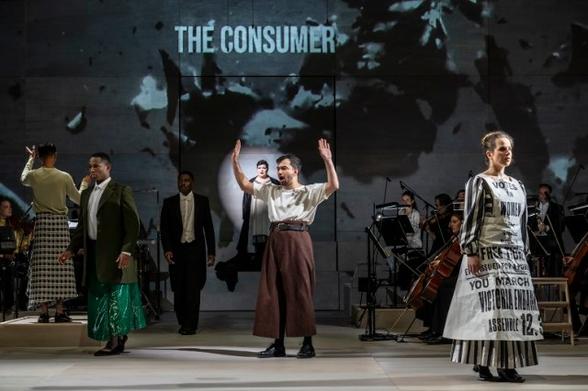


 PostGenre