 Peter Petrík
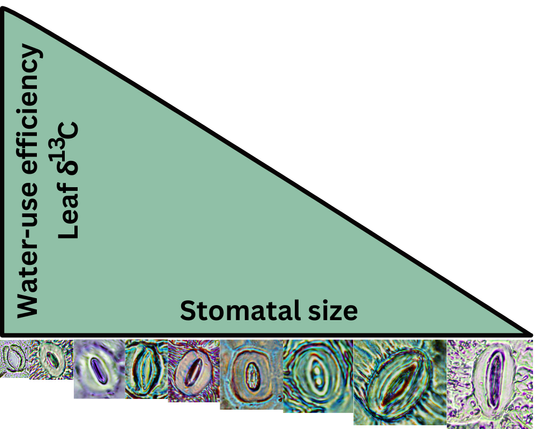
New OA 🔓paper. 🍁Stomatal size correlates negatively with water-use efficiency and leaf δ13C in both juvenile and mature trees.🌳 #ecophys #wue #stomata
https://doi.org/10.1111/ppl.14619
https://doi.org/10.1111/ppl.14619

Among ectotherms, rare species are expected to have a narrower thermal niche breadth and reduced acclimation capacity and thus be more vulnerable to global warming than their common relatives. To assess these hypotheses, we experimentally quantified the thermal sensitivity of seven common, uncommon, and rare species of temperate marine annelids of the genus Ophryotrocha to assess their vulnerability to ocean warming. We measured the upper and lower limits of physiological thermal tolerance, survival, and reproductive performance of each species along a temperature gradient (18, 24, and 30 °C). We then combined this information to produce curves of each species’ fundamental thermal niche by including trait plasticity. Each thermal curve was then expressed as a habitat suitability index (HSI) and projected for the Mediterranean Sea and temperate Atlantic Ocean under a present day (1970–2000), mid- (2050–2059) and late- (2090–2099) 21st Century scenario for two climate change scenarios (RCP2.6 and RCP8.5). Rare and uncommon species showed a reduced upper thermal tolerance compared to common species, and the niche breadth and acclimation capacity were comparable among groups. The simulations predicted an overall increase in the HSI for all species and identified potential hotspots of HSI decline for uncommon and rare species along the warm boundaries of their potential distribution, though they failed to project the higher sensitivity of these species into a greater vulnerability to ocean warming. In the discussion, we provide some caveats on the implications of our results for conservation efforts.
Trying out this platform as Twitter appears to be heading in a bad way. Despite Twitter’s very, very grave flaws, I’ve loved #sciencetwitter and would hate to lose that community and forum.
To introduce myself, I’m working in kelp habitat restoration in the northeast Pacific, and in my past science life I researched fish and invertebrate ecophysiology.
Do we even use hashtags on here? Here goes nothing…#fishsci #kelp #ecophys #restoration


 Nicholas Wu
 William Hammond
 Clay Steell