Europlanet. Sci. Congress 2024, Part Epsi (SSSB) - Asteroid Blog, c Phlo...

Nearing the end of this year’s Europlanet meeting. The program for this day is particularly small-body-related: Keynote lecture SB “Highlights of Hayabusa 2 sample return mission” by Patrick MichelKeynote lecture TP by “An estimate of the impact rate on Mars from statistics of very-high-frequency marsquakes” by Natalia Wojcicka MITM11 Fri, 13 SepPlanetary Defense: space missions,… Read More »Europlanet. Sci. Congress 2024, Part Epsi (SSSB)

Asteroid Blog, c Phlo...

De nombreux membres de l’équipe se sont rendus à l’EuroPlanet Science Congress qui s’est tenu du 8 au 13 Septembre 2024 à Berlin (comme en 2018!).

Inès a présenté le mardi l’état d’avancement de ses travaux qui visent à réunir les géologies des minéraux hydratés des régions d’Oxia Planum et Mawrth Vallis.

Maxime présentait un poster ce même jour sur des échantillons de silice prélevés au Botswana au niveau des lacs salés du Makgadigadki, un analogue terrestre aux observations martiennes. Il a également fait une présentation orale sur l’observation de minéraux hydratés en contexte de volcanisme sédimentaire sur Mars, vendredi matin.

Matthieu a repris ses devoirs et pu présenter un poster MarsSI et rencontrer nouveaux et anciens utilisateurs pour leur parler des évolutions et nouveaux jeux de données tels que CaSSIS.

Cédric a présenté en session orale ses travaux sur les lois géomorphologiques des cratères de petites tailles (<50m), résultats de nouvelle méthodes plus robustes d’estimation des profondeurs de cratères.

L’équipe n’était qu’une partie de l’impressionnante présence française dans cette conférence, ce qui fut l’occasion de nombreux échanges!

https://eplanets.univ-lyon1.fr/2024/09/20/e-planets-a-berlin-pour-lepsc-2024/

#Berlin #Congrès #epsc #epsc2024 #Geomorphometry #MarsSI #MartianAnalogs #MawrthVallis #OxiaPlanum

Mars sous toutes ses coutures à Berlin : – e-Planets

Made it back to @iaa_csic after #EPSC2024 in Berlin and a very productive #comet meeting in @tubraunschweig Some smooth traveling yesterday, thanks (for once!) DB!
Leaving Berlin after #EPSC2024 for Braunschweig for a mini reunion/meeting with colleagues @tubraunschweig . Had time to see some nature and some city yesterday. Wunderbar! 😀
Presenting my poster at #EPSC2024. It summarises the results of my @ISSIBern team which have also just been accepted in @[email protected]

Presentations by #TeamRadar at #EPSC2024 :

Ferrais et al. on the binary asteroid #1994AW1 : https://meetingorganizer.copernicus.org/EPSC2024/EPSC2024-161.html

Cannon et al. on the contact binary asteroid #2006DP14 : https://meetingorganizer.copernicus.org/EPSC2024/EPSC2024-660.html

Abstract EPSC2024-161

The #EPSC2024 meeting is happening this week.

There is quite a lot on the #DARTMission and the #HeraMission : https://meetingorganizer.copernicus.org/EPSC2024/session/51224 .

Also interesting presentations on #Apophis mission plans: https://meetingorganizer.copernicus.org/EPSC2024/EPSC2024-199.html , asteroid satellites found by #Gaia: https://meetingorganizer.copernicus.org/EPSC2024/EPSC2024-770.html , and an asteroid that spins with a period of 2.59 seconds: https://meetingorganizer.copernicus.org/EPSC2024/EPSC2024-719.html

Session MITM11

#EPSC2024 is great, we'll be at the poster for a while!

According to Colin Wilson speaking at #EPSC2024, Mars Express uses just 200g of fuel a year.

Despite being rather squiffy, Mars is massive enough that the spacecraft is in a proper orbit which doesn't require fuel to maintain. A small amount of fuel is therefore used for attitude control each year.

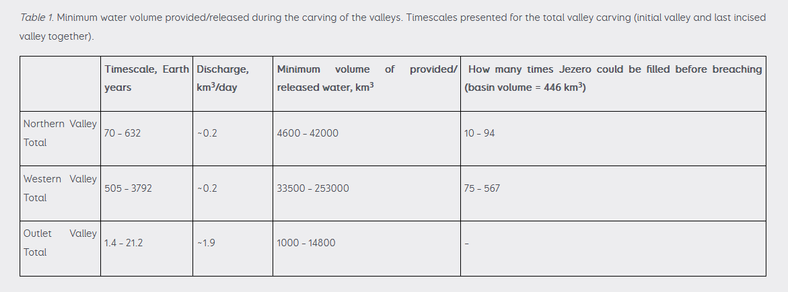
Preliminary presentation in #EPSC2024 of a paper on more modeling of Jezero water budget and delta timescales. Many constraints apply 😉

Ovchinnikova et al: "Water and Sediment Transport Processes in Jezero Crater"
https://meetingorganizer.copernicus.org/EPSC2024/EPSC2024-748.html

#JezeroDeltaScience

Abstract EPSC2024-748