 WE AND THE COLOR
TAN Malone Font by TanType
TAN Malone Is the Retro Display Font Your Next Branding Project Has Been Waiting For
Nostalgia is having a moment—but not the lazy kind. Designers aren’t just reaching for dusty textures and faded palettes anymore. They’re chasing something more specific: the feeling of a neon sign reflected in wet asphalt, a motel marquee glowing at midnight, a Hollywood title card from a film you half-remember. That’s exactly the territory TAN Malone by TanType occupies. And it does so with a confidence that’s rare in the retro display category.
Download the font for a low budget from Creative MarketRetro typography has become one of the most competitive niches in independent type design. Therefore, a new release needs more than a nostalgic premise to earn its place in a working designer’s font library. TAN Malone earns it. After putting it through real projects—restaurant branding mockups, editorial headlines, packaging concepts, and logotype explorations—this typeface holds up with consistent authority. Here’s everything you need to know about it.
TAN Malone font by TanType. Download the font for a low budget from Creative MarketWhat Makes TAN Malone Different from Other Retro Display Fonts?
TAN Malone sits at the intersection of three distinct visual traditions: vintage American motel signage, Art Deco geometry, and old Hollywood glamour. Most retro fonts anchor themselves in just one of these. Malone pulls from all three simultaneously, and that’s what makes it unusually versatile for a display-only typeface.
The letterforms are tall and proportionally narrow—a construction choice that immediately signals classic signage DNA. Consequently, the typeface has strong vertical rhythm. You feel the upward pull of each character even before you read a single word. At the same time, the curves are soft and rounded at their terminals, which prevents the font from reading as cold or overly geometric. This balance between structure and warmth is what I’d call its neon warmth coefficient—a quality where the architectural rigidity of Art Deco meets the approachable glow of a diner sign at 11 pm.
That tension is the whole point. TAN Malone doesn’t try to be one thing. It’s bold but never aggressive. It’s nostalgic but never clichéd. It evokes a specific era without locking you into a period piece aesthetic.
The Anatomy of the TAN Malone Letterforms
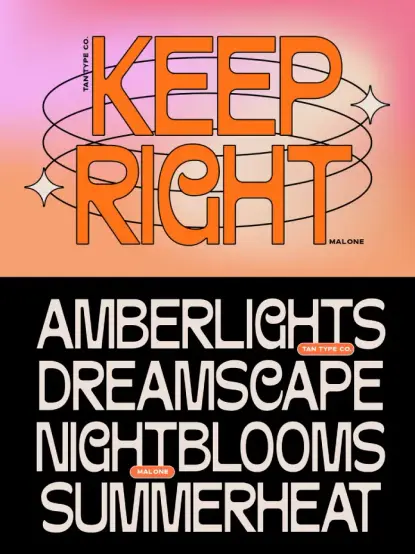
Look closely at individual characters, and you’ll notice a deliberate design language. The uppercase letters carry the weight of the font’s personality. They’re confident, with generous counters that stay open even at smaller display sizes. The geometry is soft-edged—think Art Deco filtered through a roadside sign painter rather than a Manhattan skyscraper architect.
Several letterforms show particularly interesting construction choices. The uppercase M has a measured, symmetrical descent in its central V-junction that feels calligraphic without being ornate. The G has a tucked spur that echoes mid-century American signage lettering without copying it directly. The O and Q sit on subtly elliptical bodies—slightly taller than they are wide—which reinforces the typeface’s tall proportional logic.
These aren’t accidents. Moreover, they’re the kind of micro-decisions that separate a thoughtfully designed display typeface from a template-based nostalgia exercise. TanType clearly spent time studying primary source material.
The Roadside Americana Aesthetic: Why It Resonates Right Now
There’s a cultural reason this visual language is landing so well in 2025. Audiences are exhausted by hyper-polished, algorithm-optimized design. As a result, anything that carries genuine warmth and a sense of physical place feels refreshing. Motel signage, diner typography, and neon-lit Americana connect to an idea of slowness—of actual places with actual character.
TAN Malone taps directly into that appetite. Its visual vocabulary reads as pre-digital, even when used in fully contemporary contexts. Place it on a tote bag, a cocktail menu, or a brand identity for an independent hotel, and it immediately signals authenticity. It doesn’t look like it was generated. It looks like it was made.
This is what I call the Handmade Illusion Index—the degree to which a digital typeface convincingly evokes the warmth of hand-lettered or hand-painted work without actually being either. TAN Malone scores exceptionally high on this scale. Furthermore, it achieves this while maintaining precise geometric construction. That’s a difficult balance, and the designer handles it well.
Where Does Old Hollywood Come In?
The old Hollywood influence shows most clearly in how TAN Malone handles weight distribution. The strokes have a cinematic confidence—thick and deliberate, without the spidery decorative flourishes that make some Art Deco fonts feel overwrought. Think title cards from a 1940s picture show rather than a Great Gatsby party invitation.
This restraint is important. It means the font works in contexts that require authority—a headline, a brand name, a poster credit—without demanding attention in the wrong way. It holds the frame rather than stealing it.
Testing TAN Malone in Real Design Contexts
Theory only takes you so far. So I put TAN Malone through several practical scenarios to understand where it performs and where it has limits.
Restaurant and Bar Branding
This is the most natural home for TAN Malone, and it shows. Set in a deep burgundy against cream stock on a menu cover, the font immediately communicates warmth, personality, and a sense of place. It doesn’t look like it’s trying to be vintage—it simply is. For a cocktail bar, a late-night diner, or a retro-styled restaurant concept, this typeface does immediate heavy lifting.
Specifically, it works best at headline scale—48pt and above—where the details of its construction are fully visible. Below 30pt, some of the nuance in the letterforms starts to compress. For body copy or small-size applications, pair it with a neutral grotesque or a classic humanist sans.
Packaging and Product Labels
TAN Malone on packaging brings a premium-but-playful energy that’s genuinely hard to achieve. I tested it on a candle label concept and a hot sauce bottle mockup. In both cases, the typeface communicated character without overwhelming the product. The tall proportions work particularly well on narrow label formats—bottles, tubes, and sleeves—where vertical space is limited and readability at small dimensions is critical.
Additionally, the font pairs well with simple two-color print treatments. Black on kraft, white on deep green, gold on navy—TAN Malone handles all of these with ease. Its clean construction means it doesn’t get muddy with spot-color or foil processes.
Editorial Headlines and Poster Typography
Set as a magazine cover headline at 120 pt, TAN Malone fills space with authority. The tall proportions create strong vertical blocks of type that photograph well and reproduce clearly. For editorial use, it works best with generous tracking—5 to 10 units of letter spacing—which opens the forms up and lets each character breathe.
On posters, it combines naturally with photographic backgrounds. The bold, open construction means it doesn’t disappear against complex images. Furthermore, it layers well with secondary typefaces—particularly slab serifs and monolinear scripts—for multi-typographic layouts.
Logo and Wordmark Design
TAN Malone makes a convincing wordmark typeface for the right brand identity. It’s most compelling for brands in the hospitality, food and beverage, creative services, and lifestyle categories. The letterforms are distinctive enough to carry a brand name without modification but also structured enough to allow careful custom adjustments when a designer wants to push the refinement further.
One important note: because of its display-oriented proportions, TAN Malone works best in horizontal or mixed-case logotype treatments. All-caps text set in a tight stacked arrangement can feel heavy. Give it room to breathe horizontally.
TAN Malone and the Broader TanType Design Philosophy
TanType has built a distinctive identity in the independent type design space. Their portfolio—which includes typefaces like TAN Fairmont, TAN Thistle, and TAN Waverly—reflects a consistent design philosophy: classical influences, meticulous construction, and a preference for typefaces with strong standalone personality.
Each TanType release typically includes over 300 glyphs and advanced OpenType functionality. TAN Malone follows this pattern. Multilingual support is included, which matters more than most designers initially realize. Working on projects with non-English copy—German, French, Spanish, and Portuguese—requires proper diacritics and extended character sets. The fact that TAN Malone ships with this support built in removes a significant workflow friction point.
Free future updates are also included with purchase. That’s a meaningful commitment from a type designer. It signals that TAN Malone is a living product rather than a static asset.
TanType’s Approach to Retro Typography
What separates TanType from many boutique type foundries is their willingness to commit fully to a visual reference without becoming nostalgic tribute acts. TAN Malone doesn’t feel like a museum piece. Instead, it feels like something that could have been designed in 1948 but was actually refined for contemporary design practice.
This approach—which I call Temporal Displacement Design—produces typefaces that feel historically rooted but practically contemporary. The result is a font that works equally well on a vintage-inspired coffee brand and a contemporary fashion editorial. The visual references are clear, but the execution never feels trapped by them.
Who Should Use TAN Malone?
TAN Malone is a specialist tool. It won’t serve every project, and it shouldn’t. But for the right applications, it’s exceptionally effective.
Brand designers working in hospitality, food and beverage, lifestyle, or entertainment will find it immediately useful. Editorial designers who need a typeface with strong personality for feature headlines or cover treatments will reach for it regularly. Packaging designers working on artisan, vintage-inspired, or premium casual products will find it earns its place in their toolkit.
Importantly, TAN Malone is also a strong choice for designers who want to bring a sense of warmth and wit to otherwise neutral brand systems. Paired with a clean geometric sans for body copy, it creates a typographic contrast that feels considered rather than accidental.
When to Avoid TAN Malone
Not every brief calls for roadside Americana. Corporate identity work, fintech, medical, or enterprise software contexts are unlikely to benefit from TAN Malone’s personality. Similarly, any project that requires body-copy-scale typography should look elsewhere. This is a display typeface through and through. Use it accordingly.
Extended digital reading environments—websites, apps, and long-form documents—aren’t where this font belongs. Its strength is impact on a large scale. Respect that constraint, and it will reward you consistently.
TAN Malone Pairing Recommendations
Every display font needs complementary typefaces to function in real-world layouts. Here are combinations that work reliably with TAN Malone.
For Editorial and Magazine Layouts
Pair TAN Malone headlines with a clean, neutral grotesque for body copy—something like Inter, Neue Haas Grotesk, or Aktiv Grotesk. The contrast between Malone’s warm, retro personality and a modern, functional sans creates visual dialogue without competition.
For Brand Identity Systems
Consider a humanist serif like Freight Text or Garamond Premier Pro for secondary typographic elements. The warmth in those serifs complements Malone’s personality without mimicking its aesthetic. Alternatively, a monolinear script for smaller accent text—à la 1950s restaurant menus—reinforces the vintage Americana register.
For Packaging
A condensed slab serif works particularly well alongside TAN Malone on product packaging. The structural contrast reads clearly in small-format applications and gives the layout a sense of layered typographic hierarchy.
The Future of Retro Display Typography
Retro display fonts are not a passing trend. They’re a response to a permanent cultural appetite for warmth, character, and visual specificity in an increasingly generic digital landscape. Consequently, the market for well-executed vintage-inspired typefaces will continue to grow.
My prediction: the next wave of retro typography will move away from broad period references—”1950s,” “Art Deco,” “vintage”—toward hyperspecific cultural moments. Think single-city signage traditions, specific decade aesthetics within decades, or narrow industrial contexts like laundromat lettering or drive-in theater marquees. TAN Malone already points in this direction with its motel-specific reference frame. It’s ahead of the broader market shift.
Furthermore, as AI-generated imagery becomes increasingly dominant in commercial design, the demand for typefaces with genuine craft pedigree will intensify. Fonts like TAN Malone—built on real historical reference and executed with precision—will carry increasing premiums in that environment. They’ll signify that a human designer made deliberate choices.
TAN Malone: A Final Assessment
At $19 on Creative Market, TAN Malone is a strong value proposition. It’s a typeface with clear creative conviction, practical multilingual support, and a visual personality that earns attention in competitive design contexts. After thorough testing across multiple use cases, I’m comfortable recommending it as a primary display font for the right projects.
It’s not a universal tool. However, within its intended territory—branding, packaging, editorial, and poster design—it performs with consistency and style. The motel signage and old Hollywood references aren’t arbitrary. They’re channeled through a genuine design intelligence that understands both the history and the contemporary application of this aesthetic.
TAN Malone knows exactly what it is. That clarity of identity is, ultimately, what makes a display typeface worth using.
Download the font for a low budget from Creative MarketFrequently Asked Questions About TAN Malone
What is TAN Malone?
TAN Malone is a retro display font designed by TanType. It draws inspiration from vintage motel signage, neon-lit Americana streetscapes, and old Hollywood title card typography. The typeface features tall proportions, soft geometric curves, and a bold yet approachable visual character suited to display applications.
Who designed TAN Malone?
TAN Malone was designed by TanType, an independent type foundry known for producing classical and decorative typefaces with strong visual personality. Their portfolio includes numerous retro, serif, and display typefaces available through Creative Market and other type marketplaces.
What design styles does TAN Malone suit?
TAN Malone is best suited to projects requiring a vintage Americana, Art Deco, or old Hollywood aesthetic. It works particularly well for restaurant and bar branding, packaging design, editorial headlines, poster typography, and logo or wordmark design in the hospitality, food and beverage, and lifestyle sectors.
Does TAN Malone support multiple languages?
Yes. TAN Malone includes multilingual support, covering extended Latin character sets with the diacritics required for French, German, Spanish, Portuguese, and other European languages. Free future updates are also included with purchase.
What font formats does TAN Malone come in?
TanType fonts typically ship in OTF, TTF, WOFF, and WOFF2 formats, covering desktop use in Adobe Creative Cloud applications and web embedding needs. Check the current product listing on Creative Market for the specific files included with TAN Malone.
What fonts pair well with TAN Malone?
TAN Malone pairs well with clean grotesque sans-serifs (such as Inter or Neue Haas Grotesk) for editorial and branding layouts, humanist serifs (such as Garamond or Freight Text) for secondary typographic elements, and condensed slab serifs for packaging hierarchy. Monolinear scripts also complement its vintage Americana register effectively.
Is TAN Malone suitable for body copy or digital interfaces?
No. TAN Malone is a display typeface designed for headline, logotype, and large-scale applications. It is not recommended for body copy, extended reading text, or small-scale digital interface typography. Its strength lies in high-impact display use at 30pt and above.
Where can I buy TAN Malone?
TAN Malone is available for purchase on Creative Market, where it is priced at $19. TanType also distributes their typefaces through other type marketplaces. Check YouWorkForThem and similar platforms for additional purchasing options.
How does TAN Malone compare to other retro display fonts?
TAN Malone distinguishes itself from other retro display fonts by combining three distinct visual references—vintage motel signage, Art Deco geometry, and old Hollywood typography—in a single cohesive design. Most comparable typefaces anchor to one reference tradition. Malone’s multi-source approach gives it broader contextual range while maintaining a consistent, identifiable character.
Is TAN Malone a good investment for professional designers?
For designers working regularly in branding, packaging, editorial, or hospitality design, TAN Malone represents strong value at its price point. Its multilingual support, free future updates, and strong performance across multiple use cases make it a practical addition to a professional type library—provided the project brief calls for a retro display aesthetic.
Check out other trending typefaces on WE AND THE COLOR.
#displayFont #font #retroFont #TANMalone #TanType #typeface #vintageFont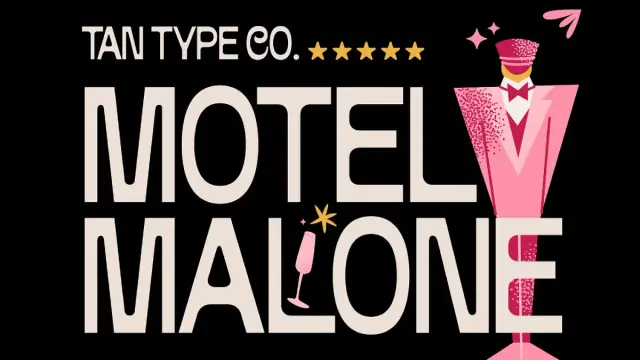
 Letterhanna Studio