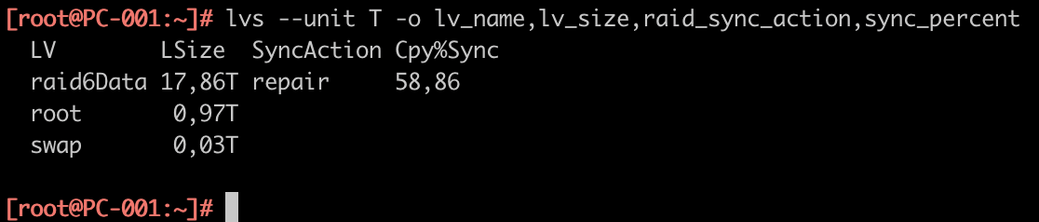
A few hours ago I complained about the dmraid initialisation taking ages.

Well dodged a bullet there I think.

Maybe I should always just run a "dd if=/dev/random of=/dev/newDrive" before using them.

This one was old but still brand new. It most likely got damaged in shipping (but too late to complain to the vendor about it as I had laying it around for a while myself too...

#linux #devicemapper #LVM

Why does initialising a new dmraid raid6 with dmintegrity and striping across all disks take so long...

#LVM #devicemapper #Linux #RAID

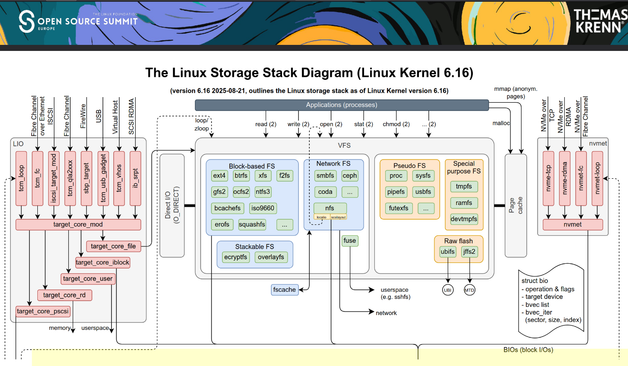
Recording (https://www.youtube.com/watch?v=05gfIRahZA8 ) and slides (https://static.sched.com/hosted_files/osseu2025/e4/OSS-EU25-Werner-Fischer-The-Power-of-theDevice-Mapper.pdf ) from Werner Fischer's #OSSEU25 talk "The Power of the #DeviceMapper - From Dm-cache To Dm-zoned" are now online.

From the abstract: "The device mapper has been part of the #LinuxKernel since #kernel version 2.6. It allows the creation of virtual block devices by mapping their address space to other block devices or special functions. In this way, it can map physical block devices such as hard disks or SSDs to higher-level virtual block devices. It is the basis for the Logical Volume Manager (LVM), #Linux software RAIDs and dm-crypt encryption, and provides additional features such as file system snapshots.

However, the use of Device Mapper targets is not limited to that. Many other targets offer often unknown features. Most of these are intended for production use. However, there are also some targets designed specifically for debugging.

In this talk, Werner gives a full overview of all Device Mapper targets.

For production use these are: dm-cachd, dm-clone, dm-crypt, dm-ebs, dm-era, dm-integrity, dm-linear, dm-mirror, dm-raid, dm-stripe, dm-switch, dm-thin, dm-unstripe, dm-verity, dm-vdo, dm-writecache and dm-zoned.

For debugging: dm-delay, dm-dust, dm-flakey and dm-zero.

He also briefly shows drbd, md (RAID) and bcache, which, like device mapper targets, can work as devices "on top" of normal block devices."

https://osseu2025.sched.com/event/25VsT/the-power-of-the-device-mapper-from-dm-cache-to-dm-zoned-werner-fischer-thomas-krennag

Linux 6.15 will offer inline crypto for Device Mapper

The upcoming version of Linux has just earned new code for improvements to the Device Mapper feature due to how this pull request was merged. The following changes were made to the device mapper fe…

Aptivi

Maximizing hardware with SSD caching via Device Mapper: or, how I got my aging setup's startup time from 8 minutes to mere seconds thanks to Linux.

https://bojidar-bg.dev/blog/2025-02-07-dm-cache/

#linux #archlinux #dmcache #initramfs #performance #devicemapper #ssd

LVM2 Resource Page

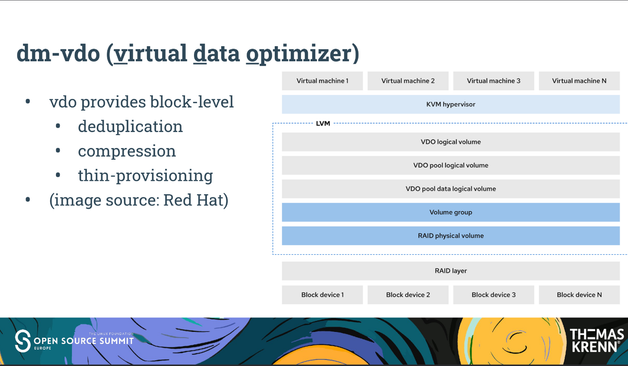
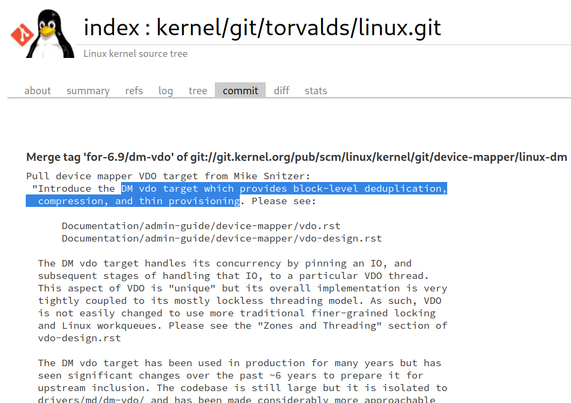
The #DeviceMapper #VDO target, which provides block-level deduplication, compression, and thin provisioning, has been merged for #Linux 6.9: https://git.kernel.org/torvalds/c/61387b8dcf1dc0f30cf690956a48768a3fce1810

For more details see https://git.kernel.org/pub/scm/linux/kernel/git/torvalds/linux.git/plain/Documentation/admin-guide/device-mapper/vdo.rst and https://git.kernel.org/pub/scm/linux/kernel/git/torvalds/linux.git/plain/Documentation/admin-guide/device-mapper/vdo-design.rst; from the former:

"As a device mapper target, it can add these features to the storage stack, compatible with any file system. The vdo target does not protect against data corruption, relying instead on […]"

#LinuxKernel #kernel

Interesting, the #Linux #kernel device mapper target "dm-vdo" that allows deduplication and compression is finally submitted upstream:

v1: https://lore.kernel.org/all/2023050901[email protected]/

v2: https://lore.kernel.org/all/2023052321[email protected]/

122 files changed, 58741 insertions(+) 🥴

```[…] The dm-vdo target provides inline deduplication, compression, zero-block elimination, and thin provisioning. A dm-vdo target can be backed by up to 256TB of storage, and can present a logical size of up to 4PB. […]``` #LinuxKernel #DeviceMapper

[dm-devel] [PATCH 0/5] Add the dm-vdo deduplication and compression device mapper target. - J. corwin Coburn

 Linux 5.1 kann zu Datenverlust führen

Kernel 5.1 hat einen Fehler im Device Mapper eingeführt, der unter bestimmten Umständen zu massivem Datenverlust führen kann. Vorweg sei gesagt, dass der Fehler nur verschlüsselte Systeme betrifft. Wer nicht zu diesem Anwenderkreis gehört, muss sich also keine Sorgen machen.

#Linux #Linux51 #Datenverlust #Kernel #Kernel51 #Fehler #DeviceMapper #verschlüsselteSysteme

https://linuxnews.de/2019/05/linux-5-1-kann-zu-datenverlust-fuehren/

Linux 5.1 kann zu Datenverlust führen | linuxnews.de

Kernel 5.1 hat einen Fehler im Device Mapper eingeführt, der unter bestimmten Umständen zu massivem Datenverlust führen kann.