Fun fact: the ethereal #Datatrak sound even got into a short film. "145 kHz" by Ian Bell and Julia Childs at Another Wave AV Productions.

https://www.youtube.com/watch?v=krF8f1Ic690

https://collections-search.bfi.org.uk/web/Details/ChoiceFilmWorks/150736624
145khz

YouTube

I think the thing I'm most chuffed about with all the #Datatrak stuff isn't the reverse engineering. It's that I added "wav file output" as an option and one of the people who helped build the system now has it as his phone ringtone.

I'm not far off doing that myself... after some filtering it has a sort of ethereal air about it. To the point someone made a film, "145 kHz", about it.

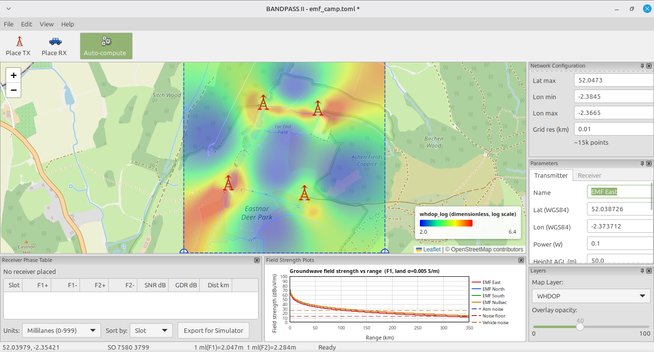
I won't say why I'm using Eastnor Deer Park as a test location, but also please don't tell Jonty. #datatrak

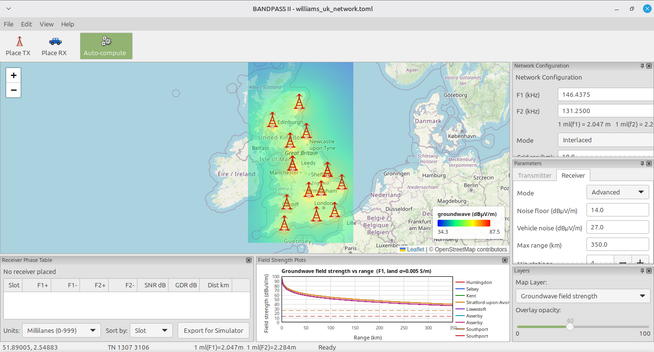
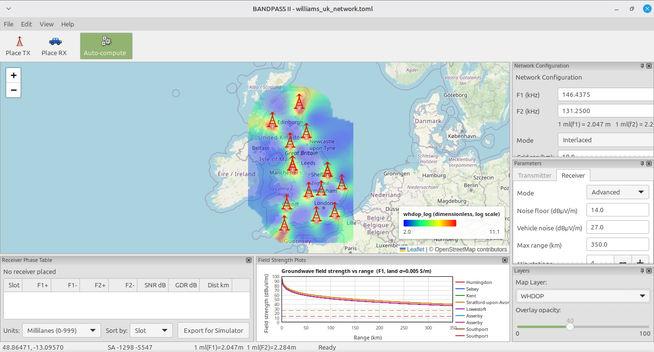
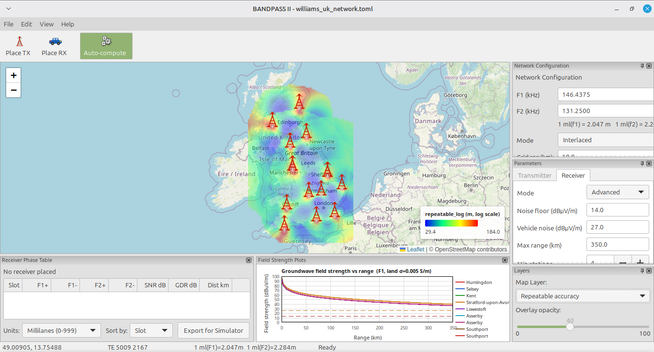
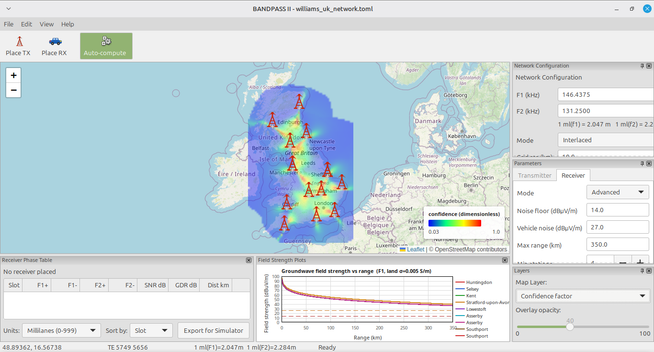
This is what the old Datatrak UK network looks like in field strength, WHDOP, repeatable accuracy and measurement confidence factor.
These seem to match up pretty closely with Williams (2004).
If you want to play with it, it's on Github:
https://github.com/philpem/datatrak-bandpass2

Tip: Set the Grid Resolution to about 10km per square to start with for fast calculation, then reduce it for prettier plots.
#Datatrak

If anyone else is interested in the #Datatrak LF navigation network, it turns out Alwyn Williams' PhD thesis is on the University of Bangor's website for download:
https://research.bangor.ac.uk/en/studentTheses/prediction-of-the-coverage-and-performance-of-the-datatrak-low-fr/

This contains a mountain of information on the network and how it was set up. It's a long read though - 300 pages.

Prediction of the coverage and performance of the Datatrak low-frequency tracking system

Bangor University

macOS and Linux autobuilds 95% pass rate. Takes under a minute (each) to run.
Windows autobuild? 45%. Takes 20 minutes to run.

I'm on the verge of disabling the Windows autobuild and saying "screw that platform".

(this is related to my trying to put together a #Datatrak network simulator and foolishly answering "which platform?" with "yes")

Doing work while I occasionally watch my poor Thinkpad running number crunching to undo the effect of an IIR filter by brute force and ignorance.
#datatrak things.
Anyone wanting to make a hokey #Datatrak transmitter in the 1980s/90s would have had a job on. The phase values go through an IIR filter on their way to the trigger (sync marker) template matcher.
If you use the trigger templates from the firmware, it only matches on '1' bits. If you use a sine wave it won't match at all.
I'm using simulated annealing and a model of the receiver software to try and improve the trigger waveforms...
great, now I have an #EMFcamp project crisis: do I do the cable TV, or do I try and talk some people into putting up big masts and bringing back #Datatrak for one weekend only?
Spent a bit of time looking at #Datatrak again last night. The upshot is, now I know how the almanac, Fast Update Table (almanac updates) and vehicle commands are sent.
It's not fast. One byte every 1.68 seconds, muxed into three streams. About 108 seconds to send a packet (command) on all three streams.