💁🏻♀️ TIL: 🐟🧠 A see-through #fish called #Danionella lets scientists watch its #brain while it swims, no surgery needed.
Researchers at #HHMI and UC #SanDiego aim to decode how 650,000 neurons produce complex behaviors, using #AI to bridge the gap between brain activity and action.
👉 https://www.npr.org/2026/06/16/nx-s1-5859393/ai-science-brain-humans-fruit-fly-danionella
#neuroscience #science #janelia #artificialintelligence #research #biology #animals #washingtondc
💁🏻♀️ TIL: 🐟🧠 A see-through #fish called #Danionella lets scientists watch its #brain while it swims, no surgery needed.
Researchers at #HHMI and UC #SanDiego aim to decode how 650,000 neurons produce complex behaviors, using #AI to bridge the gap between brain activity and action.
👉 https://www.npr.org/2026/06/16/nx-s1-5859393/ai-science-brain-humans-fruit-fly-danionella
#neuroscience #science #janelia #artificialintelligence #research #biology #animals #washingtondc
Ultrafast sound production mechanism in one of the smallest vertebrates
#Danionella https://www.pnas.org/doi/full/10.1073/pnas.2314017121Von wegen stumm wie ein Fisch: Der gerade einmal fingernagelgroße Fisch Danionella cerebrum kann Töne von mehr als 140 Dezibel erzeugen – und zwar indem er mit seinen Rippen trommelt.
#Fisch #Danionella #Tierlaute #Biologiehttps://www.scinexx.de/news/biowissen/dieser-fisch-trommelt-mit-seinen-rippen/
Dieser Fisch trommelt mit seinen Rippen
Von wegen stumm wie ein Fisch: Der gerade einmal fingernagelgroße Fisch Danionella cerebrum kann Töne von mehr als 140 Dezibel erzeugen – und zwar indem
@albertcardona @benjulab @andrewplested #Danionella's beauty and the work from Benjamin's lab makes it easy to fall in love (again)

Longitudinal in vivo imaging of adult Danionella cerebrum using standard confocal microscopy
Editor's choice: Experimental imaging setup, materials and procedures for in vivo and longitudinal confocal imaging of the transparent adult vertebrate model Danionella cerebrum.
Happy to share our comparative analysis of #Danionella cerebrum and #zebrafish larval locomotor activity in a light-dark test
https://www.frontiersin.org/articles/10.3389/fnbeh.2022.885775/full

A comparative analysis of Danionella cerebrum and zebrafish (Danio rerio) larval locomotor activity in a light-dark test
The genus Danionella comprises some of the smallest known vertebrate species and is evolutionary closely related to the zebrafish, Danio rerio. With its optical translucency, rich behavioral repertoire, and a brain volume of just 0.6 mm3, Danionella cerebrum (Dc) holds great promise for whole-brain in vivo imaging analyses with single cell resolution of higher cognitive functions in an adult vertebrate. Little is currently known, however, about the basic locomotor activity of adult and larval Danionella cerebrum and how it compares to the well-established zebrafish model system. Here, we provide a comparative developmental analysis of the larval locomotor activity of Dc and AB wildtype as well as crystal zebrafish in a light-dark test. We find similarities but also differences in both species, most notably a striking startle response of Dc following a sudden dark to light switch, whereas zebrafish respond most strongly to a sudden light to dark switch. We hypothesize that the different startle responses in both species may stem from their different natural habitats and could represent an opportunity to investigate how neural circuits evolve to evoke different behaviors in response to environmental stimuli.
 TKSST • seethis.tv 🌈🪐✨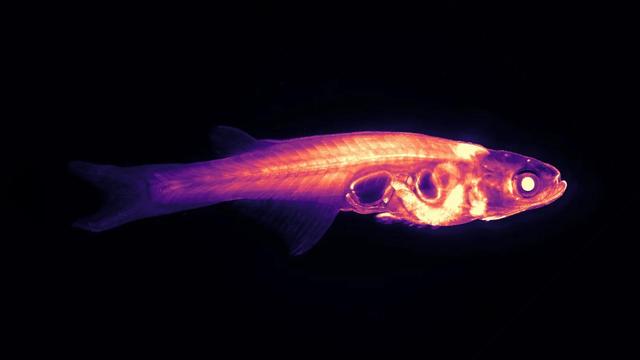

 daniodanionella
 scinexx - das wissensmagazin