 Miguel Afonso Caetano
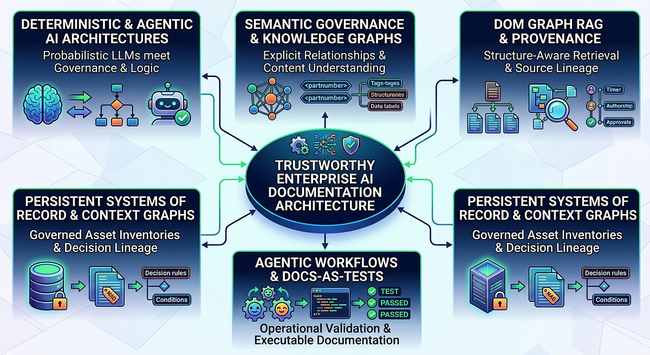
"The future of enterprise technical documentation will not belong to organizations that merely generate more content with AI. It will belong to organizations that build semantically governed, operationally validated, and explainable knowledge ecosystems around AI generation.
Large language models are remarkable language-generation systems, but they remain fundamentally probabilistic, and no amount of vector-based probabilistic augmentation, recursive prompt gymnastics, or trillions of additional parameters magically transforms probabilistic token prediction into deterministic operational intelligence — regardless of what the AI snake-oil salesmen on LinkedIn insist between inspirational rocket-ship emojis. LLMs predict statistically likely outputs. They do not inherently understand operational correctness, governance policy, procedural safety, rollback integrity, regulatory compliance, or whether the “helpful” configuration change they just suggested is going to quietly detonate a production Kubernetes cluster at 2:13 a.m. while everyone is asleep and the on-call engineer is reconsidering their career choices.
That is not a moral failure of AI. It is simply the architectural reality of probabilistic systems pretending to perform deterministic operational reasoning often enough to make people dangerously optimistic.
This is precisely why deterministic models and governance matter.
Structured content, semantic markup, metadata governance, provenance tracking, DOM Graph RAG, iiRDS frameworks, knowledge graphs, RDF and OWL ontologies, context graphs, deterministic inference engines, orchestration platforms, Docs-as-Tests automation, and runtime observability together create something fundamentally different from prompt engineering. They create governed operational ecosystems capable of supporting trustworthy enterprise AI at scale."
#AI #GenerativeAI #DocsAsTests #LLMs #AgenticAI #DITAXML #AIAgents #TechnicalWriting #SoftwareDocumentation

 Jarno Elovirta
 Jarno Elovirta
 Bill
Bill