New data reveals rising coal tip risk in Bridgend and Neath Port Talbot
Coal tip danger escalates in South West Wales
The risk rating has increased to the highest levels for five more coal tips in Bridgend and Neath Port Talbot, bringing the total number of high‑risk tips in these former mining communities to more than 80.
The newly classified tips include two in the Llynfi Valley above Caerau and Maesteg, and three in the Godre’r‑graig area of the Swansea Valley — the same community where a primary school was closed and later demolished because of fears a spoil tip could collapse.
Neath Port Talbot: Godre’r‑graig in the spotlight
Neath Port Talbot has 41 high‑risk coal tips in total. The latest update confirms that three tips at Godre’r‑graig have been reclassified to Category D, the highest risk level.
The reclassification comes just six years after Godre’r‑graig Primary School was evacuated and later demolished because of the threat from a spoil tip above the playground. Families in the village are still waiting for a permanent replacement school.
Other high‑risk tips in Neath Port Talbot are concentrated in the Afan Valley (Cymmer, Croeserw, Glyncorrwg), the Dulais Valley (Crynant, Seven Sisters, Onllwyn), and around Resolven and Blaengwrach.
📊 Table: Neath Port Talbot high‑risk tips
UID(s)CategoryLocation (valley/community)NotesT38145, T40984, T47697D
Swansea Valley (Godre’r‑graig)Reclassified to D in Oct 2025T60700, T63668, T42668, T11695, T37552, T76262, T62866, T13187, T34072D
Afan Valley uplands (Cymmer / Croeserw / Glyncorrwg)Multiple D tipsT14107, T79553, T92286, T81660C
Resolven / Glynneath clusterUpland sitesT68909, T66999, T15396, T99421C
Cwmgors / Onllwyn / CrynantEastern fringeT56703, T52113, T57200, T25164C
Blaengwrach uplandsClusteredT35787, T92095, T25116, T93419C
Upper Dulais Valley (Crynant / Seven Sisters)Several C tipsT67079D
Vale of Neath (Cwmgwrach)Site where safety works are now underway
Bridgend: Valleys carry the heaviest burden
Bridgend has 42 high‑risk tips — the highest number in South West Wales. The Garw and Llynfi valleys carry the greatest concentration, with clusters above Pontycymmer, Blaengarw and Caerau.
Two tips in the Llynfi Valley were reclassified to Category D in the October 2025 update, adding to long‑standing concerns in communities where spoil heaps sit above homes and schools.
📊 Table: Bridgend high‑risk tips
UID(s)CategoryLocation (valley/community)NotesT57724, T39158, T71689, T55621, T72477, T17377, T16088, T96040, T98300, T79775, T66578, T22623, T48095C
Garw Valley (Pontycymmer / Blaengarw cluster)Dense clusterT66915, T64633, T16374, T66769, T63136, T19176, T51749C
Ogmore Valley (Ogmore Vale / Nantymoel)Spread along valley sidesT87850, T83902, T20189, T32192, T69036, T56164, T51066, T61697, T77556, T14326C
Llynfi Valley (Maesteg / Caerau uplands)Includes
2 reclassified to DT15085, T22767, T23295, T56365, T18431D
Llynfi Valley (Caerau cluster)High‑riskT82977D
South Bridgend fringe (Heol‑y‑Cyw)Single D tip
Swansea, Carmarthenshire and Pembrokeshire: lighter but not risk‑free
Further west, the numbers are smaller but the risks remain. Swansea has five Category C tips, spread across Cadle/Portmead (2), Pontardawe, Felindre and Loughor. None are currently rated at Category D, but all require annual inspections.
Neighbouring Carmarthenshire has just one Category C tip, located at Ammanford in the Amman Valley — the only high‑risk site in the county.
In Pembrokeshire, no Category C or D tips are recorded, reflecting the county’s different mining history.
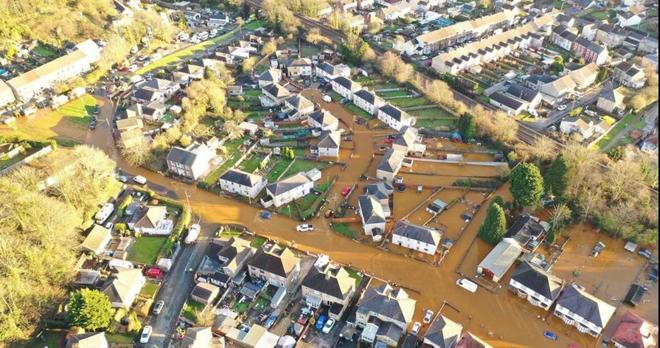
The city and county have also faced other mining‑related legacies. In January 2021, homes in Clydach were flooded after water surged from old mine workings, underlining how the impact of coal is not confined to spoil tips alone.
Flooding in Clydach in 2021 after water surged from old mine workings — a stark reminder of the risks left by Wales’ mining legacy.
📊 Table: Swansea & Carmarthenshire high‑risk tips
UIDCategoryLocation (community)NotesT11227C
Cadle / PortmeadInspected 17/12/2024T63355C
Cadle / PortmeadAdjacent to T11227T54355C
Pontardawe uplandsInspected 23/01/2025T49702C
Felindre / North Gower fringeInspected 29/01/2025T60119C
LoughorInspected 07/01/2025T69583C
Ammanford (Amman Valley)Only high‑risk tip in Carmarthenshire
➡️ Pembrokeshire: No Category C or D tips recorded.
A legacy of tragedy and neglect
It is almost sixty years since the Aberfan disaster, when 116 children and 28 adults were killed as a coal tip collapsed onto a school and nearby homes.
Coalfield historian Ben Curtis said that while some tips were removed or made safe after Aberfan, the danger has never gone away.
“It is a potential problem that continues to remain for some of these tips to become unsafe over time, perhaps because of factors like the effects of climate change and increased rainfall,” he said.
For decades afterwards, little was known about the precise locations or conditions of Wales’ thousands of disused coal tips. That changed only after a landslip above Tylorstown in Rhondda Cynon Taf five years ago, which prompted the creation of a national register and new legislation to ensure tips were monitored and made safe.
Today, more than 2,500 disused coal tips have been identified across Wales, the majority of them in the south Wales coalfield. Of these, 360 are classed as Category C or D — the higher‑risk sites that must be inspected once or twice a year. Lower‑risk tips are categorised as A or B.
Rhondda Cynon Taf, Merthyr Tydfil and Caerphilly remain the counties with the highest concentrations of Category C and D tips, each with more than 50. But the latest figures show that communities in Bridgend, Neath Port Talbot, Swansea and Carmarthenshire are also living with dozens of high‑risk sites on their hillsides.
New dataset and map
The figures come from the latest update to the Welsh Government’s national coal tip database, published on 3 October. The database, first launched in 2023, is updated twice a year and is available through an interactive online map that allows residents to check the location and risk category of tips near their communities.
Coal Authority chief executive Lisa Pinney said managing tips on hillsides was key to reducing risk.
“Just under 300 are higher‑risk sites but that really just means that they need much more regular attention and inspection to make sure they stay safe. Any tip which is old mining material sitting on a hillside can pose a risk, obviously, but the key thing to their safety is to manage water and keep it away. And that’s why these inspections and maintenance are so important.”
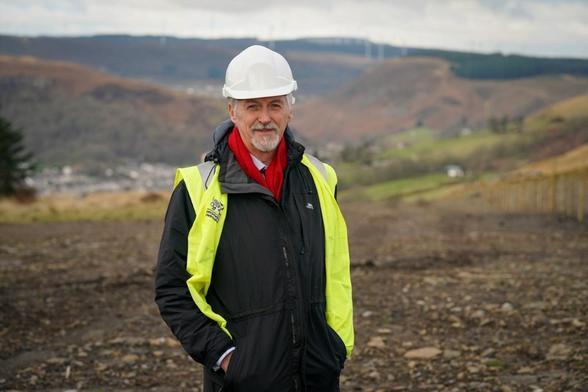
Deputy First Minister Huw Irranca‑Davies visiting a coal tip site as new safety data and legislation are rolled out.
Deputy First Minister Huw Irranca‑Davies added:
“The regular updating of this national, publicly available data demonstrates our unwavering commitment to coal tip safety across Wales, and our absolute dedication to protecting people. I want to reassure people living near to where tips have moved categories that this means they will receive increased monitoring and management.”
Related stories from Swansea Bay News
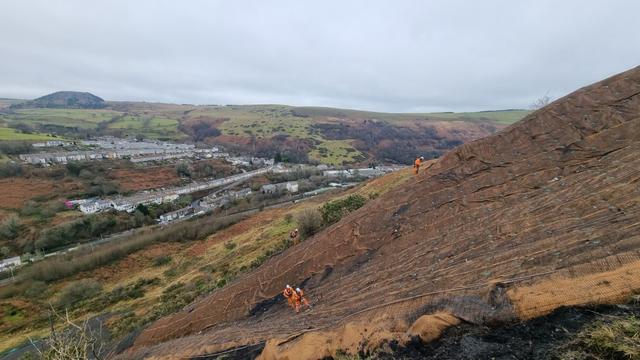
Safety works to begin at Cwmgwrach coal tip to reduce landslip risk
Drainage improvements are being carried out at a Vale of Neath tip recently upgraded to Category D.
Record funding for coal tip safety works announced – including more than £6.3m for Neath Port Talbot
The highest annual spend to date includes millions earmarked for local sites.
Investment and legislation
The Welsh and UK governments say they have now committed more than £220m to coal tip safety, with £118m pledged by Westminster over three years and the remainder from Cardiff Bay. Officials say the funding is being used for inspections, maintenance and remediation works.
But ministers have also warned that the true cost of remediation could reach £500–600m over the next 10–15 years, far above the sums invested so far. In Neath Port Talbot alone, more than £6.3m has been earmarked for safety works, including drainage improvements at Cwmgwrach where one tip was recently upgraded to Category D.
A new law — the Disused Mine and Quarry Tips (Wales) Act — received Royal Assent last month. It will establish a dedicated Disused Tips Authority in 2027 to oversee monitoring and management. The legislation builds on proposals first set out in 2022, when ministers argued that the old law was “no longer fit‑for‑purpose” and called for a supervisory body with enforcement powers and rights of access.
⚠️ What do coal tip categories mean?
Category D
Highest risk. Potential to endanger life or property. Inspected at least twice a year.
Category C
Significant risk. Potential to impact public safety. Inspected at least once a year.
Category A & B
Lower risk. A = very low, B = low. Inspected less frequently.
Why it matters: Category C and D tips are the focus of safety works and new legislation, as they pose the greatest potential danger to communities.
Communities still living with coal’s legacy
Across South West Wales, more than 90 high‑risk tips remain on hillsides above towns and villages. For residents in places like Godre’r‑graig and Caerau, the latest reclassifications are a reminder that the scars of coal mining are not just historical — they continue to shape daily life.
Campaigners say the figures underline the need for long‑term solutions, not just inspections. As one local activist put it: “We’ve lived with these tips for generations. Every reclassification is a reminder that the risk is still with us.”
The risks are not confined to spoil tips alone. In 2021, a burst mine shaft in Skewen caused catastrophic flooding, leading to a national mines safety summit. First Minister Mark Drakeford warned then that climate change and heavier rainfall would increase the likelihood of such incidents.
Related stories from Swansea Bay News
Mines safety summit called following Skewen coal mine burst
A burst mine shaft caused catastrophic flooding in Skewen, prompting a national safety summit.
Landmark coal tip safety law comes into force in Wales
New legislation establishes a Disused Tips Authority from 2027.
#AfanValley #Ammanford #Blaengarw #Blaengwrach #Cadle #Caerau #coalTip #coalTipRisk #coalTipSafety #Croeserw #Crynant #Cwmgors #Cwmgwrach #Cymmer #DulaisValley #featured #Felindre #GarwValley #Glyncorrwg #GodreRgraig #HeolYCyw #HuwIrrancaDaviesMS #LlynfiValley #Loughor #Nantymoel #OgmoreVale #OgmoreValley #Onllwyn #Pontardawe #Pontycymmer #Portmead #SevenSisters #SwanseaValley #ValeOfNeath #WelshGovernment
 Kit Peters