The Mysterious Interstellar Object May Have Just Exploded
In a stunning turn of events, the enigmatic interstellar object known as 3I/ATLAS may have just exploded in a dazzling display of cosmic fireworks. Scientists speculate that this potential explosion o...
Interstellar comet 3I/ATLAS II decided to do its best Vegas impression, lighting up with Ni I emissions like it just hit the jackpot 🎰✨. Meanwhile, astronomers are thrilled to watch the cosmic firework show from millions of miles away because, let's face it, their social calendars are as empty as the comet's atmosphere. 🚀📅
https://arxiv.org/abs/2508.18382 #InterstellarComet #CosmicFireworks #Astronomy #NiIEmissions #SpaceEvents #HackerNews #ngated
VLT observations of interstellar comet 3I/ATLAS II. From quiescence to glow: Dramatic rise of Ni I emission and incipient CN outgassing at large heliocentric distances
We report VLT spectroscopy of the interstellar comet 3I/ATLAS (C/2025 N1) from $r_{\rm h}\!\simeq\!4.4$ to $2.85$ au using X-shooter (300-550 nm, $R\!\simeq\!3000$) and UVES (optical, $R\!\simeq\!35k-80k$). The coma is dust-dominated with a fairly constant red optical continuum slope ($\sim$21-22\%/1000Å). At $r_{\rm h}\!\simeq\!3.17$ au we derive $3σ$ limits of $Q({\rm OH})<7.76\times10^{23}\ {\rm s^{-1}}$, but find no indications for [O I], C$_2$, C$_3$ or NH$_2$. We report detection of CN emission and also detect numerous Ni I lines while Fe I remains undetected, potentially implying efficiently released gas-phase Ni. From our latest X-shooter measurements conducted on 2025-08-21 ($r_{\rm h} = 2.85$\,au) we measure production rates of $\log~Q(\mathrm{CN}) = 23.61\pm 0.05$ molecules s$^{-1}$ and $\log~Q$(Ni) $= 22.67\pm0.07$ atoms s$^{-1}$, and characterize their evolution as the comet approaches perihelion. We observe a steep heliocentric-distance scaling for the production rates $Q(\mathrm{Ni}) \propto r_h^{-8.43 \pm 0.79}$ and for $Q(\mathrm{CN}) \propto r_h^{-9.38 \pm 1.2}$, and predict a Ni-CO$_{(2)}$ correlation if the Ni I emission is driven by the carbonyl formation channel. Energetic considerations of activation barriers show that this behavior is inconsistent with direct sublimation of canonical metal/sulfide phases and instead favors low-activation-energy release from dust, e.g. photon-stimulated desorption or mild thermolysis of metalated organics or Ni-rich nanophases, possibly including Ni-carbonyl-like complexes. These hypotheses are testable with future coordinated ground-based and space-based monitoring as 3I becomes more active during its continued passage through the solar system.
Ah, yes, the riveting saga of cosmic fireworks, where the sun flexes an M8.2 solar flare and Earth braces for a G4 geomagnetic storm, all while you wrestle with your browser settings. 🔥🌍 Who needs JavaScript when the universe is throwing a tantrum? 😂🌞
https://www.spaceweatherlive.com/en/news/view/581/20250531-m8-2-solar-flare-strong-g4-geomagnetic-storm-watch.html #cosmicfireworks #solarflare #geomagneticstorm #browserstruggles #universehumor #HackerNews #ngatedGrand #cosmicfireworks
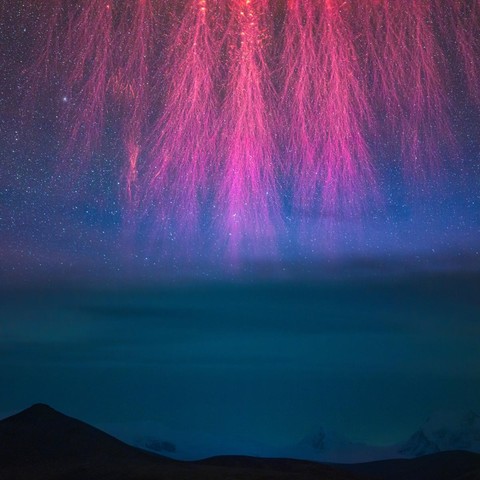
#Sprites are an extremely rare phenomenon of #atmosphericluminescence that appear like fireworks.
(#Astronomy Photographer of the Year 2023: Angel An)
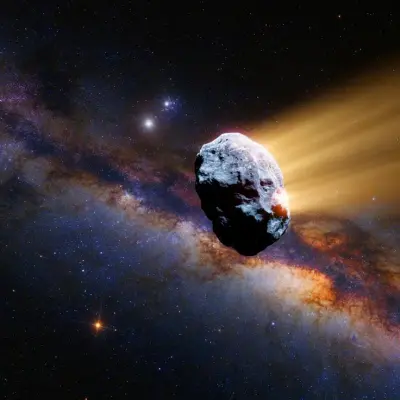 3i/Atlas
 N-gated Hacker News
 Peter Riley