 Bojidar Marinov
My hobbyist continuations-based programming language is now self-hoisting. Wohoo! 🎉
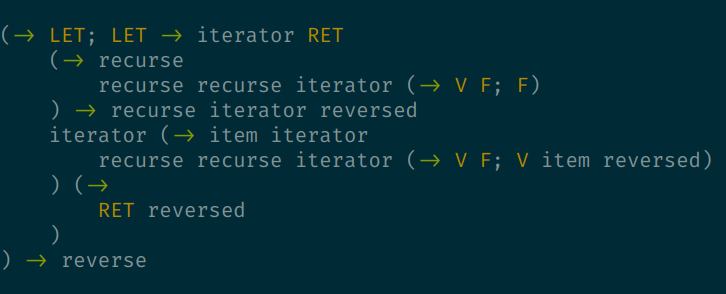
Here, gorge your eyes on this cryptic list reversion routine deep in the compiler:
#languagedesign
#ContinuationPassingStyle
#FunctionalProgramming
My hobbyist continuations-based programming language is now self-hoisting. Wohoo! 🎉
Here, gorge your eyes on this cryptic list reversion routine deep in the compiler:
#languagedesign
#ContinuationPassingStyle
#FunctionalProgramming
This #compiler for the #RosettaCode Virtual Machine assembly language can now target any of #ATS, #C, #Mercury, or #Scheme --
https://sourceforge.net/p/chemoelectric/rosettacode-contributions/ci/default/tree/vmc.dats
The Scheme code runs very fast in #ChezScheme, so-so in all else I have tried. I wonder how they do it. Maybe a lot of C code (instead of Scheme) in the runtime is part of it?
The generated Mercury is not so fast, but such is life with Mercury. It’s fastish, considering.

#Scheme compiled into C functions F
F never reach the return statement
F call a new #continuation Cn when complete.
Cn are F passed on as extra arguments to other Fs. They are calculated by compiler.
So far, this is the essence of #continuationpassingstyle
#Scheme compiled into C functions F
F never reach the return statement
F call a new #continuation Cn when complete.
Cn are F passed on as extra arguments to other Fs. They are calculated by compiler.
So far, this is the essence of #continuationpassingstyle
 Barry Schwartz 🫖
 xameer