The Freedom You Didn’t Expect

DID YOU KNOW

Did you know that Jesus defines freedom differently than we do?

In John 8:31–32, Jesus speaks to those who had already believed in Him: “If you continue in My word, you are truly My disciples. And you will know the truth, and the truth will set you free.” The word translated “continue” comes from the Greek menō, meaning to remain or abide. Freedom, according to Jesus, is not the absence of boundaries but the presence of abiding truth. Many assume freedom means unrestricted choice, the ability to do whatever feels right in the moment. Yet Jesus ties freedom to discipleship, to staying rooted in His word.

Notice something else—He is speaking to believers. These were not hostile skeptics but people who had already aligned themselves with Him. That tells us freedom unfolds as we deepen in Christ, not as we drift from Him. When someone says, “If I hadn’t accepted Christ, I would have so much more freedom,” they are often equating freedom with indulgence. But Jesus exposes a deeper reality in the same chapter: “Everyone who practices sin is a slave to sin” (John 8:34). Sin promises autonomy but delivers bondage. Christ promises surrender but produces liberty.

Did you know that sacrifice can actually lead to spiritual liberation?

The Jews listening to Jesus in John 8 would likely have faced social cost for believing in Him. Following Christ was not socially convenient; it carried ostracism and misunderstanding. Yet Jesus insists that abiding in Him results in freedom. That sounds paradoxical until we understand what we are being freed from—condemnation, fear, religious striving, and the exhausting attempt to justify ourselves.

In Leviticus 14, we see a detailed ritual for cleansing a person healed of leprosy. The ceremony was elaborate, involving sacrifice and priestly declaration. It symbolized restoration to community and worship. Under the old covenant, cleansing required meticulous adherence to prescribed steps. But in Christ, the ultimate sacrifice has already been made. He frees us not only from sin’s guilt but from a system that could never fully cleanse the conscience. Hebrews 9:14 declares that Christ’s blood purifies our conscience from dead works to serve the living God. What once required external ritual now flows from internal renewal. The sacrifice we offer today is not to earn acceptance but to express gratitude. That is freedom.

Did you know that the Spirit’s guidance replaces legalism with desire?

One of the deepest misconceptions about Christianity is that Jesus sets up a rigid system of rules that constrains life. Yet the New Testament reveals something entirely different. In Romans 8:2, Paul writes, “For the law of the Spirit of life in Christ Jesus has made me free from the law of sin and death.” The Spirit does not chain us; He animates us. The Greek word eleutheria, meaning freedom, describes release from bondage. This is not chaotic independence but Spirit-empowered obedience.

When someone feels suffocated by Christianity, it may be because they are walking closer to legalism than to grace. Legalism says, “Do this to earn God’s favor.” The Spirit says, “You are already loved; now walk in that love.” Sacrifices in this context become acts of affection, not forced compliance. The Spirit moves us from “I have to” to “I want to.” That shift is transformative. We begin to serve not out of fear but from joy. What once felt restrictive becomes relational. That is the freedom of the Spirit.

Did you know that true freedom beautifies rather than diminishes your life?

Song of Solomon 7:1–4 paints a poetic picture of beauty and delight. While often read as romantic imagery, it also reminds us that love dignifies and adorns. God’s design for intimacy and devotion is not oppressive but enriching. Sin distorts beauty; grace restores it. When we live in the freedom Christ gives, our lives take on a different radiance—marked by love, self-control, joy, and peace (Galatians 5:22–23). These are not chains; they are evidence of flourishing.

The friend who confessed feeling less free after accepting Christ had ventured down a dark road and realized the emptiness of unrestrained living. That moment of clarity reveals something critical: indulgence does not expand life; it contracts it. The so-called freedom of sin often leads to isolation, regret, and spiritual dryness. But when we walk with Christ, guided by His Spirit, we experience a widening of the soul. We are freed from shame, freed from comparison, freed from striving to prove ourselves. The boundaries Christ gives are not fences to confine but guardrails to protect joy.

As you reflect on these truths, consider your own understanding of freedom. Have you equated liberty with doing whatever you want? Or have you tasted the deeper release that comes from abiding in Christ? Jesus does not force conformity; He invites transformation. The sacrifices He calls us to make—time, pride, selfish ambition—are minimal compared to the eternal life He secured at the cross. And those sacrifices, empowered by the Spirit, do not become burdensome systems. They become expressions of love.

Today, take a moment to ask yourself where you may have confused indulgence with freedom. Recommit to abiding in His word. Allow the Spirit to guide you, not through coercion, but through conviction and comfort. The road of grace may feel narrower at times, but it leads to spacious places of joy. Freedom in Christ is not less life; it is fuller life.

FEEL FREE TO COMMENT, SUBSCRIBE, AND REPOST, SO OTHERS MAY KNOW


#ChristianFreedom #graceVsLegalism #HolySpiritEmpowerment #John83132 #spiritualGrowth

Freedom That Rests in the Rock

As the Day Ends

“A Christian is held captive by anything that hinders the abundant, effective, Spirit-filled life God planned for him.” That sentence settles heavily as the day grows quiet. We often think of captivity in dramatic terms—chains, walls, visible restraint. Yet Scripture reminds us that bondage can be subtle. Paul writes in Galatians 5:13, “For you were called to freedom, brothers. Only do not use your freedom as an opportunity for the flesh, but through love serve one another.” Freedom misused becomes a new form of slavery. What was meant to liberate can entangle when directed toward self-indulgence rather than Spirit-led love.

As the evening slows our pace, we are invited to examine what may have quietly held us captive today. Was it resentment? Pride? An anxious need to control outcomes? These are not always obvious chains, but they restrict the abundant life Christ secured for us. Jesus did not free us merely from penalty; He freed us for purpose. The Spirit-filled life is not frantic striving but surrendered trust. Anything that diminishes love, peace, and obedience becomes a rival to that freedom.

Psalm 62 gives us a steady place to land tonight: “For God alone my soul waits in silence; from Him comes my salvation. He alone is my rock and my salvation, my fortress; I shall not be greatly shaken” (Ps. 62:5–6). The Hebrew word for “rock,” tsur, carries the sense of a massive cliff—immovable and protective. When our hope is anchored in Him, lesser captivities lose their grip. We do not fight bondage by sheer willpower; we rest in the One who is stronger.

If this season of the church year calls us toward reflection—whether in Lent’s sobriety or ordinary days of discipleship—the message remains the same. True freedom is not independence from God; it is dependence upon Him. When we pour out our hearts before Him, as Psalm 62:8 encourages, we exchange anxiety for assurance. We end the day not clinging to our performance but trusting His sufficiency.

Tonight, allow your soul to grow quiet. Let the Rock bear the weight you have been carrying. Freedom deepens when we release what binds us.

Triune Prayer

Father, You are my Rock and my refuge. I come to You at the close of this day aware that I have not always lived in the fullness of the freedom You have given me. At times I have used liberty for comfort rather than service, for self-protection rather than love. Forgive me for the subtle ways I allow pride or fear to hold me captive. Help my soul to find rest in You alone. Teach me to wait in quiet confidence, trusting that my salvation and honor depend not on my effort but on Your steadfast character. Anchor me tonight in Your faithful care.

Jesus, You are the Lamb of God who purchased my freedom at the cross. Thank You for calling me not only out of darkness but into abundant life. When I drift toward self-centeredness, gently draw me back to Your example of sacrificial love. You did not cling to privilege but emptied Yourself for others. Form that same humility in me. Guard me from anything that would dull my devotion or limit my usefulness in Your kingdom. As I lay down to rest, remind me that Your finished work secures my hope. I belong to You, and nothing can separate me from Your love.

Holy Spirit, Comforter and Spirit of Truth, search my heart. Reveal any hidden captivity that I may not yet see. Strengthen me to walk in the freedom of obedience and to serve others in love. Replace restless thoughts with steady trust. Help me pour out my heart honestly before God, knowing that He hears and holds me. Fill me afresh with Your presence so that tomorrow I rise not burdened but renewed. Guide my steps, guard my mind, and grow within me the fruit that reflects Christ.

Thought for the Evening: Before you sleep, name one thing that may be hindering your Spirit-filled life, and consciously entrust it to God, your Rock and refuge.

For further reflection on Christian freedom and the Spirit-filled life, consider this resource from The Gospel Coalition: https://www.thegospelcoalition.org/article/what-does-it-mean-to-be-free-in-christ/

FEEL FREE TO COMMENT, SUBSCRIBE, AND REPOST, SO OTHERS MAY KNOW


#ChristianFreedom #eveningPrayerReflection #Galatians513 #Psalm62Devotion #SpiritFilledLife

The Freedom We Resist

On Second Thought

“If the Son makes you free, you shall be free indeed.”John 8:36

There are moments in worship when discomfort settles in quietly, almost imperceptibly. It is not the temperature of the room, the length of the sermon, or the firmness of the pew that causes it. Rather, it is the uneasy awareness that something within us has been exposed. Jesus’ words in John 8:31–36 confront us with a reality many believers recognize but rarely articulate: freedom is offered freely, yet often resisted deeply. The tension we feel is not evidence of God’s absence but of His nearness. Conviction, after all, is one of the Spirit’s most faithful ministries.

Jesus speaks these words to those who had already believed in Him. That detail matters. He does not address skeptics or opponents but followers—people who had accepted His message yet were still wrestling with its implications. “If you abide in my word, you are truly my disciples,” He says, linking discipleship not to agreement alone but to continued dwelling. The Greek verb menō, translated “abide,” suggests remaining, staying, and making one’s home. Freedom, in Jesus’ teaching, is not a momentary release but the fruit of sustained relationship with truth. To know the truth is not merely to learn information; it is to live in alignment with what God reveals about Himself and about us.

The discomfort that arises when truth presses in is often the moment we attempt escape—not from sin, but from surrender. When Scripture or preaching touches a hidden fear, a guarded habit, or a cherished illusion of control, we instinctively recoil. We delay. We rationalize. We tell ourselves we will deal with it later. Yet Jesus warns, implicitly, that delay strengthens bondage. What begins as hesitation can harden into resistance. The irony is striking: we fear surrender will cost us freedom, when in fact it is the refusal to surrender that keeps us bound.

Jesus exposes this paradox when His listeners protest, “We are Abraham’s descendants and have never been enslaved to anyone.” Their words reveal how deeply self-deception can run. Historically, Israel had known slavery well—Egypt, Babylon, Rome. Spiritually, they were blind to the chains that pride and self-righteousness had wrapped around their hearts. Jesus responds not with argument but with diagnosis: “Everyone who commits sin is a slave to sin.” The issue is not external circumstance but internal allegiance. Bondage persists not because freedom is unavailable, but because truth is unwelcome.

What Jesus offers, however, is not condemnation but escape. He presents Himself as the decisive difference. “If the Son makes you free, you shall be free indeed.” The phrase “free indeed” points to authentic, lasting freedom—not the temporary relief of avoidance, but the deep liberation that reshapes identity. This freedom is not achieved by willpower or religious effort. It flows from sonship. Slaves, Jesus says, do not remain in the house forever, but sons do. Freedom is secured not by striving harder but by belonging more fully.

For the believer, this truth carries both comfort and challenge. When we accepted Christ, the Holy Spirit fully equipped us for freedom. Bondage is no longer inevitable; it is optional. That statement can unsettle us, because it removes excuses. If chains remain, they do so not because Christ failed, but because we have not yet yielded fully to His truth. The enemy’s trap is not simply sin, but the lie that freedom can be postponed without consequence. Yet every delay deepens the habit of resistance, making submission feel increasingly costly.

Jesus’ invitation is strikingly simple: abide. Remain in His word. Allow truth to confront, correct, and heal. Freedom is not found by escaping conviction, but by walking through it with Christ. The Holy Spirit does not expose wounds to shame us, but to heal us. When truth burns, it is because it is cauterizing what would otherwise continue to infect the soul. The ultimate escape artist is not the one who avoids discomfort, but the one who allows truth to break every lock.

As we reflect on this passage, the question is not whether we desire freedom—we all do—but whether we are willing to accept it on God’s terms. Truth makes us free, but only when we stop arguing with it, delaying it, or redefining it. Jesus does not negotiate liberation. He offers it fully, lovingly, and decisively.

On Second Thought

There is a paradox hidden in Jesus’ promise of freedom that many of us overlook: the very thing we try to escape—conviction—is often the doorway to the freedom we crave. We assume that discomfort signals danger, yet in the spiritual life, discomfort frequently signals invitation. What if the unease we feel when truth confronts us is not a threat to our peace, but the beginning of its restoration? We spend so much energy trying to silence conviction that we miss its purpose. Conviction is not God pushing us away; it is God drawing us closer.

On second thought, perhaps the greater danger is not being bound, but becoming comfortable with bondage. Familiar chains can feel safer than unfamiliar freedom. Bondage offers predictability; freedom demands trust. Bondage allows us to manage appearances; freedom requires honesty. When Jesus speaks of abiding in His word, He is not describing a strategy for self-improvement, but a willingness to remain exposed before God. That exposure feels risky, yet it is the only place where real transformation occurs.

It is worth asking whether some of our spiritual routines—our attendance, our vocabulary, our habits—have quietly become ways of avoiding truth rather than embracing it. We may prefer the comfort of religious familiarity over the disruption of obedience. Yet Jesus does not offer partial freedom or symbolic release. He offers freedom indeed—the kind that reaches the deepest places of fear, habit, and resistance. On second thought, the question is not whether truth will cost us something, but whether we are willing to let it cost us what is already costing us far more.

FEEL FREE TO COMMENT, SUBSCRIBE, AND REPOST, SO OTHERS MAY KNOW


#ChristianFreedom #DiscipleshipAndObedience #HolySpiritConviction #John8Devotional #spiritualLiberation #truthAndBondage

The Quiet Cost of False Freedom

As the day settles and the noise of decision-making fades, a sobering truth often becomes clearer: we fear sacrifice, yet we pay hidden costs when we resist the will of God. The irony named in tonight’s meditation is not abstract—it is experiential. When we avoid surrender, we do not become free; we simply trade one form of mastery for another. Scripture names this plainly. 2 Peter 2:19 warns that promises of freedom can mask deeper bondage: “for a man is a slave to whatever has mastered him.” Evening is a fitting hour to ask what, if anything, quietly mastered us today.

The apostle Paul sharpens the point with pastoral realism. 1 Corinthians 6:12 records a slogan of liberty—“Everything is permissible for me”—only to correct it with wisdom: “but not everything is beneficial… I will not be mastered by anything.” Christian liberty is not the absence of restraint; it is the presence of right mastery. The gospel does not invite us into chaos, but into a life ordered by love. True freedom includes the grace to say yes—and the strength to say no—without fear or shame.

This matters at day’s end because our habits tell the truth about our loves. False teachers promise ease, self-expression, and autonomy, yet deliver exhaustion and dependency. The will of God, by contrast, may call for sacrifice, but it yields rest. When Jesus says His yoke is easy and His burden light, He does not deny discipline; He redeems it. As night approaches, the Spirit invites us to exchange the weariness of self-rule for the peace of being ruled by Christ. Authentic liberty is learning to belong wholly to the One whose mastery heals rather than harms.

Triune Prayer

Father,
I come to You as this day closes, grateful for Your patience and mercy. You know the places where I resisted surrender and the moments where I mistook comfort for freedom. I confess that I sometimes fear the sacrifices obedience may require, forgetting the heavier costs of disobedience. Teach me to trust Your wisdom when You set boundaries, and to believe that Your commands are gifts meant for life. As I lay this day before You, quiet my heart and help me rest in Your fatherly care.

Jesus, Christ, Son of God,
I thank You for Your gentle mastery—the kind that liberates rather than constrains. You gave Yourself fully, not to enslave me, but to free me from every lesser lord. Tonight I acknowledge the sins and habits that have sought to rule me, and I ask for Your redeeming authority to reclaim those spaces. Shape my desires so that I long to be mastered by You alone. Let Your words guard my thoughts as I sleep, reminding me that freedom is found in following You.

Holy Spirit, Spirit of Truth,
I invite Your discerning presence to search my heart as this day ends. Show me what is not beneficial, even when it appears permissible. Grant me wisdom to recognize subtle bondages and courage to release them. As I rest, work quietly within me—renewing my mind, strengthening my will, and forming holy desires. Lead me into the restful freedom that comes from living under God’s gracious rule, and prepare me to walk wisely tomorrow.

Thought for the Evening

Before you rest, name what sought to master you today—and consciously entrust it to Christ, whose mastery alone brings peace.

For further reflection on Christian freedom and spiritual discernment, see this article from Desiring God:
https://www.desiringgod.org/articles/what-is-christian-freedom

FEEL FREE TO COMMENT, SUBSCRIBE, AND REPOST, SO OTHERS MAY KNOW


#1Corinthians612Devotional #2Peter219 #beingMasteredByChrist #ChristianFreedom #eveningPrayerAndReflection #spiritualDiscernment

Free, Yet Bound to Christ

There is a subtle difference between being a disciple of Scripture and being a disciple of the One to whom Scripture bears witness. Jesus exposed this tension clearly in John 5:24–38. He spoke to people who knew the texts, revered the law, and searched the Scriptures diligently—yet somehow missed the living Word standing before them. Their devotion to written authority had become a substitute for relational obedience. Jesus’ rebuke was not against Scripture itself, but against the misuse of Scripture as a shield against surrender. “You search the Scriptures because you think that in them you have eternal life; and it is they that testify on my behalf. Yet you refuse to come to me to have life.” Eternal life, He insists, is not found in textual mastery but in relational trust.

This distinction becomes even clearer when read alongside Galatians 5:1: “Stand fast therefore in the liberty by which Christ has made us free, and do not be entangled again with a yoke of bondage.” Paul is not warning against moral seriousness, but against confusing freedom in Christ with the re-imposition of spiritual constraints that Christ Himself never required. Christian liberty is not license to do whatever feels right; it is freedom to do what is right under the lordship of Jesus. The paradox is that freedom is found not in autonomy, but in obedience rightly ordered.

Oswald Chambers captured this tension with penetrating clarity when he wrote, “A spiritually minded man or woman will never come to you with the demand, ‘Believe this and that,’ but with the demand that you square your life with the standards of Jesus.” Chambers recognized that the gospel does not spread primarily through argument or coercion, but through conscience awakened by Christ’s authority. The goal of discipleship is not uniformity of opinion, but conformity of life to Jesus Himself. Scripture serves this end by revealing Christ, not by replacing Him.

This is why Jesus’ words in John 5 are so unsettling. The religious leaders had turned Scripture into a system of control rather than a pathway to communion. They believed correctly in many respects, yet their belief had become detached from obedience to Christ’s presence and voice. In contrast, Jesus calls His followers into what might be called liberty of conscience rather than liberty of view. Christian freedom does not mean everyone must agree on every secondary matter, but that each conscience is governed by Christ’s lordship. When Christ reigns in the conscience, truth is neither diluted nor weaponized.

The danger Chambers names is not merely theoretical. It shows up whenever believers bind burdens on others that Jesus Himself never placed there. Jesus warned against this explicitly, criticizing leaders who “tie up heavy burdens, hard to bear, and lay them on the shoulders of others” (Matthew 23:4). True discipleship measures life by the standards of Jesus, not by the comfort of our traditions or the security of our interpretations. To bow the neck to Christ’s yoke alone is to refuse every other yoke—whether it comes from fear, pride, group identity, or spiritual impatience.

Yet this freedom requires patience. Chambers wisely reminds us to remember how gently God dealt with us. None of us arrived at obedience overnight. The Spirit works incrementally, reshaping conscience through truth and grace together. Impatience with others often reveals unresolved impatience with God’s timing in our own lives. At the same time, patience must never become an excuse to soften truth. Love does not require apology for what God has spoken clearly. It requires humility in how that truth is lived and shared.

Jesus’ final commission reinforces this balance. He did not say, “Go and make converts to your opinions,” but “Go and make disciples.” Disciples are formed through relationship, imitation, and submission to Christ’s authority. Opinions may change; Christ’s lordship does not. When liberty is rightly understood, it becomes contagious—not because it persuades, but because it frees. Those who live under Christ’s yoke invite others into that same freedom simply by the integrity of their lives.

On Second Thought

On second thought, the greatest threat to Christian freedom may not be obvious bondage, but invisible substitution. We substitute certainty for obedience, agreement for discipleship, and correct belief for transformed conscience. The paradox is that many of us fear losing truth if we loosen our grip on control, when in reality we lose truth most quickly when we use it to dominate rather than to submit. Jesus never asked for intellectual uniformity; He asked for allegiance. He never demanded that everyone see exactly as we do, but that all would see Him.

This reframes how we approach both Scripture and one another. If the Bible is primarily a witness to Christ rather than a tool to enforce compliance, then our task is not to make others think like us, but to help them listen to Him. Liberty of conscience does not mean relativism; it means responsibility before Christ. Each believer stands or falls before the same Lord, guided by the same Spirit, shaped by the same truth—yet formed uniquely through grace.

Perhaps the more unsettling question is whether we truly trust Christ to govern the consciences of others without our constant intervention. It takes faith to release people into Christ’s care rather than binding them to our expectations. It also takes courage to remain under Christ’s yoke ourselves, resisting the urge to exchange it for something heavier but more familiar. True freedom is not the absence of restraint, but the right restraint—the restraint that comes from love, truth, and submission to Jesus alone.

FEEL FREE TO COMMENT, SUBSCRIBE, AND REPOST, SO OTHERS MAY KNOW


#ChristianFreedom #conscienceAndChrist #discipleshipAndFreedom #Galatians51Liberty #John5ScriptureStudy #OswaldChambersDiscipleship

Held in Freedom as Night Falls

As the Day Ends

As the light of the day softens and our thoughts begin to settle, we are invited to rest in a truth that runs deeper than our efforts or failures: God cares more for our freedom than even we do. Freedom is not a late development in God’s plan, nor a reluctant concession to human weakness. It is central to His saving purpose. Scripture consistently reveals a God who initiates liberation—calling slaves out of Egypt, lifting David from oppression, and in Christ, breaking the chains of sin that bind the human heart. As evening comes, this truth steadies us. We do not have to manufacture freedom before God will welcome us; He welcomes us in order to free us.

David’s prayer in Psalm 21 reminds us that joy flows from God’s victories, not our own strength. “O Lord, how the king rejoices in Your strength!” he declares, acknowledging that deliverance is God’s work from beginning to end. That posture is especially fitting at night, when striving gives way to surrender. We bring before God not only gratitude for what went well today, but also the honest confession of where old patterns still tug at us. Scripture assures us that such honesty is not weakness; it is the doorway to freedom. God does not withhold the requests of lips that are lifted toward Him in trust.

Paul deepens this hope in Romans 6 by anchoring freedom in the finished work of Christ. “Our old self was crucified with Him… that we should no longer be slaves to sin.” Freedom, then, is not merely the promise of change tomorrow; it is a reality secured already. Even when habits linger and temptations resurface, the believer’s identity has been decisively altered. Sin no longer has rightful authority. As the day ends, this truth allows us to lay down self-condemnation. We rest not because we have conquered everything, but because Christ has.

Galatians 5:1 gathers these themes into a single, steady call: “It is for freedom that Christ has set us free.” God’s desire is not simply that we avoid wrongdoing, but that we live unburdened—standing firm rather than slipping back into spiritual slavery. Evening prayer becomes an act of resistance against despair and self-reliance. We entrust our unfinished work, unresolved struggles, and unmet hopes to the God who liberates over time and through grace. Nightfall is not an ending; it is a pause under God’s faithful care.

Triune Prayer

Father, I come to You as this day closes, grateful that You are not indifferent to my longing for freedom. You see the places where I still struggle, the habits I wish were gone, and the fears that quietly return when I am tired. Thank You that You do not turn away from these confessions. You invite them. I ask You now to grant the desire of my heart—to live free, not by my resolve, but by Your sustaining grace. As I rest tonight, help me trust that You continue Your work even while I sleep.

Jesus, Christ, You are the Liberator of my soul. I thank You that my old self was crucified with You, and that sin no longer defines who I am. When I feel discouraged by slow progress or weighed down by memories of failure, remind me that freedom was purchased fully at the cross. Teach me to stand firm in what You have already accomplished, not striving to earn what You have freely given. Let my rest tonight be an act of faith in Your finished work.

Holy Spirit, Helper, I welcome Your gentle presence as the day fades. Search my heart and quiet my anxious thoughts. Where I am tempted to carry burdens into the night, teach me how to release them. Empower me to walk in freedom tomorrow, attentive to Your guidance and responsive to Your truth. Shape my desires, strengthen my will, and renew my mind as I sleep, that I may rise ready to live in the freedom Christ secured.

Thought for the Evening

As you lay down to rest, entrust your unfinished struggles to God, confident that the One who set you free continues His work even through the night.

For further reflection on Christian freedom, consider this article from Desiring God:
https://www.desiringgod.org/articles/it-is-for-freedom-that-christ-has-set-us-free

FEEL FREE TO COMMENT, SUBSCRIBE, AND REPOST, SO OTHERS MAY KNOW


#breakingStrongholds #ChristianFreedom #eveningDevotional #freedomInChrist #Galatians51 #Romans6 #spiritualLiberation

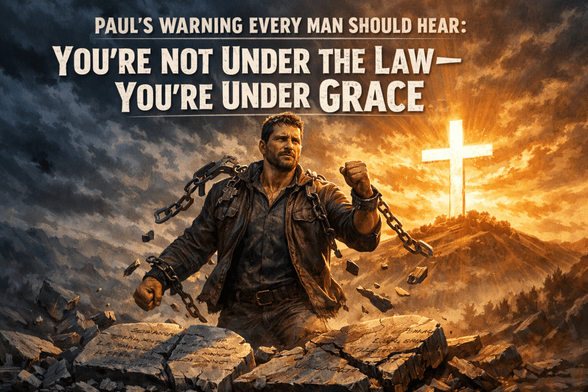
Paul’s Warning Every Man Should Hear: You’re Not Under the Law—You’re Under Grace

2,362 words, 12 minutes read time.

Why This Truth Hits Home for Me—and Why It Should for You

Brother, I’ve been hinting at this idea for a while now in my writings, and it’s time to lay it out plain. This isn’t some side note or pet theory—it’s something that makes up a core part of my faith. For years, through stories of redemption, grace breaking through broken lives, reflections on what it really means to walk with Christ, and digging deep into Scripture, I’ve kept coming back to this truth: the Law of Moses, including those so-called “Ten Commandments,” was Israel’s national contract, not a universal burden for every believer. It was conditional, tied to their covenant at Sinai, and Gentiles like us were never signed on. Paul drops the hammer on it—”you are not under law but under grace” (Romans 6:14)—and that shift from performance to freedom has anchored my walk more than anything else.

Digging Deeper: What the Law of Moses Really Is

Let’s pause right here and go a lot deeper into this, because if we’re going to talk man-to-man about freedom in Christ, we need to nail down what the Law of Moses actually is. This isn’t just background noise—it’s the foundation that makes Paul’s warning hit like a gut punch. The Law of Moses, or the Mosaic Covenant, isn’t some vague set of good ideas or eternal principles floating out there for anyone to grab. No, it’s a specific, historical agreement God made with the nation of Israel after He delivered them from slavery in Egypt.

Think about the context: these people had been crushed under Pharaoh’s boot for generations, building pyramids with their blood and sweat. God steps in with miracles—plagues, parted seas, manna from heaven—not because they earned it, but by sheer grace. Then, at Mount Sinai, He offers them a covenant: “Now therefore, if you will indeed obey my voice and keep my covenant, you shall be my treasured possession among all peoples, for all the earth is mine; and you shall be to me a kingdom of priests and a holy nation” (Exodus 19:5–6). They agree—not once, but multiple times: “All that the Lord has spoken we will do” (Exodus 19:8; 24:3,7). It’s voluntary, but it’s binding on them and their descendants as a nation.

What exactly is this Law? It’s the Torah—the instructions, statutes, commandments, and ordinances laid out primarily in Exodus through Deuteronomy. We’re talking 613 mitzvot in Jewish counting: moral guidelines like “You shall not murder” (Exodus 20:13), ceremonial rituals like sacrifices and festivals (Leviticus 23), civil laws for justice in their society (Exodus 21–23), and even dietary rules (Leviticus 11). It’s often divided into categories—moral, ceremonial, civil—but the Bible doesn’t slice it that way; it’s one cohesive covenant package. And here’s the key: it came with promises. Obey, and you’d get blessings like fruitful land, protection from enemies, and prosperity (Deuteronomy 28:1–14). Disobey, and curses like drought, defeat, and exile (Deuteronomy 28:15–68). This wasn’t about individual salvation by works; it was national—tied to their life in the Promised Land, their role as God’s witnesses to the nations.

The structure echoes ancient suzerain-vassal treaties common in the Near East: a powerful king (God) offers protection and identity to a weaker people (Israel) in exchange for loyalty. God sets the terms, recalls His deliverance (the historical prologue), lays out the stipulations (the laws), calls witnesses (heaven and earth), and spells out blessings and curses. It’s a contract, brother—solemn, enforceable, and exclusive to Israel.

Why Gentiles Aren’t Under It: We Were Never Part of the Deal

Now, why aren’t Gentiles under this? Simple: we weren’t part of the deal. The covenant was explicitly “between me and the people of Israel” (Exodus 19:3; Leviticus 26:46). Paul hammers this home: “the covenants… the giving of the law… belong to the Israelites” (Romans 9:4). Gentiles were outsiders—”excluded from citizenship in Israel and foreigners to the covenants of the promise, without hope and without God in the world” (Ephesians 2:12).

Sure, non-Jews could join as proselytes, getting circumcised and adopting the whole Law (Exodus 12:48–49), but it was never mandatory for the rest of us. God had already given universal principles earlier, like the Noahide laws in Genesis 9—basic stuff like don’t murder, don’t eat blood with life in it, establish courts of justice, no idolatry, no blasphemy, no sexual immorality, and no theft or kidnapping. These apply to all humanity as descendants of Noah. But the Mosaic Law was Israel’s unique yoke, designed to set them apart as a holy nation (Exodus 19:6). Gentiles were accountable to God through conscience and natural revelation (Romans 1:18–20; 2:14–15), but not this specific covenant.

History proves it: Israel struggled under it. The prophets rail against their failures, leading to exile. It revealed sin, but couldn’t fix the heart (Romans 3:20; 7:7–12). That’s why a New Covenant was promised (Jeremiah 31:31–34), one written on hearts, not stone—fulfilled in Christ.

This belief shapes everything for me. Growing up, I saw guys buckling under legalism—trying to “keep the Law” to feel worthy, only to burn out. But Scripture freed me: the Law was good, holy, and just (Romans 7:12), but it was temporary for Israel, a “guardian until Christ came” (Galatians 3:24). For Gentiles, imposing it now is like trying to drive a tank through a modern battlefield when you’ve got air support—it’s the wrong tool for the fight. Grace through Jesus changes the game.

Most guys hear the Ten Commandments preached like they’re the unbreakable code: post them up, memorize them, live by them or you’re slipping. It feels right—strong, disciplined, masculine even. But digging into Scripture, especially how Jesus fulfills and Paul explains, shows something tougher and more liberating. The Hebrew calls them Aseret HaDibrot—the Ten Statements, Ten Sayings, Ten Declarations, or even Ten Utterances—not cold mitzvot commands from the root for “command.” From davar meaning word, speech, or thing, these were majestic divine declarations God spoke directly at Sinai, revealing His character and framing Israel’s identity in covenant—like a father laying out heart-level expectations for his sons after yanking them from slavery. Not a checklist to earn favor, but relational words protecting the bond, categorizing the broader 613 mitzvot without making these the “only” or “top” ones. Jewish tradition even dialed back emphasizing them in daily prayer to avoid folks thinking they trumped the full Torah.

This matters because clinging to the old framework as binding law can chain us to performance Christianity—always proving we’re good enough. But grace says the work’s done. You’re accepted first, then you live from that strength. I’m going to walk you through three hard truths straight from the Bible that back this up. First, the Mosaic Covenant was Israel’s exclusive contract—Gentiles were never bound by it. Second, Jesus fulfilled the Law completely, shifting us from obligation to relationship. Third, Paul’s teaching releases us into the freedom of grace so we can live like men who are secure, not scrambling.

The Mosaic Covenant Was Israel’s Exclusive Contract—Gentiles Were Never Bound by It

Let’s cut through the fog. God didn’t hand the Law to humanity like a global rulebook. He gave it to Israel after redeeming them from Egypt by pure grace—no works on their part earned the exodus. At Sinai, He says, “If you obey me fully and keep my covenant, then out of all nations you will be my treasured possession… a kingdom of priests and a holy nation” (Exodus 19:5–6). Israel agrees voluntarily: “All that the Lord has said we will do” (Exodus 19:8; 24:3,7). It’s bilateral, conditional—blessings for obedience, curses for rebellion (Deuteronomy 28; Leviticus 26). The structure echoes ancient treaties: a sovereign king offers protection and identity to a vassal people in exchange for loyalty.

Paul makes it crystal: the covenants, the law, the promises belonged to Israel (Romans 9:4). Gentiles were “alienated from the commonwealth of Israel and strangers to the covenants of promise” (Ephesians 2:12). We had conscience bearing witness (Romans 2:14–15), but no Mosaic yoke.

This exploded at the Jerusalem Council in Acts 15. Judaizers demanded Gentile believers get circumcised and keep Moses’ Law to be saved. The apostles pushed back hard. Peter: “Why are you putting God to the test by placing a yoke on the neck of the disciples that neither our fathers nor we have been able to bear?” (Acts 15:10). James: don’t burden them; just practical guidelines for fellowship (Acts 15:19–20). Salvation? By grace through faith—no add-ons from the old contract (Acts 15:11).

For a man grinding through responsibility, this is gold. You’re not renegotiating terms you never agreed to. The contract wasn’t yours. Freedom starts there—no scrambling to measure up.

Jesus Fulfilled the Law, Shifting Us from Obligation to Relationship

Jesus enters as the true Israel. He doesn’t abolish the Law—He says, “Do not think that I have come to abolish the Law or the Prophets; I have not come to abolish them but to fulfill them” (Matthew 5:17). Fulfill means complete the purpose: live it perfectly, bear its curse, accomplish what it pointed to. Sacrifices shadowed His death; festivals His redemptive work; the system a tutor leading to faith in Him (Galatians 3:24; Hebrews 10:1).

He sums it up: love God fully and love neighbor as self—on these hang the Law and Prophets (Matthew 22:37–40). Not new rules, but the heart motive exposed. He declares foods clean (Mark 7:19), heals on Sabbath calling it mercy (Mark 2:27; Matthew 12:7 quoting Hosea 6:6). The moral essence reflects God’s character, but Jesus accomplishes what Israel couldn’t—taking the curse (“Cursed is everyone hanged on a tree,” Galatians 3:13) so the Abrahamic blessing hits Gentiles by faith (Galatians 3:14).

This flips the script for leadership. Law demanded performance for blessing. Jesus gives blessing first—then calls us to respond in love. It’s like a brother who takes the hit in the fight, wins the battle, then hands you the victory and says, “Now live free—no more proving.” Acceptance comes before action.

Paul’s Teaching Releases Us from the Law’s Yoke into the Freedom of Grace

Paul, the apostle sent specifically to Gentiles like us, doesn’t pull punches. He lays it out raw and clear. In Galatians 3:23–25 he says the law functioned as a guardian—a temporary overseer—until Christ came; now that faith has arrived, “we are no longer under a guardian.” Straight talk in Romans 6:14: “you are not under law but under grace.” Ephesians 2:14–15 shows Christ Himself “broke down the dividing wall of hostility” by abolishing “the law of commandments expressed in ordinances,” forging one new humanity out of Jew and Gentile. Colossians 2:16–17 drives it home: don’t let anyone judge you over food and drink, festivals, new moons, or Sabbaths—these were shadows pointing forward; the substance is Christ.

Does this mean we throw morality overboard? Not even close. Paul insists love fulfills the law (Romans 13:8–10; Galatians 5:14—”the whole law is fulfilled in one word: ‘You shall love your neighbor as yourself'”). We live by the Spirit now, producing fruit that no external code could ever manufacture—love, joy, peace, patience, kindness, goodness, faithfulness, gentleness, self-control (Galatians 5:22–23). We’re under the “law of Christ” (Galatians 6:2; 1 Corinthians 9:21)—bearing one another’s burdens, restoring gently, walking in love—not grinding under Mosaic obligation.

This is warrior ground, brother. The world screams at you to grind harder, achieve more, prove your worth every single day. Grace flips the script: rest in what’s already finished. Fight temptation not to earn security, but from the security you’ve already got. Lead your home, your wife, your kids from a place of deep acceptance instead of insecurity. Serve others without keeping score, because your standing isn’t on the line anymore. The old yoke is shattered; the new life runs on resurrection power—the same Spirit that raised Jesus from the dead now lives in you.

Conclusion: Grace Over Law—Stand Firm in the Liberty You’ve Been Given

Brother, this core truth—grace over law, fulfillment in Christ—has shaped my faith through every story I’ve written, every trial I’ve faced. Paul’s warning isn’t optional; it’s liberation. You’re not under the Law. You’re under grace. That changes the fight entirely.

If this hits you square in the chest—maybe you’re worn out from performance Christianity, or you’re hungry for the kind of freedom that lets you breathe and lead without constant fear of falling short—take the next step. Drop a comment below and tell me where law vs. grace is hitting you hardest right now. Subscribe to get more no-fluff, straight-talk studies delivered right to your inbox—built for men who want truth that actually strengthens the spine. Or shoot me a direct message; let’s talk it out brother-to-brother, no judgment, just real conversation.

Stand firm therefore in the liberty with which Christ has made us free (Galatians 5:1). The yoke is broken. The fight is different now. He’s got you—and He’s not letting go.

Call to Action

If this study encouraged you, don’t just scroll on. Subscribe for more bible studies, share a comment about what God is teaching you, or reach out and tell me what you’re reflecting on today. Let’s grow in faith together.

D. Bryan King

Sources

Disclaimer:

The views and opinions expressed in this post are solely those of the author. The information provided is based on personal research, experience, and understanding of the subject matter at the time of writing. Readers should consult relevant experts or authorities for specific guidance related to their unique situations.

#613Mitzvot #Acts15 #AseretHaDibrot #bibleStudyForMen #biblicalGrace #blessingsAndCursesDeuteronomy28 #ChristBrokeDividingWall #ChristianFreedom #ChristianMenEncouragement #Colossians21617 #conditionalCovenant #Ephesians212 #Ephesians21415 #freedomFromLegalism #freedomInChrist #fruitOfTheSpirit #fulfilledInChrist #Galatians3 #Galatians51 #Galatians514 #GentilesAndTheLaw #GentilesNotBound #graceChristianity #graceOverPerformance #graceThroughFaith #graceVsLaw #HebrewTenCommandments #Jeremiah313134 #JerusalemCouncil #JesusFulfilledTheLaw #lawAsGuardian #lawOfChrist #LawOfMoses #legalismVsGrace #loveFulfillsTheLaw #Matthew517 #menSBibleStudy #MosaicCovenant #MosaicLawForIsrael #newCovenant #noLongerUnderLaw #NoahideLaws #notUnderLawButUnderGrace #PaulApostleToGentiles #PaulSWarning #PaulSTeachingOnLaw #performanceChristianity #Romans614 #Romans94 #SinaiCovenant #SpiritLedLife #standFirmGalatians51 #standFirmInLiberty #TenCommandments #TenDeclarations #TenStatements #warriorFaith #yokeOfTheLaw

Forgiven and Freed to Move Forward

As the Day Begins

“If indeed I have forgiven anything, I have forgiven that one for your sakes in the presence of Christ.”
2 Corinthians 2:10

The apostle Paul writes these words in the context of real hurt, real failure, and real restoration within the life of the church. Forgiveness here is not theoretical; it is practiced in the open, “in the presence of Christ.” That phrase matters. Paul is reminding us that forgiveness is never merely an emotional decision or a private coping strategy. It is a spiritual act carried out before the living Lord, who sees both the offense and the grace extended to cover it. When God forgives, He does so fully, decisively, and without reservation. Scripture consistently affirms this truth, declaring that God removes our sins “as far as the east is from the west” and remembers them no more. Forgiveness is not God overlooking reality; it is God redefining reality through grace.

Yet, many believers struggle not with receiving God’s forgiveness, but with living as though it is true. We accept forgiveness intellectually while continuing to punish ourselves internally. Guilt becomes a lingering companion, shame settles into our self-understanding, and regret quietly dictates our choices. Paul’s words confront this pattern. If forgiveness has been granted “in the presence of Christ,” then continuing to live under condemnation is not humility; it is resistance to grace. The Greek word often used for forgiveness, charizomai, carries the sense of a gift freely given. A gift rejected or left unopened still belongs to the giver, but it never benefits the receiver. God’s forgiveness is offered so that it may be lived in, not merely acknowledged.

This does not mean that forgiveness erases consequences. Scripture is honest about this tension. David was forgiven, yet he lived with the aftermath of his sin. Peter was restored, yet he carried the memory of denial. Forgiveness removes condemnation, not responsibility. It frees us from the crushing weight of shame so that we can face consequences with clarity, humility, and hope. The enemy seeks to anchor believers to their past failures, whispering that yesterday defines today and determines tomorrow. The gospel declares otherwise. Because forgiveness is rooted in Christ, not in our performance, our past no longer has authority over our future. As this day begins, the call is simple but demanding: forgive others as God has forgiven you, forgive yourself as God has already done, and step forward unburdened into the opportunities God places before you.

A Triune Prayer

Father, I come before You at the start of this day acknowledging both Your holiness and Your mercy. You are faithful and just, slow to anger and rich in steadfast love. I thank You that Your forgiveness is not fragile or conditional, but complete and enduring. Where I have allowed guilt and shame to linger long after You have spoken grace, I ask for the humility to release those burdens. Teach me to see myself as You see me—redeemed, restored, and invited into new obedience. Give me the courage to forgive others not because they deserve it, but because You have forgiven me first. Shape my heart today so that I walk in freedom rather than fear.

Jesus, Son of God and Lamb who takes away the sin of the world, I thank You for standing at the center of all forgiveness. Your cross is the place where my failures were named and my future was secured. I confess that I sometimes live as though Your sacrifice was partial rather than sufficient. Today, I choose to trust Your finished work. Help me release the resentment I carry toward others and the harsh judgments I direct toward myself. Let Your presence guide my decisions so that I no longer react from wounded memory but respond from healed identity. Walk with me into this day, teaching me how forgiven people live.

Holy Spirit, Comforter and Spirit of Truth, I invite You to govern my thoughts and emotions today. Where old regrets try to resurface, remind me of what Christ has accomplished. Where shame seeks to silence my witness, speak truth louder. Give me discernment to recognize opportunities that arise from freedom rather than fear. Strengthen me to choose obedience without condemnation and growth without self-contempt. Lead me gently but firmly into the life God intends, forming in me a spirit that reflects grace, peace, and quiet confidence.

Thought for the Day:
Live today as someone whose past has been forgiven and whose future is no longer held hostage by yesterday’s failures.

For further reflection on forgiveness and freedom in Christ, you may find this article helpful:
https://www.desiringgod.org/articles/forgiving-and-forgiven

FEEL FREE TO COMMENT, SUBSCRIBE, AND REPOST, SO OTHERS MAY KNOW

#2Corinthians210 #ChristianFreedom #forgiveness #graceInChrist #overcomingGuilt

The sermon on the mount: Give your gifts in private, and your Father, who sees everything, will reward you. Matthew 6:4 — Steemit

In the Sermon on the Mount, with his new promises, Jesus fully developed the message of salvation of the doctrine of… by bernardo69

Steemit
The apostle Paul and the baptism: When you put your faith in Jesus, were you given the Holy Spirit? Acts 19:2 — Steemit

When Jesus preached on earth many of his teachings did not make sense to his disciples and listeners, because the… by bernardo69

Steemit