 The New Renaissance Mindset
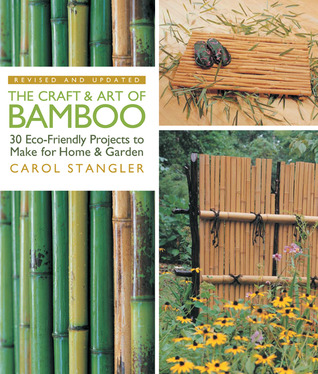
T.A.E.’s Book Review – The Craft & Art of Bamboo: 30 Eco-Friendly Projects to Make for Home & Garden by Carol Stangler
Carol Stangler’s The Craft & Art of Bamboo: 30 Eco-Friendly Projects to Make for Home & Garden is, at heart, a book about persuasion: it asks the reader to see bamboo not as a decorative novelty, but as a living medium with history, utility, and aesthetic dignity. The revised and updated 2009 edition presents itself as “a highly regarded introduction to the material,” one that offers “rich history, fascinating background and great projects,” and that framing matters. This is not merely a how-to manual; it is a conversion narrative in practical form, inviting the reader into an older, more ethical relationship with making.
What gives the book its distinct character is the way it balances romance and procedure. The publisher’s description opens with “beautiful, sustainable bamboo,” a phrase that already joins visual pleasure to ecological responsibility, and then moves quickly into the language of use: “harvesting, storing, and making things with bamboo.” That progression is revealing. The author does not let bamboo remain an abstract symbol of greenness; she insists on its material life, its handling, its resistance, its needs. The book’s appeal, then, lies in its double vision: bamboo is at once an emblem of harmony and a substance that must be cut, dried, bent, fastened, and preserved.
The project list confirms this hybrid ambition. The book promises “30 eco-friendly projects,” including “bamboo fences, trellises, chopsticks, teacups, and even an outdoor shower.” The range is striking because it moves from the infrastructural to the intimate, from garden boundary to tableware, from enclosure to ritual. In literary terms, the book stages bamboo as a material that crosses thresholds: between exterior and interior, craft and architecture, ornament and necessity. Even the improbable charm of an “outdoor shower” suggests bamboo’s capacity to transform ordinary domestic acts into something lightly ceremonial.
The book’s vocabulary further strengthens that impression. Its preview metadata is thick with technical terms—“culm,” “rhizomes,” “square lashing,” “metric equivalents,” “drill bit,” “sealer,” “pressure-treated,” “reed fencing,” and “bamboo lengths.” This lexicon matters aesthetically. It signals a text that respects craftsmanship as a language of exactness, not just inspiration. One could say Stangler writes in the idiom of the workshop rather than the showroom. The result is a style of practical knowledge that feels almost literary in its attention to named parts, precise motions, and the stubborn intelligence of materials.
As a reader, I find the book most compelling when it treats bamboo as both ecological resource and cultural form. Its promise of “lush photography and abundant illustrations” suggests that visual pleasure is not an afterthought but part of the argument: the book wants the reader to admire before they build, to understand with the eye as well as the hand. That is one reason the volume feels enduring rather than merely instructional. It belongs to a tradition of craft books that do more than transmit technique; they cultivate a sensibility, teaching that usefulness and grace need not be opposites.
In the end, The Craft & Art of Bamboo succeeds because it takes seriously the ancient, adaptable intelligence of its subject. It is practical without being dry, ecological without being preachy, and technical without losing a sense of delight. Stangler’s book reminds us that craft is never only about making objects; it is about learning how to see a material world already full of form, possibility, and restraint. Bamboo, in her hands, becomes a lesson in disciplined abundance.
#art #artBooks #Bamboo #BookReviews #CarolStangler #craftProcess #crafts #Design #LiteraryCriticism #Stangler #Sustainability